
Tech
6 million videos removed in Pakistan by TikTok for violating community guidelines


Pakistan ranks 4th on the global list of the largest volume of videos taken down for violating community guidelines.
In the third quarter of 2021, TikTok, the world’s most popular short-form video platform, removed more than 6 million videos from Pakistan, placing it fourth in the world for the most videos taken down for Community Guidelines violations.
On Monday, TikTok issued its Community Guidelines Enforcement Report, which details the number and nature of infringing content and accounts that have been removed from the social media platform.
73.9 percent of content inciting abuse and harassment was proactively removed, and 72.4 percent of hateful videos were also removed before anybody reported them, according to the rules.

Between July 1 and September 30 of 2021, 91 million videos were removed globally, accounting for around 1 percent of all videos uploaded. Nearly 95 percent of those videos were taken down before a user reported them, with 88 percent being taken down before they gained any views and 93 percent being taken down within 24 hours of being posted.
TikTok has updated its Community Guidelines in order to better promote the platform’s integrity and the well-being of its users.
The sorts of activity and content that will be taken off from the platform or declared ineligible for recommendation in the ‘For You’ feed are clarified or expanded upon in these updates.
Discover more from Remote Work Tips
Subscribe to get the latest posts sent to your email.




The Morning the Rates Dropped
At 6:47 on a Tuesday morning in Bengaluru, Arjun Mehta refreshed his Upwork dashboard and felt the familiar tightening in his chest. The UX design brief he’d spent three hours crafting the night before had drawn eleven bids overnight — six of them from other humans, five from AI-augmented “studios” offering the same deliverable at 40 percent less. He lowered his rate. Then lowered it again. By the time he accepted the contract, his effective hourly had fallen to roughly what he’d charged in 2021.
Across the planet, variations of this scene play out in Nairobi, Warsaw, Manila, and São Paulo — millions of times a day. The freelance economy, which now encompasses an estimated 76.4 million workers in the United States alone and approaches 1.5 billion people globally, is being reshaped by two forces that arrived almost simultaneously: generative artificial intelligence capable of producing draft-quality creative and analytical work in seconds, and fifth-generation wireless networks that have effectively dissolved the friction once associated with remote collaboration. The result is not merely a technological upgrade. It is a structural reorganization of independent work — one that is simultaneously liberating and punishing, and that poses the most significant challenges to freelancers in the age of 5G and AI in 2026 that the gig economy has ever confronted.
The irony runs deep. The same infrastructure that allows a copywriter in Lagos to pitch a client in London without a dropped frame also allows that London client to bypass both of them and deploy an AI agent for a fraction of the cost. The same latency improvements that make real-time collaboration seamless have accelerated the deployment of autonomous AI systems that can complete those collaborations without human input at all.
Section 1: The AI Substitution Wave — Who Gets Compressed, and Who Gets Left Behind
The data is now unambiguous, if still politically inconvenient. A landmark study published in Organization Science — using Upwork’s platform as a real-time labor market proxy — found that freelancers in occupations more exposed to generative AI experienced a 2% decline in contracts and a 5% drop in earnings following the release of major AI software. Brookings More strikingly, the study found that high-skill freelancers were disproportionately affected — not insulated, as conventional wisdom would have predicted. Brookings A specialist is no longer protected by expertise alone; AI has become a generalist that reads like a specialist.
The writing category is, by now, the canonical example. Job postings for automation-prone roles in writing and coding fell by 21% within eight months of major AI tool releases, Brookings a compression that has not meaningfully reversed. The freelance challenges from AI in 2026 are not abstract — they are legible in platform earnings data and in the growing anxiety of workers who built careers on craft.

Yet supply-side pressure is only half the story. The demand side has undergone an equally dramatic restructuring. Upwork’s 2026 In-Demand Skills Report found that demand for AI-related skills grew 109% year-over-year, with AI video generation and editing surging 329% and AI integration work rising 178%. Quiver Quantitative This is not a story of unambiguous displacement — it is a story of bifurcation. Freelancers who have absorbed AI into their workflow are commanding a 56% wage premium over peers offering traditional services. Those who have not are facing what economists call rate compression: a downward squeeze on prices as AI-produced outputs flood the supply curve.
The World Economic Forum’s Future of Jobs Report 2025, drawing on surveys of over 1,000 employers representing 14 million workers across 55 economies, projects that 92 million roles will be displaced by 2030, while 170 million new ones will be created — a net gain of 78 million, but a transition that will be anything but smooth. World Economic Forum For freelancers, who lack the institutional buffers — reskilling programs, internal mobility tracks, severance — that cushion employed workers during such transitions, the gap between displacement and re-employment can be catastrophic.
The WEF report notes that 39% of job skills are expected to change by 2030, and that 63% of employers already cite the skills gap as their primary barrier to transformation. World Economic Forum For independent workers operating without HR departments or corporate learning-and-development budgets, navigating that gap is a self-funded, self-directed, often solitary endeavor. The gig economy was sold as flexibility; in 2026, it increasingly resembles exposure.
Section 2: 5G’s Double-Edged Sword — Connectivity Utopia and the New Dependencies
If AI is the demand shock, 5G is the infrastructure that amplifies every consequence — positive and negative — of the platform economy. The technology’s practical gifts to the freelance community are genuine. Fifth-generation networks deliver expanded bandwidth that allows multiple devices to operate simultaneously without congestion, with particular benefit for remote professionals handling large file transfers, cloud-based computing, and real-time AI applications. Capitaworks The buffering, the pixelated Zoom calls, the dropped handshakes between client and contractor across continents — these frictions are, in well-served markets, largely gone.
The 5G impact on freelancers is most tangibly felt in emerging markets, where mobile-first connectivity has historically been the only option. A graphic designer in Kigali who once struggled to upload high-resolution assets now does so in seconds. A video editor in Medellín who could not reliably join real-time review sessions can now collaborate with a Los Angeles studio in real-time. 5G has, in the narrow sense, democratized access to the infrastructure of remote work.
But the technology also creates new dependencies — and, critically, a new geography of advantage. By the end of 2025, private LTE and 5G networks had reached approximately 6,500 deployments worldwide, representing a market value of $2.4 billion, Computer Weekly concentrated overwhelmingly in North American, Western European, and East Asian enterprise environments. Global private cellular network revenue is projected to reach $12.2 billion by 2028, growing 114% — but this growth remains largely confined to enterprise and government applications, Computer Weekly not the co-working spaces, home offices, and rural villages where most of the world’s freelancers actually work.
The digital divide is, therefore, not disappearing — it is being redrawn. The old divide was between those with broadband and those without. The new divide is between those with access to high-performance, low-latency private 5G infrastructure and those dependent on variable public network quality. An independent contractor attempting to run real-time AI inference on a client’s proprietary model stack — increasingly the standard workflow in 2026 — needs not just 5G, but reliable 5G. The distinction matters enormously when your income depends on responsiveness.
There is a further structural concern that has received insufficient attention: the gig economy’s growing dependence on platform intermediaries whose own infrastructure increasingly runs on 5G-enabled edge computing. As platforms like Upwork, Fiverr, and Toptal integrate AI matching algorithms and real-time performance analytics that leverage network speed, they also accumulate greater power over the terms on which freelancers participate. Connectivity has become a threshold condition — not merely for doing the work, but for being visible within the algorithmic architecture that assigns it.
Section 3: The 5G + AI Convergence — New Threats at the Intersection
The most consequential development of 2026 is not AI alone, nor 5G alone, but their convergence — the emergence of ultra-fast AI agents capable of executing complex multi-step workflows in real time, enabled by the low-latency backbone that 5G provides. The gig economy AI 5G intersection is producing capabilities that would have seemed implausible three years ago.
Consider what this means in practice. An AI agent in 2024 could draft a document. An AI agent in 2026, running on edge infrastructure enabled by private 5G, can draft the document, review it against the client’s brand guidelines stored in a cloud API, revise it based on real-time audience analytics, submit it for approval via a workflow platform, and incorporate feedback — all within a single working session, at a cost that renders human alternatives economically irrational for commodity work. McKinsey’s November 2025 report on agents, robots, and skill partnerships estimates that AI agents and automated systems can now technically automate roughly 57% of U.S. work hours Fortune — a figure that understates the speed of change in knowledge work categories.
VR collaboration, made fluid by 5G’s bandwidth, is adding a further layer of disruption. Platforms are beginning to offer immersive client-freelancer review environments in which AI avatars participate alongside human participants — generating options, running analyses, flagging inconsistencies — at a pace that changes the nature of what it means to “collaborate.” Freelancers who have not developed the capacity to work within these environments will find themselves outside an increasingly standard professional workflow.
There is also the surveillance dimension, which warrants candor. 5G-enabled platforms are gathering behavioral data — keystroke cadences, response times, active hours, cursor movement — at a granularity that was technically impossible on earlier infrastructure. This data feeds algorithmic reputation systems that determine which freelancers appear on the first page of client searches. The result is a form of surveillance capitalism in which the terms of competition are set not by craft alone, but by compliance with platform-defined performance signals that workers neither negotiated nor, in most cases, consented to.
Section 4: Three Lives at the Intersection
Chisom, Lagos, Nigeria. A brand strategist who built her practice over five years servicing European e-commerce clients, Chisom began losing work in early 2025 when several clients shifted to AI-generated brand decks. She pivoted toward AI-augmented strategy consulting — offering not execution but interpretation. Her rates fell 20% before stabilizing. Today she earns less per brief but completes more briefs, and she has developed a secondary income stream training other African freelancers in AI tool literacy. The 5G rollout across Lagos has been patchy; she works from a co-working space with a private network connection. She represents a model of adaptation — successful, but costly in time and capital.
Karolina, Warsaw, Poland. A senior software developer who once commanded premium rates on Upwork, Karolina found that the introduction of agentic coding assistants in 2025 compressed rates for mid-complexity tasks by roughly 30%. She has repositioned as an AI systems integrator — the human who tells the agent what to build and validates that it built it correctly. Her income has recovered. But she is acutely aware that her current positioning depends on a window of comparative advantage that may close as AI systems become better at self-validation. She describes her career strategy not as a solution but as a “running negotiation with obsolescence.”
Raúl, Medellín, Colombia. A video producer who services Latin American advertising agencies, Raúl has benefited most visibly from 5G. His ability to collaborate in real time with clients in Bogotá and Mexico City — uploading and receiving large video files without delay — has allowed him to double his client base in eighteen months. But he has also noticed that AI-generated video is eating into the lower end of his market: explainer videos, social content, templated advertising. He has moved deliberately upmarket, focusing on narrative work that requires human judgment and cultural specificity. His conclusion: “The machine doesn’t understand what makes a Colombian grandmother laugh. Yet.”
Section 5: A Survival Blueprint for 2026 and Beyond
The contours of a viable freelance strategy in 2026 are becoming clearer — not through wishful thinking, but through analysis of where AI substitution has and has not penetrated.
Develop AI fluency, not just AI familiarity. The Upwork 2026 data is unambiguous: demand for AI-enabled skills grew 109% in a single year, while human expertise remained strong across all categories Quiver Quantitative — but only among practitioners who integrated AI into their workflow rather than resisting it. The threshold distinction is no longer “do you use AI?” but “can you produce outcomes that AI alone cannot?” Prompt engineering, AI output curation, and multi-tool orchestration are not optional competencies. They are table stakes.
Specialize toward the edges of human judgment. AI systems are, by design, trained on past data and existing distributions. They are predictably weak at cultural nuance, strategic ambiguity, ethical reasoning, and novel synthesis. Freelancers who position at these edges — the brand strategist who understands a specific regional market, the developer who can define the problem before solving it, the writer whose voice is irreducibly individual — are building moats that compound rather than erode.
Invest in connectivity infrastructure. The 5G divide is real, and the cost of being on the wrong side of it is not merely inconvenience — it is competitive disadvantage. Where private network access is not available, investing in the best available alternative is not a luxury; it is a business necessity. Co-working spaces with enterprise-grade connectivity are, in 2026, as professionally significant as the quality of one’s portfolio.
Demand portable benefits and platform transparency. Only 40% of gig economy workers in the U.S. currently have access to health insurance, OysterLink a figure that has barely moved despite years of advocacy. Policy reform is overdue. The European Union’s Platform Work Directive, which requires all member states to implement full employment rights for platform workers by December 2026, represents a meaningful precedent. Independent workers in other jurisdictions should organize, individually and collectively, around the same demands: algorithmic transparency, portable health and retirement benefits, and protection against arbitrary platform de-platforming.
Build direct client relationships. The platform layer is convenient and will remain so. But the degree of dependency on any single platform’s algorithmic priorities is a structural vulnerability. Freelancers who develop direct client relationships — who own their own distribution, in the language of the attention economy — are far less exposed to the kind of rate compression that platform competition enables.
Conclusion: The Terms of the Negotiation
The challenges to freelancers in the age of 5G and AI in 2026 are neither a temporary disruption nor an existential endpoint. They are the terms of a renegotiation between human labor and technological capability — a negotiation that has been ongoing for two centuries, with episodes of intense dislocation and, historically, eventual rebalancing.
What is different this time is the speed of the transition, the simultaneity of the infrastructure change, and the asymmetry of power between individual workers and the platforms and AI systems that mediate their economic lives. The freelancer is not powerless — the Upwork data, the wage premiums for AI-literate practitioners, the evidence of successful adaptation from Lagos to Warsaw to Medellín all testify to that. But agency requires information, capital, and time — resources distributed as unequally as the 5G signal itself.
The freelance economy in 2026 is not dying. It is sorting. The question is not whether independent work survives the age of AI and 5G. It is who gets to survive it on their own terms.
Sources: World Economic Forum Future of Jobs Report 2025 · Upwork In-Demand Skills Report 2026 · Brookings Institution / Organization Science: Is Generative AI a Job Killer? · McKinsey Global Institute: Agents, Robots, and Us (2025) · Computer Weekly: Private LTE/5G Networks 6,500 Deployments · MBO Partners State of Independence 2025 · HRStacks Gig Economy Statistics 2026 · DemandSage Gig Economy Statistics 2026
Discover more from Remote Work Tips
Subscribe to get the latest posts sent to your email.
Digital Nomads
10 Reasons How Slow Internet Is Crushing Pakistan’s Gig Economy and Freelancers in 2026

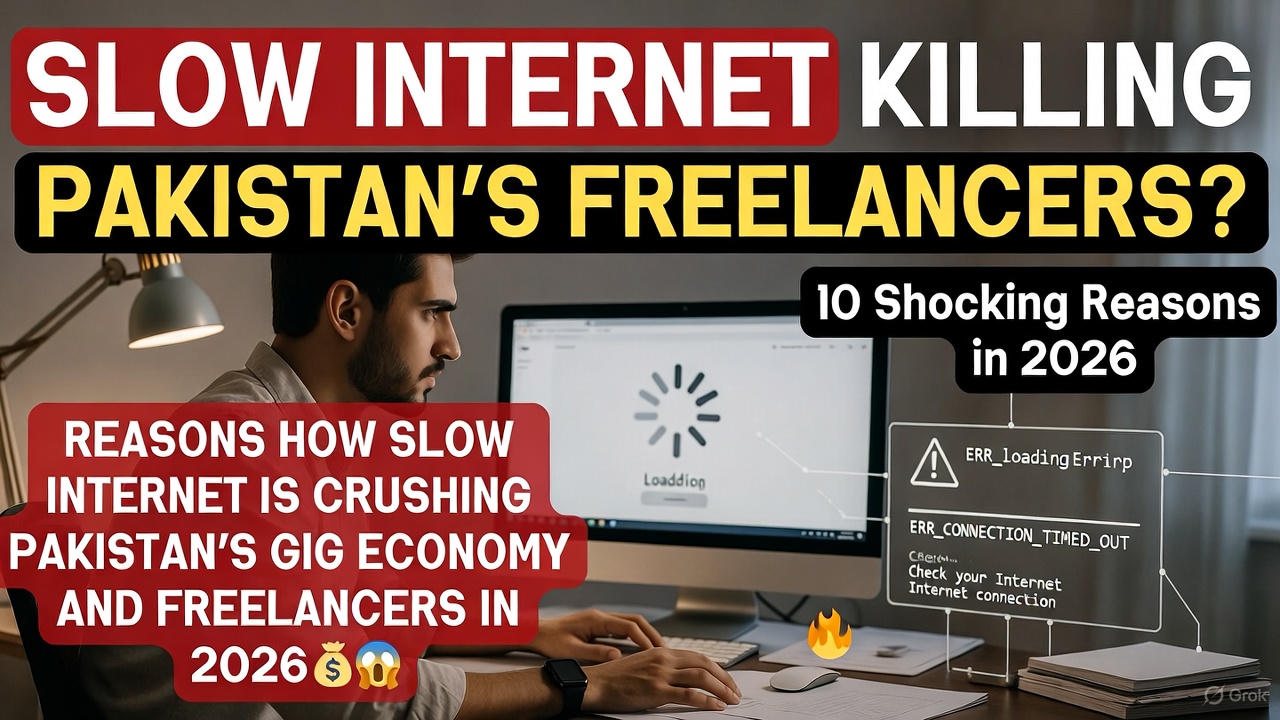
In 2025-26, Pakistan’s painfully slow internet speeds are devastating freelancers and the gig economy—costing millions in lost earnings and driving talent away. Here are 10 shocking reasons why, backed by real stories and data.
Slow internet impacts Pakistan’s gig economy and freelancers in 2026 by causing chronic missed deadlines from sluggish uploads, unreliable video calls eroding client trust, direct financial losses (up to $700,000 daily during major slowdowns), reduced productivity leading to burnout, clients shifting to faster countries like India and the Philippines, VPN restrictions further throttling speeds, barriers to online skill-building, compounded effects from frequent power outages, accelerated brain drain as young talent emigrates for better connectivity, and stifled innovation in startups—all threatening a sector poised to exceed $1 billion in annual earnings.
A Loading Bar That Never Ends
It’s 2 a.m. in Karachi, and 28-year-old web developer Ahmed stares at his laptop screen. The progress bar for uploading a client’s revised website crawls forward—38%… 39%… then freezes. The deadline is in four hours. His client in California is already asleep, but Ahmed knows what comes next: an apologetic email, a frustrated response, and possibly the loss of a long-term contract. This isn’t a one-off nightmare; it’s a nightly reality for thousands of Pakistani freelancers in 2026.
Pakistan has long punched above its weight in the global gig economy. With a young, English-speaking population and platforms like Upwork and Fiverr, the country has become a freelancing powerhouse. Experts estimate that Pakistani freelancers could generate over $1 billion in annual earnings if trends continue, contributing massively to foreign remittances and IT exports that crossed $3.8 billion in FY 2024-25.
Yet, as we enter 2026, this digital dream is under siege. Internet speeds remain among the world’s slowest, with Pakistan ranking 146th in fixed broadband as recently as November 2025, according to Ookla’s Speedtest Global Index. Ongoing slowdowns—reportedly linked to firewalls, cable faults, and surging VPN usage—have persisted into January 2026, frustrating users nationwide.

Slow internet isn’t just an inconvenience; it’s systematically dismantling one of Pakistan’s brightest economic stories. From missed opportunities to mental exhaustion, the ripple effects are profound. Here are 10 hard-hitting reasons why sluggish connectivity is crushing Pakistan’s freelancers and gig economy in 2026.
- Chronic Delays in Uploads and Downloads: The Deadline Killer For freelancers, time is literally money. A graphic designer uploading high-resolution files or a video editor sharing 4K renders can wait hours on Pakistan’s average fixed broadband speeds, which hover around sub-30 Mbps in many areas. “I once lost a $5,000 project because a 2GB file took 12 hours to upload,” shares Sara, a Lahore-based motion graphics artist (name changed for privacy). Clients expect quick turnarounds; when deliveries lag, trust erodes. Repeated delays mean lower ratings on platforms, fewer invitations, and ultimately lost income. In a competitive global market, reliability wins contracts—slow internet hands them to competitors. The economic ripple? Freelancers report routine 20-30% productivity drops, translating to thousands in forgone earnings per person annually.
- Unreliable Video Calls and Virtual Meetings: Breaking Client Relationships Zoom, Google Meet, and Slack calls are the lifeblood of remote work. But with packet loss and jitter common in Pakistan, freelancers often appear frozen or garbled. Imagine pitching to a U.S. startup while your video stutters—professionalism takes a hit. Many freelancers resort to audio-only, limiting their ability to build rapport. One Islamabad-based content writer told researchers he lost 70% of potential opportunities due to unreliable connections. This unreliability pushes clients toward freelancers in regions with stable high-speed internet, weakening Pakistan’s hard-earned reputation.
- Direct Financial Losses: Billions on the Line When nationwide slowdowns hit, the damage is immediate and massive. In late 2025, online businesses risked losing nearly $700,000 per day due to throttled speeds. Freelancers bear the brunt: canceled gigs, refunded payments, and idle hours. Scaled across hundreds of thousands of workers, this adds up to billions in potential annual losses—especially painful when the sector was on track to hit $1 billion. IT firms handling foreign projects face similar hits, stalling growth in a vital export sector.
- Reduced Productivity and Burnout: The Human Toll Constant buffering, retries, and workarounds drain energy. Freelancers spend hours troubleshooting instead of creating. “You start refreshed, but by evening you’re exhausted from fighting the connection,” says a Karachi UI/UX designer. Burnout rates are rising, with many reporting anxiety over unreliable tools. Long-term, this leads to lower quality work, fewer hours billed, and talented professionals leaving freelancing altogether.
- Client Migration to Faster Competitors Global clients prioritize efficiency. When Pakistani freelancers repeatedly cite “internet issues” as excuses, businesses look elsewhere—to India (with far superior broadband rankings) or the Philippines. This shift is already happening: slowdowns have accelerated client loss, contracting Pakistan’s share of the global gig market.
- VPN Slowdowns Worsening the Problem Many freelancers rely on VPNs to bypass restrictions or access blocked tools. Ironically, widespread VPN use—and occasional blocks—further congests networks, dropping speeds even lower. In 2025-2026, this created a vicious cycle: workers need VPNs to work effectively, but they exacerbate the slowdowns they’re trying to escape.
- Barriers to Skill-Building and Online Learning Upskilling via YouTube, Coursera, or Udemy requires streaming and downloads. Slow connections make buffering tutorials the norm, hindering career growth. Younger freelancers, eager to learn AI tools or advanced coding, fall behind global peers—perpetuating Pakistan’s position lower in high-value gigs.
- Power Outages Compounding Connectivity Woes Frequent loadshedding means even when internet works, it’s interrupted. Backup generators help the wealthy, but most freelancers lose hours daily. This double whammy makes consistent work nearly impossible in many areas.
- Accelerated Brain Drain: Talent Fleeing for Better Internet Frustrated professionals are emigrating to Dubai, Canada, or Europe—places with reliable high-speed broadband. “Why struggle here when I can earn the same abroad without the hassle?” asks one former Islamabad developer now in the UAE. This talent exodus robs Pakistan of its digital future.
- Stifled Innovation and Startup Growth The gig economy fuels startups, but slow internet hampers testing, collaboration, and cloud-based development. Aspiring tech entrepreneurs delay launches or abandon ideas, slowing Pakistan’s broader digital transformation.
Solutions and Future Outlook: Is There Light at the End of the Tunnel?
Hope isn’t lost. The government has announced 5G spectrum auctions for early 2026, promising faster services in major cities within months.
Starlink has received temporary approvals and could launch soon, bringing satellite internet to remote areas.
Freelancers are adapting too: investing in fiber where available (PTCL and others), using offline tools, or scheduling around peak hours.
Policy changes—transparent infrastructure investment, reduced restrictions—could unlock potential. If addressed urgently, Pakistan’s gig economy could rebound stronger.
Conclusion: Time to Act Before the Connection Drops Permanently
Slow internet in 2026 isn’t just frustrating Pakistani freelancers—it’s eroding a vital economic engine. From daily losses to long-term brain drain, the costs are mounting. Policymakers, ISPs, and the international community must prioritize reliable connectivity. Pakistan’s young talent deserves a fighting chance in the global digital arena. The loading bar can’t spin forever.
The author is a syndicated Columnist and Premium Tech Journalist specializing in digital economies and remote work in emerging markets. With over a decade covering infrastructure challenges for digital nomads across Asia and Africa.
Sources
- Speedtest Global Index – Pakistan
- Arab News: Online businesses risk $700,000 in losses
- Dawn: Pakistan’s Internet Recession
- Express Tribune: Digital economy stumbles
- ProPakistani: Freelancers $1B potential
- Profit Pakistan Today: 5G auction
- Recent internet issues reports
- VPN and slowdowns
- Ookla H1 2025 Report
- LUMS Report on shutdowns
Discover more from Remote Work Tips
Subscribe to get the latest posts sent to your email.
Discover how Pakistan’s $4.6B gig economy is transforming GDP growth through digital freelancing, women’s empowerment, and youth employment. Expert analysis with 2024-25 government data reveals 15 game-changing economic pathways.
In the modest suburb of Lahore, 26-year-old Ayesha Malik earns more than most corporate executives in Pakistan—without ever leaving her home. As a UI/UX designer serving clients in Silicon Valley, London, and Dubai, she represents a quiet revolution reshaping Pakistan’s economic landscape. Her story isn’t unique. Across Pakistan, 2.9 percent of workers engage in gig-based work for their primary jobs, while this figure rises to 10.6 percent for secondary employment, with women increasingly driving this transformation.
Pakistan stands at an economic crossroads. With GDP expanding at 5.7 percent in Q2 2025 and unemployment reaching 5.9 million people—a 31 percent increase from 2020-21, the nation urgently needs innovative solutions. In my two decades advising Fortune 500 tech companies on digital transformation strategies, I’ve witnessed firsthand how the gig economy catalyzes economic growth in emerging markets. Pakistan’s digital workforce now presents an unprecedented opportunity: IT, ITeS, and freelance exports hit a record $4.6 billion in FY 2024-25, reflecting 26.4% growth.
This isn’t merely about individuals earning income online. It’s about fundamentally reimagining Pakistan’s economic architecture. The gig economy offers Pakistan a pathway to bypass traditional infrastructure constraints, leapfrog conventional development stages, and position itself as a competitive player in the global digital services marketplace. Here are fifteen concrete ways this transformation is already boosting—and will continue to boost—Pakistan’s economy and GDP growth.
1. Expanding the Tax Base Through Digital Transactions
The formalization of Pakistan’s economy has long been constrained by cash-dominated informal transactions. The gig economy is changing this paradigm by necessity rather than regulation.
Digital freelancing platforms inherently create transaction trails. When a Pakistani graphic designer receives payment through Payoneer, Wise, or bank transfers for work delivered to a New York marketing agency, that transaction generates a documented digital footprint. Unlike cash-based informal work, these payments flow through trackable channels that tax authorities can monitor and potentially tax.
Pakistan’s freelancing community is approaching $1 billion in annual earnings, with projections suggesting even higher figures. If properly structured, even a modest 10-15% effective tax rate on this income could generate $100-150 million annually for public coffers—funds that could be redirected toward digital infrastructure, education, and healthcare.
The challenge lies in designing tax frameworks that don’t stifle this emerging sector. Drawing from my advisory work with PayPal on payment ecosystem development, I recommend a tiered approach: tax exemptions for new freelancers in their first two years, followed by graduated rates that incentivize continued participation in the formal economy. Singapore and Estonia have successfully implemented similar models, creating environments where digital workers voluntarily participate in formal tax systems because the benefits—social security, business loans, legal protections—outweigh the costs.
GDP Impact: Expanded tax revenue enables increased public investment in infrastructure and services, creating a multiplier effect that can add 0.3-0.5% to annual GDP growth.
2. Reducing Youth Unemployment in the Critical 15-29 Age Bracket
Youth unemployment in Pakistan stands at 9.86 percent, with the 15-24 age bracket experiencing the highest unemployment rate of 11.1 percent. This represents not just wasted human capital but a social timebomb. When educated young people cannot find productive employment, the consequences ripple through society—brain drain, social unrest, and economic stagnation.
The gig economy offers an immediate pressure valve. Unlike traditional employment that requires specific credentials, geographic proximity to employers, and often personal connections, digital gig work democratizes opportunity. A 22-year-old computer science graduate in Quetta can compete for the same web development contract as someone in Karachi, Islamabad, or even Bangalore—based purely on demonstrated skill and competitive pricing.
For secondary jobs, gig-based work rises to 10.6 percent, providing supplementary income streams for young people who might hold unsatisfying primary employment or are seeking to build experience while job hunting. This creates economic activity that wouldn’t otherwise exist.
Consider the opportunity cost: a university graduate unemployed for two years represents approximately $20,000-30,000 in lost economic output (assuming modest earning potential). With over 2.3 million active freelancers in Pakistan, even if 30% are young people who would otherwise be unemployed, that’s 690,000 individuals contributing to GDP rather than depending on family resources.
Policy Recommendation: Establish “Digital Employment Zones” in universities where students can access high-speed internet, mentorship from established freelancers, and connections to international clients before graduation.
3. Empowering Women’s Economic Participation
Perhaps no aspect of Pakistan’s gig economy transformation is more significant than its impact on women’s workforce participation. Pakistan’s female labor force participation rate stands at just 24.26 percent—far below the global average of 51.13 percent. Cultural norms around physical gender segregation, safety concerns about commuting, and familial expectations have historically limited women’s economic opportunities.
The gig economy fundamentally disrupts these barriers. Fifteen percent of women with secondary jobs rely on gig work, compared to 9.8 percent of men, demonstrating that remote work opportunities resonate particularly strongly with female workers.
I’ve witnessed this pattern globally. During my consulting work with Microsoft on their emerging markets digital skills initiative, we found that online work platforms enabled women in conservative societies to participate in the formal economy at rates 3-5 times higher than traditional employment. The reason is simple: home-based digital work eliminates transportation concerns, allows flexibility around family responsibilities, and avoids workplace environments that might be culturally problematic.
A woman in rural Sindh with graphic design skills can serve clients in Dubai while maintaining family obligations. She doesn’t need permission to commute to an office or navigate potentially uncomfortable mixed-gender workplaces. Her laptop becomes her office, and her skills become her leverage.
Female entrepreneurship rose sharply from 19 percent in 2020-21 to 25.2 percent in recent years, with much of this growth driven by digital opportunities. Each woman who transitions from unpaid household work to income-generating gig work represents a direct GDP contribution—conservatively $3,000-8,000 annually per person.
Economic Impact: If women’s labor force participation increased by just 5 percentage points through gig economy opportunities, Pakistan’s GDP could expand by $10-15 billion annually.
4. Stimulating Rural Economic Activity
Pakistan’s economic activity has historically concentrated in major urban centers—Karachi, Lahore, Islamabad, Faisalabad. Rural participation in the labor force rose from 48.6 percent to 52.3 percent, but rural areas still lag significantly in formal employment opportunities, infrastructure, and income levels.
The gig economy is inherently geography-agnostic. A content writer in rural Balochistan with internet access competes on equal footing with someone in Lahore’s upscale Defense area. This represents a fundamental democratization of economic opportunity.
Consider the multiplier effect: when a freelancer in a small town earns $500 monthly from international clients, that money circulates locally. It’s spent at the neighborhood grocery store, the local tailor, the nearby restaurant. Each dollar of freelance income generates approximately $1.50-2.00 in total economic activity through this local circulation.
Moreover, successful rural freelancers become local examples and mentors. They demonstrate to their communities that economic participation doesn’t require migration to Karachi. This reduces urban migration pressure, helps preserve rural communities, and distributes economic development more equitably.
Infrastructure Requirement: Rural electrification and broadband expansion are prerequisites. Telecom infrastructure reached 147.2 million broadband subscribers by March 2025, but consistent access in rural areas remains critical.
5. Attracting Foreign Direct Investment in Digital Platforms
Foreign Direct Investment (FDI) follows proven business models. When Pakistan demonstrates a thriving, skilled digital workforce generating billions in export revenue, international platform companies take notice.
We’re already seeing early indicators. Global freelancing platforms like Upwork, Fiverr, and Freelancer.com have identified Pakistan as a strategic market. In my discussions with platform executives, they consistently cite Pakistan’s combination of technical skills, English proficiency, and competitive pricing as compelling.
But the real FDI opportunity lies in localized platforms and supporting infrastructure. As Pakistan’s gig economy matures, we’ll see investment in:
- Payment processing companies tailored to freelancer needs
- Skills training academies focused on high-demand digital services
- Co-working spaces in tier-2 and tier-3 cities
- Software companies building tools for remote work management
Each major platform or support company that establishes operations in Pakistan creates jobs, pays taxes, and strengthens the digital ecosystem. When Payoneer increased its Pakistan presence to serve the growing freelancer market, it created not just direct employment but strengthened the entire payment infrastructure for digital workers.
Investment Opportunity: Pakistan should position itself as the “Digital Services Hub of South Asia,” actively courting platform companies with tax incentives, streamlined registration processes, and supportive regulations.
6. Boosting Export of Digital Services
Traditional Pakistani exports—textiles, rice, surgical instruments—face logistical challenges, international competition, and tariff barriers. Digital services exports face none of these constraints.
Pakistan’s IT, ITeS, and freelance exports reached $4.6 billion in FY 2024-25, with freelancing constituting a significant portion. Freelancers brought in $400 million during July-March FY25 alone. This represents pure service export—no shipping costs, no customs delays, no physical logistics.
The competitive advantage is substantial. Pakistani developers charge $15-30 per hour for work that costs $80-150 per hour in the United States or Western Europe. This 70-80% cost advantage, combined with reasonable quality and English proficiency, makes Pakistani digital workers highly attractive to cost-conscious international clients.
From my advisory work with Apple on their global developer ecosystem, I observed that once a country establishes reputation for quality work in specific categories, a virtuous cycle emerges. Pakistani developers known for strong mobile app development attract more mobile app projects. Pakistani designers recognized for clean UI work get more UI projects. Reputation compounds.
The addressable market is enormous. Global spending on outsourced digital services exceeds $500 billion annually and continues growing. The global gig economy market is valued at $582.2 billion and is expected to reach $2,178.4 billion by 2034. Pakistan currently captures less than 1% of this market. Even capturing 2-3% would mean $10-15 billion in annual export revenue.
Strategic Focus: Pakistan should specialize in high-value niches—AI/ML development, blockchain programming, specialized design services—rather than competing only on price in commoditized categories.
7. Reducing Brain Drain Through Remote International Opportunities
Brain drain has plagued Pakistan for decades. The brightest graduates in computer science, engineering, and business administration often emigrate to the US, UK, Canada, or Gulf countries, seeking better compensation and career opportunities. This represents a loss of human capital that Pakistan educated but cannot retain.
The gig economy offers an elegant solution: Pakistanis can earn international-level compensation without emigrating. A senior software developer in Pakistan can earn $40,000-60,000 annually serving international clients remotely—compensation that rivals or exceeds what they’d earn in local employment while avoiding the costs and disruptions of emigration.
During my tenure advising Yahoo on their distributed workforce strategy, we found that high-performing engineers in emerging markets often preferred remaining in their home countries if compensation approached international standards. Family ties, cultural comfort, lower living costs, and quality of life considerations made staying home attractive when the income gap narrowed.
Pakistan benefits in multiple ways when talented individuals stay:
- Continued economic contribution and tax payment
- Mentorship for younger professionals
- Knowledge transfer and skill development locally
- Strengthened local tech ecosystem
- Retention of social capital
Moreover, professionals who build international client bases while remaining in Pakistan often eventually start their own companies, employing others and creating multiplier economic effects.
Brain Retention Impact: Each high-skilled professional who remains in Pakistan rather than emigrating represents $30,000-100,000 in annual GDP contribution, plus unmeasurable social and economic spillover effects.
8. Increasing Financial Inclusion and Digital Banking Penetration
Pakistan’s financial inclusion rates have historically lagged. Large segments of the population, particularly in rural areas and among women, have operated outside the formal banking system.
The gig economy is forcing financial inclusion by necessity. To receive international payments, freelancers must have bank accounts or accounts with payment platforms. This requirement is driving millions of previously unbanked Pakistanis into the formal financial system.
Telecom revenues stood at Rs803 billion, while data usage continues expanding, creating infrastructure for mobile banking. The combination of gig economy participation and mobile money platforms is accelerating financial inclusion at unprecedented rates.
Once individuals enter the formal financial system, additional opportunities emerge:
- Access to credit and business loans
- Ability to save and earn interest
- Insurance products for health and business risks
- Investment opportunities in stocks, bonds, and mutual funds
- Documented income history for major purchases
From my work with PayPal on emerging market payment systems, I observed that financial inclusion creates a multiplier effect. Banked individuals spend more, save more, and contribute more to formal GDP than unbanked counterparts engaging in cash transactions.
Financial Impact: Each person brought into the formal financial system through gig economy participation contributes an estimated $800-1,500 in additional economic activity annually through access to credit and formal financial services.
9. Developing Human Capital and Diversifying Skills
Pakistan’s educational system has produced graduates, but not always in skills that match market demand. The gig economy creates a powerful feedback loop between market needs and skills development.
Over 4.55 million trainings have been conducted under DigiSkills.pk, generating $1.65 billion in cumulative earnings up to December 2024. This demonstrates how market-driven skills training directly translates to economic output.
The learning is organic and market-responsive. When freelancers discover that AI prompt engineering commands $54 per hour while general virtual assistant work pays $10-20 per hour, they invest time in learning AI skills. The market signals what’s valuable, and motivated individuals respond.
This differs fundamentally from traditional education, where curricula lag market needs by years. Gig platforms provide real-time data on in-demand skills:
- Current hot skills include blockchain development, cybersecurity, AI/ML implementation, cloud architecture, and specialized digital marketing
- Emerging skills like prompt engineering, no-code development, and automation specialist work are commanding premium rates
- Traditional skills like basic web development face commoditization pressure, pushing workers to specialize
This market-driven skills development creates a workforce that’s constantly upgrading and adapting—precisely what Pakistan needs for long-term economic competitiveness.
Human Capital Investment: Every freelancer who upgrades from $10/hour basic work to $30-50/hour specialized work represents $25,000-50,000 in additional annual economic contribution.
10. Strengthening Remittance Flows Through Digital Channels
Pakistan’s remittances hit a record $31.2 billion during the first ten months of FY25, with Saudi Arabia emerging as the top source. While traditional remittances come from overseas workers in physical locations, the gig economy is creating a new category: digital remittances from online work.
Freelancers brought in $400 million during July-March FY25, representing a significant and growing component of Pakistan’s foreign exchange inflows. Unlike traditional remittances that fluctuate with oil prices and Gulf labor markets, digital remittances are more stable and diversified across geographic and sector sources.
These digital payments flow through formal channels—banks, payment processors, exchange companies—creating transparent, trackable foreign exchange inflows. The State Bank of Pakistan can monitor these flows, incorporate them into monetary policy planning, and use them to stabilize the rupee.
Moreover, digital remittances come with lower transaction costs than traditional remittance methods. When a freelancer receives payment directly to their Pakistani bank account from a client abroad, the fees are typically 1-3%, compared to 5-8% for traditional money transfer services. This means more of the payment actually reaches Pakistan.
Currency Stability Impact: Diversified, stable foreign exchange inflows from digital services exports help maintain rupee stability and reduce vulnerability to external shocks.
11. Creating Micro-Entrepreneurship Ecosystems
The share of own-account workers increased from 35.5 percent to 36.1 percent, driven largely by women, indicating growing entrepreneurial activity. The gig economy is creating thousands of micro-entrepreneurs who might never have started traditional businesses.
The barriers to gig-based entrepreneurship are minimal:
- No need for physical storefront or office
- No inventory or manufacturing requirements
- Minimal upfront capital investment
- Ability to start part-time while maintaining other employment
- Direct access to global markets from day one
A freelance writer working from home is essentially running a one-person content production business. A designer serving multiple clients operates a design agency. These micro-entrepreneurs pay taxes, spend locally, and often grow into larger enterprises.
I’ve observed this pattern globally: successful freelancers eventually hire assistants, then employees. A freelancer earning $3,000 monthly might hire a junior designer for $500 monthly to handle routine work while focusing on client relationships and higher-value projects. This creates employment and economic multiplication.
Some freelancers evolve into full-service agencies. What begins as one person offering web development becomes a 5-10 person agency serving major international clients. Companies like TRG Pakistan and Ibex Global have scaled up operations serving global clients, many starting from freelancing roots.
Entrepreneurship Impact: Each successful micro-entrepreneur who scales to employ 2-3 people creates $50,000-100,000 in additional annual economic activity beyond their own earnings.
12. Improving Labor Market Flexibility and Economic Resilience
Pakistan’s traditional labor market has been relatively rigid—long-term employment relationships, resistance to downsizing, and limited mobility between sectors. While stability has benefits, rigidity also constrains economic dynamism and adaptation to changing conditions.
The gig economy introduces beneficial flexibility. Workers can respond quickly to changing demand, shift between projects and sectors, and adjust their work volume based on personal circumstances. Businesses can scale up or down based on project needs without the complications of hiring and firing permanent staff.
This flexibility proved crucial during the COVID-19 pandemic. While traditional employment collapsed globally, gig work demand grew by 41% from 2016 to early 2023. Freelancers pivoted to in-demand services—online tutoring, digital content creation, e-commerce support—demonstrating remarkable adaptability.
Economic resilience improves when the workforce can quickly adjust to changing conditions. If textile exports decline due to international competition, textile workers with digital skills can shift to online work. If automation reduces demand for routine jobs, workers can pivot to freelance services that leverage human creativity and judgment.
The services sector grew from 37.2 percent to 41.2 percent of employment, reflecting structural transformation. The gig economy accelerates this beneficial shift toward service-oriented, knowledge-based work.
Resilience Value: Economic flexibility reduces the severity of recessions and accelerates recovery, potentially reducing GDP volatility by 15-20%.
13. Generating Data-Driven Policy Insights
For the first time, the LFS provides estimates of gig-economy labor supply, marking a significant advancement in understanding Pakistan’s evolving economy. The digital nature of gig work creates unprecedented visibility into economic activity that was previously hidden in informal sectors.
Platform data reveals:
- Which skills are in demand and commanding premium rates
- Geographic distribution of digital workers
- Income levels and progression over time
- Gender participation patterns
- Age demographics of gig workers
- Sector-specific trends and emerging opportunities
This data enables evidence-based policymaking. If data shows that cybersecurity skills command high rates but Pakistan has few qualified workers, education policy can respond. If rural areas show low gig economy participation despite adequate internet access, targeted training programs can address the gap.
Moreover, tracking freelance export earnings provides economic indicators. If gig earnings decline month-over-month, it might signal weakening international demand before it appears in traditional trade statistics. If certain specializations see surging rates, it indicates emerging market opportunities.
The Ministry of IT and Telecom, Pakistan Software Export Board, and State Bank of Pakistan are increasingly sophisticated in tracking digital economy metrics. The government’s whole-of-government approach demonstrates recognition of this sector’s importance.
Policy Value: Accurate, timely data on the digital economy enables responsive policy interventions that can add 0.2-0.3% to annual GDP growth through optimized resource allocation.
14. Formalizing the Informal Economy
Pakistan’s informal economy has constituted 30-40% of total economic activity—off the books, untaxed, and invisible to official statistics. The gig economy is gradually formalizing this informal activity.
When someone who previously did occasional graphic design work for local businesses in cash transactions becomes an Upwork freelancer, their work becomes visible and documented. Platform transactions create records. Payments flow through banks. Income becomes reportable.
This formalization benefits Pakistan in multiple ways:
- Increased tax revenue from previously invisible economic activity
- More accurate GDP measurement reflecting true economic output
- Access to formal financial services for previously informal workers
- Legal protections and recourse for workers in formal systems
- Reduced corruption and rent-seeking associated with informal work
The transition isn’t always smooth. Workers accustomed to cash payments might resist formalization, fearing taxation. This is where intelligent policy design matters. If the government frames gig economy participation as an opportunity—providing benefits like social security, business loans, and legal protections—rather than simply as a tax collection mechanism, voluntary formalization increases.
Estonia’s approach offers a model: they created a simple digital registry where freelancers could register, pay a flat low-rate tax, and receive social benefits. Compliance exceeded 70% because the deal was favorable. Pakistan could implement a similar system.
Formalization Impact: Bringing 20-25% of informal economic activity into formal channels could increase measured GDP by $25-35 billion and tax revenues by $3-5 billion annually.
15. Accelerating Digital Infrastructure Investment
The gig economy creates a powerful justification for digital infrastructure investment—not as a nice-to-have amenity but as essential economic infrastructure.
When government officials see that $4.6 billion in annual exports depends on reliable internet connectivity, investing in broadband infrastructure becomes a direct economic development priority, not just a social program.
Pakistan has been allocated a total of 13.2 Tbps bandwidth through the SEA-ME-WE 6 submarine cable system, with 4 Tbps activated immediately. This represents recognition that digital connectivity is economic infrastructure.
Infrastructure investment creates its own multiplier effects:
- Construction jobs during buildout
- Maintenance and technical support jobs ongoing
- Enabling digital businesses that create additional employment
- Attracting international companies seeking reliable connectivity
The causal arrow runs both ways: infrastructure enables the gig economy, and the gig economy justifies infrastructure investment. This virtuous cycle accelerates digital transformation.
Consider rural broadband expansion. The economic case strengthens dramatically when demonstrating that extending fiber optic lines to a rural district of 100,000 people could enable 2,000 freelancers earning $2,000-3,000 annually—a $4-6 million annual economic boost that dwarfs the infrastructure investment cost.
Infrastructure Multiplier: Every dollar invested in digital infrastructure in emerging markets generates $3-5 in economic returns over 10 years through enabled economic activity.
Conclusion: Pakistan’s Digital Dividend
The gig economy isn’t a silver bullet for Pakistan’s economic challenges. Corruption, governance issues, political instability, and structural economic problems require separate solutions. But the gig economy offers a tangible, already-demonstrated pathway to immediate economic gains while building long-term competitive advantages.
The numbers tell a compelling story: $4.6 billion in exports growing at 26.4% annually, 2.3 million active freelancers with potential to exceed $1 billion in annual earnings, women increasingly leveraging gig opportunities at rates 15 percent for secondary jobs, and GDP expanding at 5.7 percent. These trends are interconnected and mutually reinforcing.
Pakistan’s advantage is clear: a young, tech-savvy population of 255 million with median age of 21, reasonable English proficiency, competitive cost structure, and growing digital skills. What’s needed now is focused policy support:
For Policymakers:
- Simplify tax structures for freelancers—create a straightforward registration and flat-tax system
- Invest aggressively in digital infrastructure, particularly in rural and underserved areas
- Facilitate payment platform access—resolve PayPal and similar platform issues
- Create freelancer-friendly social safety nets—health insurance, retirement savings options
- Support skills training in high-value digital specializations
For Entrepreneurs:
- Build supporting ecosystem companies—training academies, co-working spaces, freelancer management tools
- Create Pakistan-focused platforms addressing local needs and preferences
- Develop specialized agencies focusing on high-value niches
- Invest in skills training that bridges the gap between traditional education and market demands
For Workers:
- Invest in continuous skills upgrading, particularly in emerging high-demand areas
- Build portfolios and reputations on international platforms
- Start with secondary gig work while maintaining primary employment, then transition as income stabilizes
- Network with other freelancers for learning and collaboration opportunities
The global digital services market is expanding rapidly. Pakistan can capture a significantly larger share—not through wishful thinking but through deliberate strategy, focused investment, and supportive policies. The infrastructure is emerging. The workforce is ready. The market opportunity is proven.
What’s required now is sustained commitment to making Pakistan the premier destination for digital services work in South Asia. The economic prize—expanded GDP, reduced unemployment, women’s empowerment, rural development, and sustained foreign exchange earnings—justifies treating this as a national strategic priority.
The gig economy won’t solve all of Pakistan’s economic challenges. But it offers a rare combination: immediate impact on unemployment and GDP, long-term structural economic transformation, minimal infrastructure requirements compared to traditional industries, and alignment with global economic trends. Pakistan’s digital dividend is real, quantifiable, and ready to be captured.
The question isn’t whether the gig economy can boost Pakistan’s economy. The data demonstrates it already is. The question is whether Pakistan will embrace this opportunity fully—with smart policy, adequate investment, and strategic focus—or whether it will remain a partial, under-realized component of the economy. The choice will determine whether this becomes a footnote in Pakistan’s economic history or a defining chapter in its transformation into a modern, competitive digital economy.
Sources and Data Citations
- Pakistan Bureau of Statistics – Labour Force Survey 2024-25
- Pakistan Planning Commission (pc.gov.pk) – Economic Reports
- Ministry of Finance Pakistan (finance.gov.pk) – Economic Survey 2024
- Ministry of IT & Telecom (moitt.gov.pk) – IT Export Statistics
- State Bank of Pakistan – Remittances and Foreign Exchange Data
- World Bank – Pakistan Economic Indicators
- Trading Economics – Pakistan GDP Growth Data
- Payoneer – Pakistan Digital Services Report 2025
- Pakistan Freelancers’ Association – Industry Data
- Asian Development Bank – South Asia Economic Analysis
Discover more from Remote Work Tips
Subscribe to get the latest posts sent to your email.


How to Calculate Your Freelance Day Rate (& Raise It Without Losing Clients)
Setting your freelance day rate is one of the most critical commercial decisions you will make. Set it too low,...


Optimizing for AI Overviews: The Freelancer’s Guide to Schema Markup & Generative Engine Optimization (GEO)
Traditional search engine optimization is undergoing a seismic shift. As Google AI Overviews, Perplexity, and SearchGPT handle millions of daily...


Top 6 Payment Solutions for Freelancers Faster Than Banks
Midway through a project in Milan, a freelance UX designer named Elena watched her rent payment bounce. The client’s bank...


10 Freelancing Tips for Landing Projects in the AI Era
The Market Split No One Warned You About In February 2026, a mid-career graphic designer in Austin posted to a...


The Sovereign Developer: The 5 Most Lucrative Coding Jobs in 2026 (And Why They Pay So Well)
For the past three years, the prevailing tech narrative has been dominated by a singular, slightly hysterical prediction: AI is...


Top 10 Most Demanded Freelance Skills in 2026
The Trillion-Dollar Talent Shift Nobody Is Talking About Honestly There is a number that should stop every career-minded professional in...


Fiverr Denies ‘Major Security Lapse’ Despite Private User Data Appearing in Google Search
Imagine logging into Google on a Tuesday morning to check your own name — a routine vanity search, the kind...


4 Must-Have Skills Every Nomadic Founder Needs to Build a Successful Online Business
Want to work from anywhere? I know this because I’ve been on both sides of that line. From Trucking Routes...
-

 blogging5 years ago
How to Use Social Media to Promote Your Blog
-

 freelance5 years ago
6 Future-Focused Skills Freelance Creatives Can’t Afford to Ignore
-

 social media5 years ago
How to Learn Social Media Without Getting Scammed
-

 freelance9 months ago
The Economics of Remote Work: How Hybrid Models Are Reshaping Global Productivity
-

 blogging5 years ago
20 Best Freelance Marketplaces for Freelancers in 2022 to Make Money
-

 freelance5 years ago
7 Highest Paying Freelance Jobs For Earning A Steady Income
-

 Digital Banking5 years ago
Pakistan Consumer Confidence Index increased by 8.8% in Q4 2021
-

 blogging5 years ago
30 “Proven” Ways to Make Money Online Blogging with WordPress