
blogging
20 Best Freelance Marketplaces for Freelancers in 2022 to Make Money


Freelance platforms and the marketplace help companies get contingent workers for projects or job roles that do not require permanent employees. On these platforms, you need to create your profile, share your work portfolio, and then you can communicate with potential employers.
On freelance platforms, employers and people who are looking for work post their offers. You can apply for any project that you like and are interested in, and using these websites would help you set a solid start for your freelance career. They aid you in making your first client quickly and earn employers’ trust as well.
Here is a list of the best free marketplace and websites of 2022 for those people who wish to work as a freelancer
1. Upwork

Formerly known as oDesk, Upwork has become one of the best websites to work with no matter what type of freelancer you are searching for. It is the world’s biggest freelance platform with over 12M registered freelancers and around 5Mregistered clients.
Think of any expertise, and you would get projects and freelancers related to it here for sure. It is a user-friendly website, but you would have to submit an application that would get approved or rejected based on the current need for your skills to register with them.
They charge a 20% fee initially that lessens as you work more with the same client. Once you get billed for $500 with the same client, then the fee reduces to 10%, and after that, if you bill $10,000 for the same client, they would just charge a 5% commission. Here you can work with big brands like Airbnb, Microsoft, Dropbox, etc.
2. Fiverr

It connects freelancers and businesses digitally and has an impressive, comprehensive assortment of professional service offerings with over 250 categories. On this website, freelancers post the amount they can offer, and clients can search for them and give them the project.
Fiverr pays comparatively higher than Upwork, and they charge $1 for $5 gig or 20%. Here usually, every single job costs $5 in which you can find writers, photographers, video creators, web designers, and other such work done. It is a good launching pad for entry-level freelancers, and they can earn a decent amount of money depending on the projects they get.
If you wish to render digital services, then you would have to create a seller profile. After that, you require to make a gig and give all the information the clients might need to decide whether to work with you or not. For attracting more clients, you can also add a video to your gig.
3. Freelancer

This website is best for small businesses who require talent and help in anything related to website development, logo designing, writing, and marketing. Their client list has big brand names with whom a lot of people wish to work with such as Intel, Microsoft, and Boeing.
The freelancer website is very easy to use, plus signing up with them is also very simple and straightforward. You just need to upload previous work examples, bid for work, and after that, you can chat with the hirers employing. The best thing is that you do not have to pay anything to sign up, plus you do not have to pass an interview or test to join them.
They have over 17,000,000 registered users and 10,000,000 projects which they have posted. They are serving people in over 240 countries and are in this industry for more than 15 years. Hence, it is a fully reliable website in terms of payment, work, and brands.
4. Guru

This freelance marketplace is specifically made to help companies get professional freelancers from all over the world. There hiring process is straightforward, which makes it easy for the clients to hire freelancers. Although it is a new website, it has still managed to make its user-base of more than 1,500,000 million. https://377f2a57754b76a260c462a27a62d745.safeframe.googlesyndication.com/safeframe/1-0-38/html/container.html
The numbers are growing with every passing day; in fact, they have completed more than 1,000,000 jobs. Creating a profile with them is pretty simple and easy; all you need is to make your profile, and you are good to go. They have a massive amount of job postings every day, which are from various profiles.
They offer five monthly memberships; the basic one is free for all, but in that, you are allowed only 120 bids in a year. If you get a job, then Guru charges a 7% fee for that.
Their maximum fee is $39.95 per month if you pay annually, in which you get 600 bids a year with an annual rollover of 300, 5% job fee, and a few marketing features like boosting your ranking in search results, create premium quotes, etc.
5. People Per Hour

It is a massive and one of the best freelance marketplaces as here you can get a wide range of categories such as audio, video, web development, web design, mobile development, social media, and much more. On this platform, people have earned more than £130 million through 1 million businesses.
Its primary aim is to link its customers with the right kind of people. The unique thing about them is that every person you work with has been hand-curated by them; hence the quality of people and work with them is fabulous.
Their hiring process is very flexible, and their prices are also affordable. For creating your profile, first, you would have to fill an online application that is reviewed by a moderation team to make sure that they hire the best freelancers.
Once you get the approval after that, you can access a stream of projects from international clients as well. You can either search for the projects manually or save automatic searches to receive notifications when they list any new projects .
6. Toptal

If you are looking for top-quality freelancers, then this should be the first freelance marketplace you should think of. Their application process is so tough that out of thousands of applications they receive every day, they only accept a few. It is created to assist companies to hire from the top tier of world-class freelancers.
You would get all types of work and freelancers such as designers, developers, project managers, and finance experts. Toptal helps you find the right person for your job who eventually becomes a part of your team. You get to access their great clients once you get selected after your screening process is complete.
They have big brands working with them, such as Motorola, Hewlett-Packard, Airbnb, Zendesk, etc.
7. FlexJobs

It is a platform specializing in flexible jobs as it comprises remote work, on-site jobs, freelance opportunities, and flexible work schedules. More than 40,000 companies hire freelancers through them, and you can choose as per your interest and skills. Its disadvantage is that you would have to search a lot out of a ton of junk to get quality job postings.
This does not mean that there are scam postings; it is a well-curated website as they research the jobs and monitor new gigs thoroughly. Every requirement posted on this platform goes through a detailed screening process that assures authenticity and legitimacy.
They have jobs from all over the world in more than 50 career categories. This platform is not free of cost; if you want to get complete access to its vast network of employers and detailed description of each company, then you would have to pay $14.95 a month for that.
8. 99designs

It is one of the best freelance marketplaces for logo, web, and graphic design. Here, you would be able to see a new design made every two seconds for the client; just imagine the talent you can get here. Clients only need to provide their requirements, and designers submit their entries.
If a logo is well-designed, it attracts a lot of customer’s attention; therefore, it is imperative that an experienced designer does this work for you. On 99designs, you can rest assured about the quality and designs.
This website works relatively differently as compared to the other websites. The clients provide the brief of their design, and designers submit their application; the client would select the one they like, and the designer gets the payment for that.
The good thing about this website is that they make you feel supported as a freelancer because they help you find opportunities or join a community of designers.
9. SimplyHired

In this marketplace, freelancers can find work in almost every field; thus, it is perfect for people who seek extra work. The significant advantage is that they do not charge people for putting the job postings, which is why there are numerous job opportunities on this website.
It is very easy for you to upload a resume and get your profile up and running as a freelancer. Once this is done, you would be able to see freelance jobs in your nearby location as well. You would also be able to see a list of top salaries and a tool where you can estimate your fee.
They provide work in more than 24 countries and in 12 different languages, which very few websites offer. You can also narrow down your searches only to what you are interested in, making job search easy for you. This feature’s major benefit is that you can do a valuable search than just seeing the loosely related results.
10. Aquent

This is a great website that helps in making connections for you. Their clients come up with the job posts, and they turn it to their group of freelancers to do the job. They provide the right match for talented people with companies who are searching to hire the same skill-set.
They majorly provide jobs related to marketing, tech, and creative careers. Aquent has won numerous awards because of the quality work they offer and the incredible talent they possess. They usually accept applicants who have more than two years of experience, but they welcome fresh graduates as well to explore their available jobs.
Here you get the opportunity to work on-site or remotely as per your preference. Plus, they also offer training in practical skills to freelancers to sharpen their skills, which helps a lot on the freelancers’ overall development.
11. PubLoft

If you love writing and have the talent to pen down on anything and everything, then this can be an excellent platform for you. They allow you to write for academics like white papers, term papers, dissertations, and much more. This platform is specifically created for academic writers.
On the website, you would be able to see profiles that display stats such as educational background, experience in the field you choose, experience, number of pages written, and previous ratings by the client. They also have a grammar and formatting test that you would have to clear to start working with them.
The good thing about this platform is that you get to work with reliable clients, and you need not interact with them. They help freelancers in finding customers again and again.
12. LinkedIn

It is one of the most important social networking websites as it offers a plethora of employment opportunities for freelancers. Every day you would be able to see millions of jobs posted on LinkedIn, some of them are full-time, but a lot of them are part-time as well.
They have both free and premium subscriptions, but if you do not wish to pay and opt for the free version, you would still be able to see many job postings and apply for them. Signing up is pretty easy with them, and the good part is that you do not have to go through any test or screening to start working with them.https://377f2a57754b76a260c462a27a62d745.safeframe.googlesyndication.com/safeframe/1-0-38/html/container.html
On LinkedIn, you can find all sorts of jobs, just upload your resume, and it would be great if you post examples of the previous work done by you. They have recently launched Profinder– which is mainly for freelancers where they find their next gig. They are spread across 200 countries with more than 420 million users.
13. Designhill

This platform has become one of the best freelance marketplaces for web design, logo, and graphic design for both freelancers and employers. Their signup process is not that easy and direct, making the competition among the designers pretty meagre. As the competition is less, you have chances to get paid more.
There are a few ways employers can search for freelance designers, such as by creating a project contest; by doing this, they will get a lot of design entries, or another way is by searching the services through a search box placed at the top of the landing page.
Here you would find numerous opportunities to work in different ways, such as designing t-shirts to print and sell them in their online shop. Hence, you not only get to work with just websites or logos, but you have different opportunities that can help you and your resumes grow.
14. Hubstaff Talent

Usually, all the freelance platforms and marketplace charge fees from their clients or freelancers, but Hubstaff is relatively different from others. You would be glad to know that they do not charge any fee from their clients and freelancers, it is absolutely free.
They have hit more than 7,000 freelancers mark in just a couple of years and are multiplying every day. The good thing about this platform is that here you can choose the work mode as per your choice as they have options for you to work full-time, part-time, on an hourly basis, or at a fixed price.
You can find an array of jobs here, such as an infrastructure manager, receptionist, product marketing, helpdesk manager, etc. Signing up with them is very simple and quick; all you need to do is fill in your personal details, skills, experience, and availability; you would be notified through an email when someone likes your service.
15. SolidGigs

Time is very precious while freelancing. If you spend hours searching for a suitable job and still do not find one as per your choice, it wastes time, effort, and money. You could have spent this time doing work and making money.
Keeping this in mind, SolidGigs filters through dozens of jobs and picks the best, and sends it to the user. It does this through its two tools- a weekly gig list and a courses & tools section. A team of SolidGigs scrolls through the various job opportunities and then alerts freelancers about the best 1% of the jobs available every day.
In the courses & tools section, they partner with people in freelancing and solopreneurship to provide training and education on numerous topics- starting from pitching to sales, pricing, and client acquisition.
It is an excellent website for beginners as it comprises a variety of jobs such as media consultant, guest blogger, salesforce administrator, etc.
16. We Work Remotely

In today’s time as a freelancer, there are various alternatives for finding a job. This is another great platform for freelancers where they can seek tons of job opportunities in multiple fields such as marketing, sales, copywriting, design, programming, and much more.
If you want, you can apply for their newsletter, tick the category that you wish to work for, and they would notify you about the jobs available in that sector through an email. Another option to search for a job on this platform is by searching on the page and see what is new or select the category that fits your interest best.
They have full-time, part-time, and contract job opportunities; you can choose any option as per your time availability. Signing up with them is pretty easy as you just need to fill in a few details, and you are good to go. It is one of the best freelance marketplaces for people looking for various options to work with big brands.
17. Dribbble

This freelance marketplace is a hub for people seeking a freelancing job. It is a great platform to share your web designing work with employers and get the most appropriate job opportunity. Dribbble comprises tons of projects for visual designers, UI & UX designers, brand designers, animators, illustrators, etc.
All in all, it is a huge platform where designers & creatives from all around the world gather to share their work. The good part about this website is that you can search for the job by specialties such as graphics, mobile, etc. Plus, you also have the option to choose a location, check remote work, select the job type (part-time or full time), and much more.
It is a user-friendly website where searching for jobs has been made really easy for both beginner and experienced freelancers. There a lot of people who have joined this website because of the quality of work they offer, plus they have a lot of reliable brands.
18. Gigster

This freelance marketplace is particularly for web developers and software developers as they can find numerous job opportunities on Gigster. You would find some of the best technology minds on this website from the world’s leading universities and corporate companies.
It has a small screening process, but that helps freelancers in matching with the projects quickly. In fact, they have a dedicated team to handle sales and administrative work so that you can concentrate on your core job. They have a pretty straightforward business platform as it helps connect people with ideas and other people who have the skill-set to execute those ideas.
On Gigster, you can be sure of your project’s timely completion by the best person irrespective of the project type. Your project might be a complicated engineering task or a simple project; they ensure client satisfaction along with keeping time and other factors in mind.
19. Behance

It is one of the best freelance marketplaces for a graphic designer as here they have tons of job opportunities to work with renowned merchants. On Behance, you can find the world’s top design collection, and it has become an immense designer community today.
You have options to work full-time, on contract, as a freelancer, or on an internship project. Other categories in which you can find jobs on Behance are photography, fashion, architecture, branding, etc. It is in various countries such as Canada, Australia, Belgium, the USA, etc.
People work differently on Behance as they share the work they have completed or working on. Here, many designers do concept art, and at times they create such beautiful concepts that it beats the original one. It is a massive marketplace; hence finding a designer or any kind of freelancer is very easy and quick.
20. CloudPeeps

People who have a big freelancing portfolio can get excellent jobs at Cloudpeeps as they have big brands associated with them that offer quality jobs. This website is run by a community of freelancers and is managed really well in a systematic manner.
They also provide an option for freelancers to make their team if they want and work accordingly. You can find an array of job opportunities in various sectors such as email, SEO, design, copywriting, content, social media, and many more.
There are thousands of professionals working as a freelancer on Cloudpeeps, and you can be a member of their team if you create a nice portfolio. The good part of this platform is that it allows you to work remotely.
Discover more from Remote Work Tips
Subscribe to get the latest posts sent to your email.



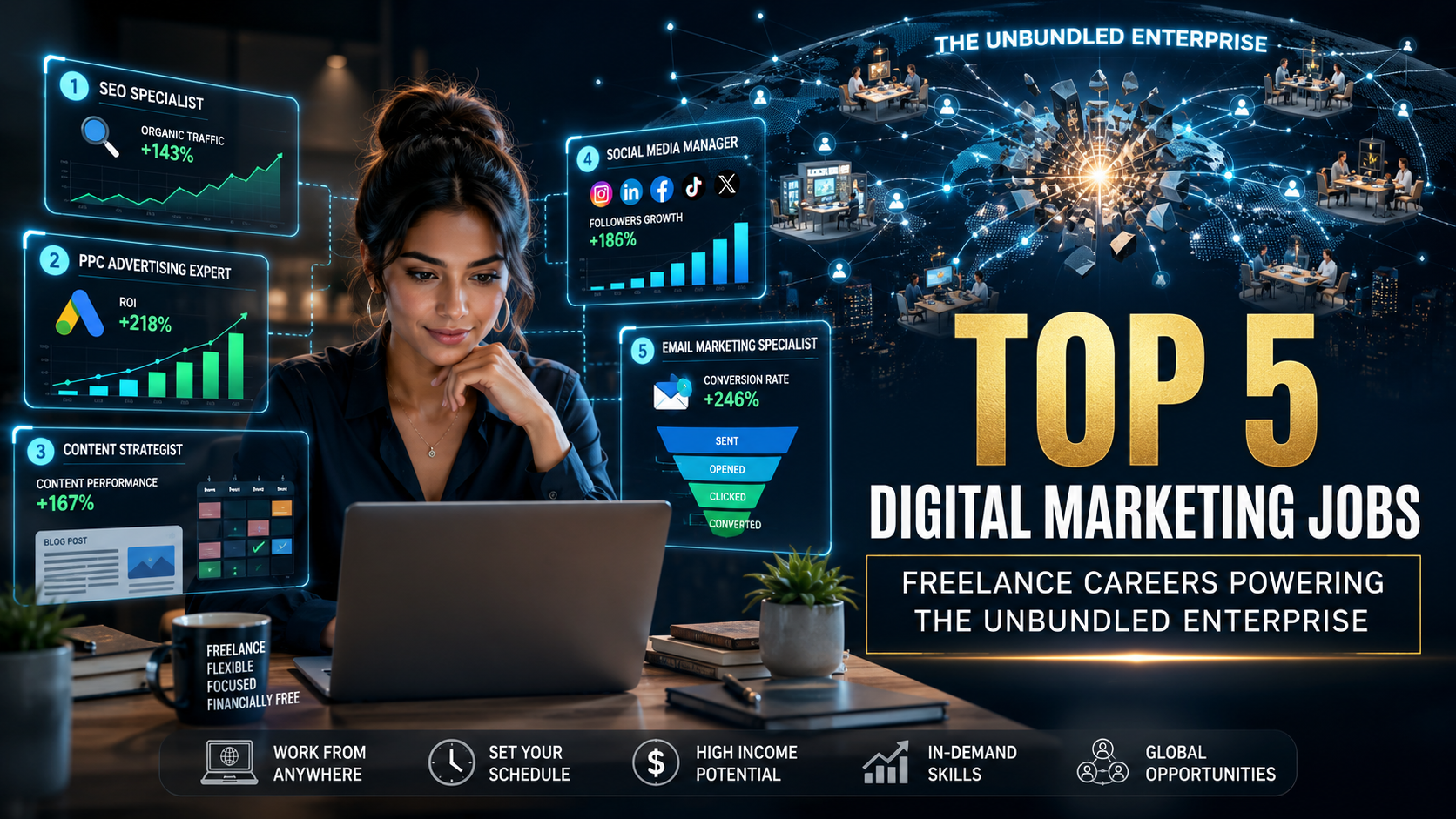
In October 2025, a quiet structural shift swept through mid-tier Madison Avenue advertising agencies. Faced with stubborn capital costs and institutional directives to optimize balance sheets, Fortune 500 brands quietly terminated long-term agency retainers worth millions. These legacy arrangements did not disappear; they fragmented. The modern corporate enterprise no longer seeks a multi-million-dollar agency suite to manage its digital presence; instead, it hunts for targeted, unbundled expertise. This structural realignment has transformed corporate marketing from an overhead liability into an on-demand network of elite, independent practitioners who operate far outside the traditional corporate framework.
The macroeconomic forces driving this migration are structural rather than cyclical. According to data compiled in the Gartner Marketing Spend Report, overall enterprise corporate marketing allocations contracted to 7.7% of total revenue, down significantly from pre-pandemic highs of over 10%. Concurrently, operational complexities have multiplied. The rapid emergence of generative search engines, predictive data frameworks, and complex privacy compliance measures has left generic in-house marketing teams flat-footed. Hiring full-time executive talent requires significant overhead, equity allocations, and lengthy onboarding cycles that modern enterprises simply cannot afford. A recent market analysis by Upwork Institutional Research indicated that 64% of corporate hiring managers plan to plug these critical capability gaps by hiring specialized, elite independent contractors over the next 18 months. Consequently, corporate capital is shifting rapidly away from generalized full-time roles toward specialized independent professionals.
1 — The Core Development
To build a sustainable income as an independent contractor, professionals must look beyond execution and focus entirely on high-impact specialization. The highest-paying digital marketing jobs for freelancers are no longer found in baseline copywriting or basic social media scheduling; those commoditized tasks have been largely absorbed by automated software pipelines. Instead, today’s marketplace rewards independent professionals who can architect systems, recover decaying organic search visibility, and directly influence pipeline revenue.
The first critical role commanding premium fees is the Fractional Chief Marketing Officer (Fractional CMO). Mid-sized enterprises earning between $10 million and $100 million annually frequently find themselves in a strategic dead zone: they need executive-level marketing leadership but lack the $300,000 annual budget required to secure a top-tier full-time CMO. The independent growth strategist steps into this vacuum, selling fractional leadership across three or four concurrent clients. On January 12, 2026, data from premium consulting registries showed that experienced fractional leaders routinely command retainers ranging from $5,000 to $12,000 per month per client, focusing exclusively on unit economics, channel diversification, and team restructuring.
The second elite domain is the Technical SEO Architect. As search engines move away from simple keyword matching toward semantic entity recognition, legacy search engine optimization practices have crumbled. Companies are watching their organic search footprints erode due to complex algorithmic core rollouts. An enterprise Technical SEO Architect operates more like a software engineer than a traditional marketer. They audit JavaScript rendering pipelines, configure structured data graphs, and optimize server-side delivery to ensure absolute search engine visibility. According to an industry study by HubSpot Enterprise Trends, organizations that invest in advanced entity-based data modeling experience a 42% faster recovery from search algorithm penalties than those relying on legacy keyword optimization. For a skilled professional operating in this niche, a single comprehensive architectural audit can easily command $15,000, with ongoing monitoring retainers clearing $6,000 monthly.
2 — Analytical Layer
Moving further down the operational funnel reveals more high paying freelance marketing roles that insulate independent contractors from market volatility. These positions succeed because they are directly tied to financial conversion and technological integration. The modern corporate buyer is deeply risk-averse; they refuse to pay for creative vanity projects, but they will eagerly write five-figure checks to an independent practitioner who treats marketing as an optimization problem.
The third position is the Conversion Rate Optimization (CRO) & User Behavior Analyst. Driving traffic to a digital property is meaningless if the traffic fails to convert into revenue. A CRO specialist combines data science, behavioral psychology, and rigorous A/B testing frameworks to extract maximum value from existing user footprints. They analyze session recordings, isolate checkout friction points, and re-engineer user paths. This role is highly insulated from budget cuts because its return on investment is immediately visible on a company’s balance sheet; if a specialist lifts a platform’s conversion rate from 1.8% to 2.4%, they instantly create millions of dollars in net new revenue without increasing the client’s advertising spend.
What are the highest-paying digital marketing jobs for freelancers?
The highest-paying digital marketing jobs for freelancers are fractional CMO leadership, technical SEO architecture, conversion rate optimization (CRO), marketing automation engineering, and performance marketing direction. These elite, remote marketing contracts command premium rates because they directly influence corporate revenue pipelines, optimize complex data infrastructure, and require advanced technical execution.
The fourth position is the Marketing Automation & Data Attribution Engineer. In an era dominated by privacy regulations like GDPR and the deprecation of third-party tracking cookies, corporate data collection has become severely fractured. Modern enterprises employ fragmented technology stacks, using separate tools for customer relationship management, email marketing, web analytics, and customer data management. The automation engineer acts as a systems architect, using tools like Zapier, Make, and custom APIs to synthesize these disconnected data feeds. They build multi-touch attribution models that trace a customer’s journey across dozens of digital touchpoints, proving exactly which marketing dollar drove the final purchase. A single system integration contract for an enterprise client can yield upwards of $25,000, creating an exceptionally stable baseline for independent data engineers.
3 — Implications & Second-Order Effects
The fifth high-paying independent role is the Paid Acquisition & Performance Marketing Director. Managing multi-million-dollar ad spends across platforms like Google, Meta, and programmatic ad exchanges requires deep analytical capability. Modern performance marketing is no longer about selecting interests or demographic toggles; it requires managing complex machine-learning bidding algorithms, structuring first-party data loops, and executing rapid creative testing pipelines.
The downstream consequences of this shift toward independent specialists are reshaping the broader business ecosystem. As elite talent decouples from traditional agency structures, corporations are building agile, modular marketing networks. Instead of paying an agency a flat 15% management fee on ad spend, enterprises retain an independent performance marketing director to oversee strategy, an independent CRO specialist to optimize the landing pages, and a technical SEO architect to protect organic visibility.
This decentralization alters corporate cost structures. Fixed marketing overhead is converted into variable project costs, increasing corporate financial resilience during economic shutdowns. A comprehensive study by the McKinsey Global Institute noted that companies utilizing agile talent models achieved a 22% reduction in operational execution costs alongside a 15% acceleration in speed-to-market for major campaigns. Still, this model creates an intensely bifurcated labor market. Generalist freelancers who refuse to specialize face severe downward pricing pressure, while the top five percent of technical and strategic independent contractors enjoy record-high billing rates.
4 — Competing Perspectives or Counterargument
The picture is more complicated than a simple migration toward freelance prosperity. Critics argue that the unbundled freelance model introduces severe hidden costs and operational vulnerabilities for both corporations and independent practitioners. Legacy agencies, despite their bloat, provide institutional continuity, centralized accountability, and deep resource redundancy. If an agency employee leaves, a replacement is inserted instantly without disrupting the client’s operational momentum.
When an enterprise relies on an independent contractor, it introduces key-person risk. If a freelance automation engineer suddenly becomes unavailable, the client’s data infrastructure can quickly become unmanageable. Furthermore, many independent professionals underestimate the operational friction of running a solo business. Data published by the Bureau of Labor Statistics indicates that independent professionals spend an average of 28% of their working hours on non-billable tasks, including lead generation, collections, and administrative overhead. This means that an attractive hourly contract rate of $150 can quickly degrade when accounting for unbilled operational hours and lack of employer-subsidized benefits. For many practitioners, the lack of a predictable income floor outweighs the theoretical autonomy of the independent market.
5 — The Technical Execution of High-Value Roles
To understand how these elite positions operate in practice, we must examine the specific technological frameworks they manage. The division between execution and architecture is best illustrated by breaking down the daily work products of these top five roles.
Role Primary Technology Stack Core Metric of Success Average Project Value Fractional CMO HubSpot, Salesforce, Tableau Customer Acquisition Cost (CAC) Efficiency $8,000 / month Technical SEO Architect Screaming Frog, Log File Analyzers, Next.js Organic Crawl Efficiency & Core Web Vitals $12,000 / project CRO Specialist Optimizely, Hotjar, Google Analytics 4 Average Order Value (AOV) & Conversion Lift $10,000 / project Automation Engineer Zapier, Make, Segment, SQL Attribution Data Accuracy $15,000 / architecture Performance Director Meta Ads Manager, Google Ads, Liveramp Return on Ad Spend (ROAS) $7,500 / month
The Mechanics of Fractional Leadership
The fractional CMO does not write social posts. They sit with the Chief Financial Officer to map out the marketing efficiency ratio. When an enterprise is burning capital on inefficient paid acquisition, the fractional leader steps in to reallocate budget toward organic channels or customer retention systems. They build the strategic roadmap that full-time junior staff members execute.
The Realities of Architectural SEO
A professional operating as a technical SEO architect looks at a website the way a structural engineer looks at a skyscraper. They isolate why search engine crawlers are wasting crawl budget on duplicate parameters. They build structured schema markup that directly feeds search engine knowledge graphs, ensuring the client’s brand is recognized as a verified entity rather than just a loose collection of keywords.
6 — Securing Premium Enterprise Contracts
Securing these premium remote marketing contracts requires a sophisticated business development methodology that completely avoids public freelance bidding marketplaces. High-earning independent practitioners build authoritative profiles through targeted publishing, technical case studies, and strategic networking with venture capital and private equity firms.
Private equity firms represent an exceptional source of high-paying freelance marketing roles. When a private equity firm acquires a portfolio of mid-market business-to-business software providers, they immediately seek to optimize marketing operations to accelerate enterprise value. They rarely want to hire permanent executive teams during the initial optimization phase. Instead, they deploy trusted independent technical architects and fractional growth specialists to audit the newly acquired companies, overhaul their data ecosystems, and install repeatable customer acquisition frameworks. A single relationship with a private equity operating partner can yield a predictable pipeline of enterprise-grade consulting contracts lasting for years.
What follows, however, is a steep learning curve for the independent professional. Managing an enterprise project requires a mastery of corporate politics, clear reporting mechanisms, and absolute clarity regarding data privacy. An independent contractor handling data integration must understand how server-side tracking complies with local privacy mandates. Those who master this intersection of technology and corporate compliance are insulated from the economic shifts that threaten generalist workers.
7 — The Transformation of the Creative Class
The structural displacement of generalist content creators has fundamentally changed the career trajectory for a modern freelance content strategist. Historically, an independent writer could build a comfortable business by churning out search-optimized articles. Today, automated language models produce baseline content for pennies. The independent professional must pivot from content production to semantic content architecture.
This means a content strategist can no longer just write; they must design thematic content hubs that demonstrate deep topical authority to automated search evaluators. They analyze search intent profiles, build comprehensive content calendars based on proprietary industry data, and construct internal link architectures that distribute search authority across commercial landing pages. They transform text from a simple creative output into an organic customer acquisition channel.
The picture is clear: the independent market no longer has room for the unspecialized intermediate. The market has broken into two distinct realities. At the bottom lies a race to the bottom, where commoditized workers compete against automated software platforms for dwindling fees. At the top sits an elite tier of independent consultants who command corporate fees because they solve structural problems that directly impact profitability.
The evolution of corporate marketing has permanently dismantled the traditional binary choice between agency employment and unspecialized gig work. The modern digital economy favors agile, highly specialized independent consultants who can step into an enterprise, solve a critical operational bottleneck, and depart without adding structural drag to the corporate balance sheet.
Success in this environment demands a continuous commitment to technical mastery, clear economic attribution, and a cold refusal to engage in commoditized work. The independent professionals who command the market are those who operate at the volatile intersection of code, capital, and consumer behavior. Ultimately, the future of marketing belongs to those who own their specialized infrastructure and can turn corporate chaos into quantifiable revenue.
Discover more from Remote Work Tips
Subscribe to get the latest posts sent to your email.

The launch of advanced large language models triggered a predictable collapse in the market for mediocre text. Content mills vanished, and freelance platforms saw rates for baseline SEO copy crater practically overnight. Yet, the death of the human writer was vastly overstated. What actually died was the commercial viability of regurgitation. For editors managing the desks at top-tier publications and corporate strategy units, the resulting flood of algorithmic prose has only clarified the value of what machines cannot execute. The market has rapidly bifurcated, placing an unprecedented premium on the specific freelance writing skills AI cannot replace.
The structural shift we are witnessing is not the end of commercial writing, but the automation of the consensus median. An algorithm trains on what has already been published, calculating the most probable next word to generate a perfectly average amalgamation of historical thought. According to global investment research from Goldman Sachs, generative AI could expose the equivalent of 300 million full-time jobs to automation, with administrative and mechanical text generation taking the heaviest initial hit.
Writing as the mere act of stringing grammatically correct sentences together is effectively a solved computational problem. Still, writing as an act of original synthesis and structural persuasion remains strictly human terrain. The economic value for independent writers no longer lies in producing the median. It lies in generating the alpha—the analytical edge that deviates from algorithmic predictability. Editors and brand directors are rapidly adjusting their budgets. They refuse to pay for competent summaries, instead directing capital toward investigative rigor, lived context, and the deliberate friction of human thought.
The Core Development: Moving Beyond Probability
To understand where freelance writers hold an insurmountable advantage, one must understand how generative models fail. AI operates on statistical probability, not truth, memory, or physical reality. It cannot pick up a phone, secure an off-the-record briefing, or read the nervous body language of a chief executive during an earnings call.
The first irreplaceable skill is primary source extraction. Algorithms summarize the internet; elite freelancers interview the people building it. The ability to identify the right human source, build sudden rapport, and extract a candid quote that has never been digitized is a moat AI cannot cross. The Reuters Institute for the Study of Journalism notes that original reporting and exclusive human sourcing remain the primary drivers of subscriber trust and retention.
Closely tied to this is strategic omission. Generative models are inherently additive. They default to comprehensiveness, listing every possible factor in a bulleted sequence because they lack the editorial confidence to leave things out. Human writers know that what you cut is as important as what you keep. Deciding to ignore three valid data points because they dilute the core narrative tension requires a discerning judgment that probability matrices do not possess.
That leads directly to subtextual analysis. AI reads text literally. It cannot read the room. Consider an editorial chief managing a digital finance publication in Sindh. When assigning a column on the latest IMF policy interventions or regional inflation metrics, they know an algorithm will merely summarize the official press release. It takes a human economist to read the deliberate silences within a central bank’s sterile prose, translating bureaucratic hesitation into a localized forecast on energy subsidies.
The Analytical Layer: Generating the Alpha
If the baseline of content is now perfectly competent and entirely unoriginal, the premium shifts to structural interpretation. This is where high-income freelancers transition from writers to analysts.
Why does AI fail at analytical writing? Generative models are designed to find the safest mathematical consensus within their training data. They average out competing viewpoints to avoid hallucinations or controversy. Analytical writing requires taking a definitive, original stance, relying on inductive reasoning and critical leaps that algorithms are explicitly programmed to avoid.
This introduces the fourth skill: counter-narrative generation. When the entire digital ecosystem is parroting the same trend, the valuable freelance writer constructs a well-defended contrarian thesis. If the market consensus is that a new technology will streamline logistics, the human analyst looks at the historical labor relations of the sector and predicts a union strike.
Fifth is institutional critique. Algorithms are heavily guardrailed by their parent companies to avoid offending governments, corporations, or protected groups. They struggle to formulate biting, structural criticisms of powerful entities. A human writer can identify systemic hypocrisy—for instance, tracking how a specific regulatory framework quietly benefits the very monopolies it claims to police.
Sixth is the mastery of asymmetric synthesis. AI is excellent at comparing two highly related concepts. It is remarkably poor at connecting two seemingly unrelated disciplines to form a new thesis. A human writer can draw a structural parallel between 19th-century maritime insurance law and modern cryptocurrency exchanges, creating a conceptual bridge that no algorithmic training data has previously linked.
Implications and Second-Order Effects: The Emotional Economy
The downstream consequences of the AI content flood are already visible in corporate marketing and digital publishing. As the volume of synthetic text approaches infinity, the cost of generating words falls to zero. Consequently, reader trust is plummeting. Businesses are discovering that while AI copy can fill a webpage instantly, it often fails to convert at the bottom of the funnel because it lacks edge, conviction, and emotional resonance.
This brings us to the seventh skill: emotional pacing. Algorithms write at a single, unrelenting cadence. They do not understand how to build intellectual suspense, when to deploy a fragmented sentence for blunt impact, or how to let a devastating statistic sit alone on a line to force the reader to pause. Human writers manipulate rhythm to control the reader’s breathing and emotional state.
Eighth is the application of irony and calculated irreverence. Sarcasm, wit, and irony require a shared understanding of cultural context and human absurdity. When AI attempts humor, it defaults to algorithmic puns or safe, sterile jokes. A human writer can deploy a dry, cynical observation about a failing tech startup that resonates perfectly with a frustrated audience.
Ninth is the capacity for ethical framing. Data does not exist in a vacuum. According to the Bank for International Settlements, while artificial intelligence can process macroeconomic data at unprecedented speeds, the interpretation of that data carries profound ethical implications. When writing about poverty metrics, job displacement, or public health, a human writer frames the statistics with an innate understanding of human suffering and dignity—something an algorithm can only pantomime.
The Counterargument: The Illusion of Algorithmic Context
Tech determinists argue this view is shortsighted. They suggest the limitations of current LLMs are temporary engineering problems, not permanent philosophical boundaries. Proponents of autonomous agents argue that the next generation of models will possess infinite contextual memory and the ability to execute multi-step research workflows independently.
According to researchers at MIT Technology Review, autonomous AI agents will soon be capable of scraping localized databases, monitoring real-time financial feeds, and generating localized analysis without human prompting. From this perspective, the idea that only humans can synthesize complex data or execute macroeconomic contextualisation is a romantic delusion. The machine, they argue, will eventually simulate empathy, irony, and analytical reasoning so flawlessly that the end consumer will neither notice nor care about the distinction.
Yet, this argument fundamentally misunderstands the economics of attention. Even if a machine perfectly simulates a controversial opinion, it remains a simulation. A machine cannot put its reputation on the line. The tenth and most critical skill is skin in the game. Readers value a bold piece of analysis because a human being risked their professional credibility to publish it. An algorithm cannot be brave, because an algorithm has nothing to lose. When a freelancer attaches their byline to a fierce institutional critique, the value stems entirely from the fact that a human mind took a verifiable risk.
The Enduring Premium on Human Friction
The paradox of the generative era is that the more flawless machine text we produce, the higher the market premium on verified human thought. The skills that will sustain high-income freelancers over the next decade have very little to do with typing speed, grammatical perfection, or baseline SEO optimization.
Those capabilities have been permanently commoditized. The future belongs to the editors, the economists, the investigative reporters, and the analysts who treat writing merely as the final delivery mechanism for their thinking. The algorithm can perfectly summarize what happened yesterday. The human writer’s job is to explain why it matters, who is lying about it, and what will inevitably break tomorrow.
Discover more from Remote Work Tips
Subscribe to get the latest posts sent to your email.

The era of the purely cosmetic digital product designer is officially over. In the opening quarters of 2026, design executives at major technology enterprises realized a sobering truth: generative systems can now convert raw product requirements into production-ready Figma mockups in under 90 seconds. The traditional premium placed on layout execution, color theory application, and button state definition has collapsed. Elite design is no longer measured by the speed of pixel output, but by the ability to orchestrate complex semantic systems, manage intense user cognitive load, and translate multi-layered corporate strategies into flawless digital architecture.
The macroeconomic shift reshaping the creative workforce is stark. According to the McKinsey Global Institute Tech Trends 2026 Index, automated system generation reduced tactical design execution timelines across the technology sector by 42% over the last 24 months. Organizations no longer hire designers to build interfaces; they hire them to govern the algorithmic engines that generate those interfaces.
This transformation requires an immediate pivot in individual capabilities. The line separating engineering, data analysis, and product strategy has blurred permanently. To maintain career defensibility, contemporary digital builders must master a sophisticated triad of systemic thinking, computational literacy, and behavioral psychology.
1: The Core Development
To secure a competitive edge in this automated marketplace, professionals must consciously cultivate the top design skills 2026 environments actively demand. The most urgent of these is systemic design governance. As product ecosystems scale dynamically through contextual generation, a product creator cannot hand-craft every potential screen state. Instead, they must construct and supervise the semantic frameworks, rule logic, and prompt parameters that dictate how software builds itself in real time.
[Design Input: Core Logic & Guardrails]
                 │
                 ▼
     [Generative Engine (AI)]
                 │
                 ▼
[Context-Aware Interface (Assembled on the fly)]
A mid-2025 assessment by the Nielsen Norman Group revealed that 68% of enterprise design systems now employ automated assembly layers. When a user interacts with an enterprise dashboard, the layout rearranges itself based on the individual’s past behavior, cognitive speed, and immediate intent.
The designer’s role shifts from static compositor to systems architect. They must understand how data objects map to user needs, ensuring that automated UI components retain structural integrity, accessibility compliance, and brand alignment across thousands of machine-generated variations.
Furthermore, this transformation elevates the necessity of deep technical literacy. A modern professional doesn’t need to write production React code, but they must possess a deep conceptual understanding of component lifecycles, API endpoints, and state management. When design artifacts are delivered directly into automated engineering pipelines, a lack of technical foresight introduces massive systemic friction. Creators must know how their systems break at scale, how network latency impacts the perceived user experience, and how structural constraints influence final code generation.
2: Analytical Layer
Beyond basic systemic governance, elite professionals are aggressively integrating machine collaboration directly into their daily routines. Optimizing AI design workflows is no longer an optional efficiency trick; it’s a foundational standard for creative productivity.
┌────────────────────────────────────────────────────────┐
│               The 2026 Copilot Workflow                │
├────────────────────────────────────────────────────────┤
│ 1. Structural Prompting (Designer sets semantic logic) │
│ 2. Rapid Variant Synthesis (AI generates 50 layouts)   │
│ 3. Heuristic Selection (Designer audits & refines)     │
└────────────────────────────────────────────────────────┘
The design cycle now initiates with structural prompting, moves rapidly through algorithmic variant synthesis, and concludes with human heuristic evaluation. The machine serves as a tireless intern, generating 50 layout variations for a multi-step checkout sequence in seconds. The human designer then steps in as the editor, selecting the optimal path based on brand strategy and deep user empathy.
What skills do product designers need in 2026?
In 2026, product designers must master systemic architecture, AI prompt governance, and advanced spatial computing. True excellence requires moving past cosmetic execution to focus on data literacy, cognitive load management across multimodal interfaces, and the ethical mitigation of algorithmic bias in context-aware software environments.
This workflow demands a massive psychological shift. Designers who previously spent days perfecting a single vector curve must learn to find fulfillment in curation, critique, and structural oversight. The value lies in the prompt logic, the guardrails, and the analytical capacity to identify why variation 34 performs better than variation 12.
3: Implications & Second-Order Effects
The downstream consequences of this shift hit corporate balance sheets directly. Organizations are overhauling how they measure design impact, abandoning soft metrics like “user delight” in favor of concrete design leadership metrics tied directly to revenue, retention, and processing efficiency.
Metric Category Traditional KPI 2026 Business Impact Standard Operational Efficiency Screen Delivery Speed Automated Component Reusability Ratio User Performance Time on Page Cognitive Friction Reduction & Completion Rate Business Alignment Aesthetic Alignment Conversion Elasticity via Dynamic UI
This focus on hard metrics requires a high degree of data literacy. Designers must comfortably navigate complex analytics platforms, interpret multivariate A/B test results, and formulate design hypotheses based on quantifiably verified user friction.
Consider the ongoing rollout of spatial and multimodal computing systems. As platforms like the Apple Vision Pro and advanced automotive heads-up displays become mainstream, interfaces are shifting from flat glass surfaces to three-dimensional environments. The interaction model is no longer just tap-and-scroll; it’s a fluid blend of eye tracking, voice commands, and spatial gestures.
          [Voice Input]
                │
                ├───► [Multimodal Orchestration Engine] ───► [Dynamic UX Output]
                │
         [Gesture Tracking]
Managing user attention across these distributed touchpoints is extraordinarily difficult. Without rigorous cognitive load management, these immersive environments quickly become chaotic and overwhelming. The modern designer must carefully budget a user’s limited mental processing power, determining exactly when to use an audio cue, when to deploy a minimal spatial visual, and when to remain completely silent.
4: Competing Perspectives
Still, a vocal contingent of veteran design leaders warns that over-indexing on automation, technical architecture, and data analytics introduces severe product vulnerabilities. On March 14, 2026, during his keynote at the International Design Congress in Zurich, veteran product strategist Marcus Vance argued that an uncritical reliance on data-driven optimization loops creates a compounding “blandness epidemic.”
“When every corporate design team optimizes for identical conversion metrics using identical generative models,” Vance observed, “our software products begin to look like a single, indistinguishable corporate template. We are systematically engineering out the human friction, the delightful asymmetry, and the unpredictable emotional resonance that transforms a functional utility into a beloved cultural artifact.”
This perspective holds significant merit. Purely algorithmic optimization inevitably gravitates toward local maxima—safe, highly predictable layouts that convert efficiently but fail to inspire long-term brand loyalty.
The top tier of the profession must balance these competing forces. They must treat machine learning systems and analytical data as raw operational inputs, while maintaining the creative courage to execute unexpected, intuition-led design choices that metrics alone can never validate.
Closing
The current transformation within digital product design isn’t a slow evolution; it’s a fundamental structural break from past paradigms. The professionals thriving in this new environment are those who have successfully re-imagined themselves as product architects rather than visual layout artists. By merging deep systemic thinking with automated execution strategies, they ensure their work remains deeply defensible against machine replacement.
Ultimately, technology will continue to commoditize execution, lowering the barrier to entry for basic visual creation down to zero. The future belongs entirely to the strategic thinkers who understand how to harness that massive computational power to build software that is deeply humane, highly efficient, and structurally brilliant.
The true art of contemporary design no longer lives within the pixel itself, but deep within the logic that dictates how those pixels come to life.
Discover more from Remote Work Tips
Subscribe to get the latest posts sent to your email.


How to Calculate Your Freelance Day Rate (& Raise It Without Losing Clients)
Setting your freelance day rate is one of the most critical commercial decisions you will make. Set it too low,...


Optimizing for AI Overviews: The Freelancer’s Guide to Schema Markup & Generative Engine Optimization (GEO)
Traditional search engine optimization is undergoing a seismic shift. As Google AI Overviews, Perplexity, and SearchGPT handle millions of daily...


Top 6 Payment Solutions for Freelancers Faster Than Banks
Midway through a project in Milan, a freelance UX designer named Elena watched her rent payment bounce. The client’s bank...


10 Freelancing Tips for Landing Projects in the AI Era
The Market Split No One Warned You About In February 2026, a mid-career graphic designer in Austin posted to a...


The Sovereign Developer: The 5 Most Lucrative Coding Jobs in 2026 (And Why They Pay So Well)
For the past three years, the prevailing tech narrative has been dominated by a singular, slightly hysterical prediction: AI is...


Top 10 Most Demanded Freelance Skills in 2026
The Trillion-Dollar Talent Shift Nobody Is Talking About Honestly There is a number that should stop every career-minded professional in...


Fiverr Denies ‘Major Security Lapse’ Despite Private User Data Appearing in Google Search
Imagine logging into Google on a Tuesday morning to check your own name — a routine vanity search, the kind...


4 Must-Have Skills Every Nomadic Founder Needs to Build a Successful Online Business
Want to work from anywhere? I know this because I’ve been on both sides of that line. From Trucking Routes...
-

 blogging5 years ago
How to Use Social Media to Promote Your Blog
-

 freelance5 years ago
6 Future-Focused Skills Freelance Creatives Can’t Afford to Ignore
-

 social media5 years ago
How to Learn Social Media Without Getting Scammed
-

 freelance9 months ago
The Economics of Remote Work: How Hybrid Models Are Reshaping Global Productivity
-

 freelance5 years ago
7 Highest Paying Freelance Jobs For Earning A Steady Income
-

 Digital Banking5 years ago
Pakistan Consumer Confidence Index increased by 8.8% in Q4 2021
-

 blogging5 years ago
30 “Proven” Ways to Make Money Online Blogging with WordPress
-

 Startups5 years ago
Private equity is buying up America’s newspapers