
Opinion
Mohammad Rizwan helps Multan Sultans ace chase of 175 to secure top-two finish


Karachi Kings guaranteed to finish bottom of the table after eighth straight defeat
Multan Sultans 176 for 3 (Rizwan 76, Masood 45, Hamza 2-24) beat Karachi Kings 174 for 6 (Clarke 40, Sharjeel 36, Dahani 2-44) by seven wickets
They might have left it a bit late, but the inevitable could not be thwarted. Multan Sultans, almost certain to top the table now, edged past Karachi Kings, guaranteed to finish bottom, in the final over, sealing a seven-wicket victory. In pursuit of 175, they were only trudging along at seven an over with five to go, with the asking rate at 14. But 71 runs in the last 27 balls – the last six a dashing flourish over square leg by Rilee Rossouw – condemned the Kings to their eighth successive defeat, at the same time ensuring the Sultans will get two bites at the cherry in their bid to qualify for the PSL final.
In the end, Karachi might blame a mystifying approach to the first innings, particularly the first ten overs. Only 57 came off the first nine, with vaunted power hitter Sharjeel Khan struggling badly, managing just 21 off his first 29 balls. With Babar Azam falling for just 2 off four, it was down to the middle order to salvage a respectable total for their side.Sharjeel belatedly clicked into gear and was good for a couple of sixes, but hadn’t nearly undone the damage he had caused in a somnambulant stroll of an innings when Khushdil Shah struck to remove him with just his second ball.
The Kings seemed well off the pace until the last seven overs, and needed cameos from Rohail Nazir and Imad Wasim – who smashed an unbeaten 32 off 16 balls – to get the 174 they eventually did finish with, the late surge thanks coming courtesy of 75 runs in the final seven overs.The Sultans innings looked, for the most part, very much like the batting effort of a side that already knew it was through to the next round. Mohammad Rizwan and Shan Masood appeared content to strike at just over a run-a-ball, prioritising preserving wickets on a pitch that didn’t look quite as free-scoring as some in this tournament have.
The free-flowing Masood was reined in for much of his innings, and would admit in a post-match interview he feared he had “messed up” the chase as the asking rate climbed inexorably and the Sultans’ power-hitters sat in the dugout where they could do little damage.It was only after Masood holed out to the deep-cover boundary that the game really moved into the next phase.
Rizwan’s best instincts came alive, and all of a sudden he seemed to be finding the gaps with every delivery, almost putting Tim David, batting alongside him, in the shade as he brought the run rate down single-handedly every over. When he fell for a 56-ball 76 that belied his early struggles, David quickly picked up the mantle with a couple of further boundaries, though his dismissal in the 18th over kept the Kings just in front.
It was, as it so often is in T20 cricket, the penultimate over when the game truly showed its hand. Khushdil Shah smashed Chris Jordan first ball for six over midwicket, with a remarkable flick of the wrists; astonishingly, it was the first six the Sultans had hit all game. The second would follow two balls later and a boundary came in between, leaving nine to get off the final over.
The winning shot was delightfully flamboyant from Rossouw, who moved across his stumps to pick Umaid Asif up over square leg for six, before nonchalantly folding his arms and holding the pose. It showed a swagger that comes so easily to the Sultans right now, and is wholly missing from the Kings, for whom this campaign cannot conclude soon enough.
Discover more from Remote Work Tips
Subscribe to get the latest posts sent to your email.



AI
Optimizing for AI Overviews: The Freelancer’s Guide to Schema Markup & Generative Engine Optimization (GEO)


Traditional search engine optimization is undergoing a seismic shift. As Google AI Overviews, Perplexity, and SearchGPT handle millions of daily queries, the traditional “blue links” are giving way to synthetic AI summaries. For SEO freelancers, relying solely on keyword density and backlink building is no longer enough to secure visibility. To deliver high-tier value for your clients in 2026, you must master Generative Engine Optimization (GEO) and advanced Schema.org markup.
Generative Engine Optimization (GEO) is the strategy of structuring content so that artificial intelligence search models can easily parse, understand, and cite your site in zero-click summaries. Freelancers can execute GEO by pairing nested JSON-LD schema markup with an “answer-first” content architecture, entity-dense vocabulary, and authoritative data citations.
Traditional SEO vs. Generative Engine Optimization (GEO)
While traditional SEO optimizes for web crawlers that index pages based on keywords and page rank, GEO optimizes for Large Language Models (LLMs) and Retrieval-Augmented Generation (RAG) systems that analyze entities, facts, and relationships.
Feature Traditional SEO Generative Engine Optimization (GEO) Primary Goal Rank #1–#3 on Search Engine Result Pages (SERPs) Earn citation links inside AI-generated summaries Core Target Web Crawlers & Indexing Bots LLM Encoders, Vector Databases & RAG Pipelines Optimization Focus Keyword density, title tags, page speed Entity clarity, structured data, direct-answer hierarchy Success Metric Organic Click-Through Rate (CTR) Brand Impression Share & AI Citation Frequency
Why Schema Markup (JSON-LD) is the Foundation of GEO
Artificial intelligence models excel at understanding context, but they rely on structured data to eliminate ambiguity. According to Google Search Central, structured data provides explicit clues about the meaning of a page, transforming unstructured text into machine-readable facts.
By implementing Schema.org standards using JSON-LD (JavaScript Object Notation for Linked Data), you directly feed the search engine’s knowledge graph.
Critical Schema Types for GEO Freelancers:
- Article / TechArticle: Defines the author, publishing entity, and canonical subject matter.
- FAQPage: Provides clean, prompt-and-response text nodes ideal for LLM extraction.
- HowTo: Breaks complex processes down into strict sequential steps.
- Organization / Person: Establishes E-E-A-T (Experience, Expertise, Authoritativeness, and Trustworthiness) by linking social profiles, credentials, and institutional affiliations.
To help you audit client sites quickly, use this interactive GEO & Schema Readiness Calculator:
3 Steps to Optimize Content for AI Citations
Groundbreaking research from Princeton, Georgia Tech, and Allen Institute for AI demonstrated that incorporating specific GEO methods can boost a website’s visibility in generative search engine responses by up to 40%.
1. Implement the “Pyramid” Content Structure
AI engines prefer content that delivers immediate value before diving into nuances.
- H1: Clear, descriptive topic title.
- H2 (Immediate Answer): Place a 50–70 word direct definition or summary immediately below the main topic heading.
- H2/H3 (Deep Dive): Follow up with bulleted data, step-by-step methodologies, and comparison tables.
2. Nest JSON-LD Schema Correctly
Never separate your schemas into disconnected code blocks. Instead, nest entities within one another to show relationships. For example, nest the Person author schema inside the TechArticle schema.
{
  "@context": "https://schema.org",
  "@type": "TechArticle",
  "headline": "Optimizing for AI Overviews with GEO",
  "author": {
    "@type": "Person",
    "name": "Jane Doe",
    "jobTitle": "Technical SEO Consultant",
    "sameAs": "https://www.linkedin.com/in/janedoe"
  },
  "publisher": {
    "@type": "Organization",
    "name": "Remote Work Tips",
    "url": "https://remoteworktips.blog"
  }
}
3. Cite High-Authority Data Sources
LLMs are trained to prioritize factually grounded information. Incorporating statistics, primary research, and direct quotes from authoritative institutions—such as the World Wide Web Consortium (W3C) or Mozilla Developer Network (MDN)—signals high citation value to RAG algorithms.
Actionable Next Steps for Freelancers
- Conduct a GEO Audit: Use Google’s Rich Results Test and Schema Markup Validator to identify missing structured data on your clients’ top-performing pages.
- Package a “GEO Upsell”: Offer existing clients a $1,500 “AI Overview Readiness Package” that updates their top 10 articles with nested JSON-LD schemas and direct-answer snippets.
- Monitor AI Impressions: Track brand queries in Perplexity and SearchGPT manually or via specialized tracking platforms to measure citation growth month-over-month.
Frequently Asked Questions (FAQ)
Does implementing JSON-LD guarantee inclusion in Google AI Overviews?
No protocol guarantees inclusion, but valid JSON-LD drastically increases the probability by reducing the computational effort required for search engines to parse and verify your site’s facts.
What is the single most effective GEO tactic?
According to academic studies on GEO, adding authoritative citations and statistics, combined with clean structured data, yields the highest increase in AI search visibility.
Can I automate JSON-LD generation for large sites?
Yes. You can write custom PHP hooks in WordPress, use dedicated SEO plugins, or write Python scripts to dynamically map CMS metadata into valid JSON-LD schemas.
Discover more from Remote Work Tips
Subscribe to get the latest posts sent to your email.
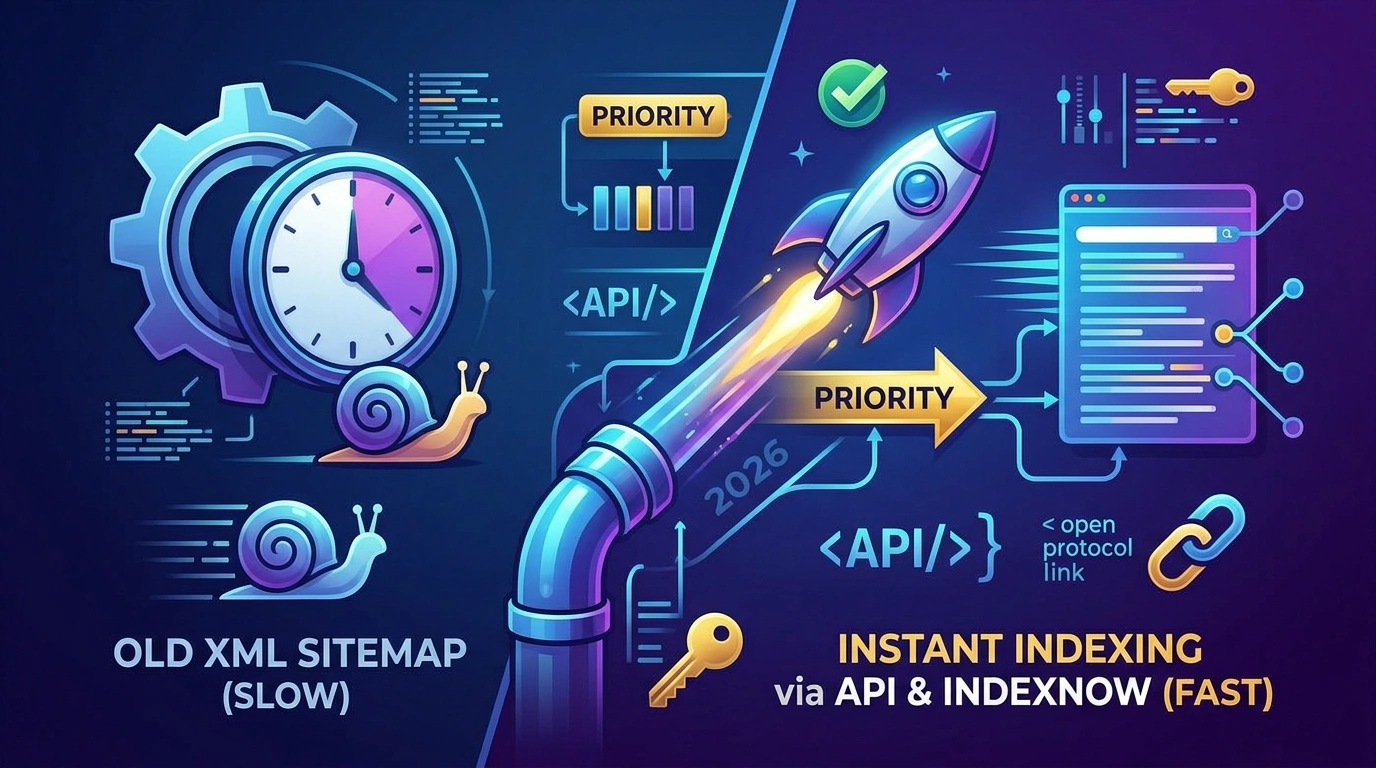
The traditional SEO model of publishing a post and passively waiting weeks for Googlebot to crawl your XML sitemap is dead. In the fast-paced 2026 digital landscape, search engines are allocating their crawl budgets more strictly than ever. For freelance developers and SEO consultants, this shift presents a highly lucrative opportunity: businesses are actively seeking technical specialists who can guarantee their new products, news, and generative AI content are indexed and ranking within hours, not weeks.
By mastering programmatic indexing protocols like the Google Indexing API and IndexNow, you can transition from selling standard “SEO optimization” to offering high-ticket “Instant Indexing Infrastructures.” This guide breaks down exactly how to implement these protocols for your clients, the technical nuances to navigate, and how to monetize this highly demanded skill.
How Do You Achieve Instant SEO Indexing in 2026?
To instantly index website content in 2026, webmasters must bypass passive XML sitemap crawling by programmatically pushing URL updates directly to search engines. For Google, this involves utilizing the Google Cloud Indexing API via a verified Service Account to trigger immediate crawls. For Microsoft Bing, Yahoo, and Yandex, implement the IndexNow protocol by hosting a verification .txt key at the server root and sending HTTP POST requests to automatically notify participating engines of new or updated content.
The Google Indexing API: Pushing Content to the Top
The Google Indexing API allows site owners to directly notify Google’s servers the exact moment a page is added, updated, or removed. Rather than waiting for a scheduled crawl, this API places your URLs in a high-priority queue.
Official vs. Unofficial Capabilities
According to official Google Search Central documentation, the Indexing API is strictly intended for pages containing JobPosting or BroadcastEvent structured data. For sites with highly volatile inventory (like daily job boards or livestream schedules), it keeps search results fresh by pushing updates individually.
However, technical SEO communities have long documented that implementing the API across standard eCommerce products and news articles frequently triggers successful, rapid indexing. While doing this operates in a gray area of Google’s official guidelines, the underlying mechanics remain the same.
Step-by-Step Implementation Framework
- Google Cloud Provisioning: Create a new project within the Google Cloud Console and enable the “Web Search Indexing API.”
- Service Account Creation: Generate a new Service Account and download the JSON key file. This file contains the cryptographic keys your script (or WordPress plugin) needs to authenticate.
- Search Console Authentication: This is the step most beginners miss. You must add the Service Account’s email address as an Owner in the Google Search Console property of the target domain.
- Sending the Payload: Using Node.js, Python, or a CMS plugin, send a POST request to
[https://indexing.googleapis.com/v3/urlNotifications:publish](https://indexing.googleapis.com/v3/urlNotifications:publish)with the target URL and theURL_UPDATEDorURL_DELETEDtype.
Quota Limitations: Google provisions a strict default limit of 200 API calls per day per project. For enterprise clients, you must request quota increases directly through the Cloud Console.
IndexNow: The Open-Source Future of Crawling
While Google maintains its proprietary API, the rest of the search landscape has unified under IndexNow. Supported by Microsoft Bing, Yandex, Seznam.cz, Naver, and Yep, IndexNow is an open-source ping protocol.
The defining advantage of IndexNow is its co-sharing mechanism. Search engines adopting the protocol agree to automatically share submitted URLs with all other participating search engines. You ping one; you update them all.
Implementing the IndexNow Protocol
Setting up IndexNow is significantly lighter than Google’s API, making it an easy “quick win” to offer clients:
- Key Generation: Generate an API key (a minimum of 8 and a maximum of 128 hexadecimal characters).
- Server Root Verification: Host a UTF-8 encoded text file named
{your-key}.txtat the root directory of the client’s website (e.g.,[https://www.example.com/3f2fa233444b4e87a5c40277499c4be4.txt](https://www.example.com/3f2fa233444b4e87a5c40277499c4be4.txt)). The file must contain the exact key string inside. - Triggering the Ping: To submit a single URL, you can fire a simple HTTP GET request.
- Example:
[https://www.bing.com/indexnow?url=https://www.example.com/product-page&key=your-key](https://www.bing.com/indexnow?url=https://www.example.com/product-page&key=your-key)
- Example:
- Batch Submissions: For bulk updates, you can submit up to 10,000 URLs per POST request using a JSON payload containing the
host,key, and anurlListarray.
Actionable Next Steps: Monetizing Your Indexing Skills
Do not sell “Google Indexing API setup” as an hourly task. Package this as a high-value technical infrastructure upgrade.
- The “Instant Index” Audit ($250 – $500): Audit a client’s current indexation ratio (pages published vs. pages indexed in Google Search Console).
- The Technical Implementation ($500 – $1,200): Set up the Google Cloud project, configure the Service Account, generate the IndexNow key, place it on their server, and configure their CMS (via custom PHP or headless architecture) to trigger pings on publish.
- The Retainer ($150/mo): Monitor API error logs, manage the 200-URL daily quota limitations, and maintain the JSON key security.
Frequently Asked Questions (FAQ)
Can I use the Google Indexing API for any type of website?
Officially, Google states the API is only for JobPosting and BroadcastEvent data. Any attempt to abuse the API to spam the index could result in your access being revoked. However, many technical SEOs successfully use it for standard pages, provided the content is high quality and not manipulative.
Do I still need XML sitemaps if I use IndexNow and the Indexing API?
Yes. Both Google and the IndexNow consortium explicitly state that APIs are meant to supplement, not replace, traditional sitemaps. The APIs handle rapid updates for volatile content, while XML sitemaps provide a comprehensive map for the complete structural coverage of your site.
How do I know if my IndexNow ping was successful?
A successful HTTP GET or POST request to the IndexNow endpoint will return an HTTP 200 response code. This confirms the search engine has received the URL, though it does not guarantee immediate inclusion in search engine results pages (SERPs).
Discover more from Remote Work Tips
Subscribe to get the latest posts sent to your email.
careers
The Sovereign Developer: The 5 Most Lucrative Coding Jobs in 2026 (And Why They Pay So Well)

For the past three years, the prevailing tech narrative has been dominated by a singular, slightly hysterical prediction: AI is going to automate software engineering. We were told that generative models would render the human coder obsolete, turning computer science degrees into expensive paperweights.
Welcome to 2026. The reality, as always, is far more nuanced—and significantly more lucrative for those who understood the shift.
It is true that the era of the “syntax translator”—the junior developer who takes highly specified Jira tickets and converts them into standard boilerplate—is fading. In fact, the Bureau of Labor Statistics explicitly projects a 6% decline in traditional “computer programmer” roles by 2034, noting that AI is successfully automating repetitive tasks.
But here is the twist: while programmers are declining, demand for software developers, architects, and quality engineers is surging by 15%, representing roughly 129,200 new openings per year. When AI writes the boilerplate, the human premium shifts away from writing code and toward orchestrating systems, designing architecture, and securing infrastructure.
The highest paying coding jobs in 2026 don’t belong to people who just write code; they belong to the “Sovereign Developers.” These are the engineers who understand how to deploy large language models in production, secure decentralized networks, and build internal platforms that multiply the productivity of entire organizations.
If you want to understand where the real money is in tech today, you have to look at the intersection of capital, complexity, and scale. Let’s dive into the data.
The Methodology: Tracking 2026 Tech Compensation
To identify the most lucrative coding jobs this year, we cannot rely on outdated, pre-AI salary surveys. The market has reorganized itself too quickly.
For this analysis, we synthesized real-time 2026 signed-offer data, crossing quantitative databases with qualitative hiring trends. Our primary sources include:
- Levels.fyi and Glassdoor for self-reported, equity-inclusive total compensation (TC) in Tier 1 and Tier 2 tech hubs.
- KORE1’s 2026 AI Salary Guide for production-grade machine learning compensation.
- Kube Careers Q1 2026 / State of Platform Engineering for the shifting economics of DevOps.
- Robert Half and InterviewPal for baseline corporate architecture ranges.
- BEON.tech’s 2026 Engineering Report for global and nearshore market benchmarking.
A note on compensation: We are focusing on “Total Compensation” (Base Salary + Bonus + Equity/RSUs). While base salaries often hit a ceiling around $250,000, equity is what pushes these roles into the half-million-dollar stratosphere.
Here are the top five most lucrative coding careers in 2026, the economic drivers behind them, and what it takes to break in.
1. AI Infrastructure Engineer (The Model Plumber)
We have officially moved past the “magic trick” phase of Artificial Intelligence. In 2023 and 2024, companies hired researchers to build prototypes. In 2026, companies are hiring AI Infrastructure Engineers to make those prototypes run at scale without bankrupting the company on cloud compute costs.
Why Demand is Exploding
According to Coursera’s 2026 AI Pay Guide, the hype has matured into operational reality. An AI Infrastructure Engineer (or MLOps Engineer) doesn’t necessarily invent new neural network architectures. Instead, they build the pipes. They figure out how to serve a 70-billion parameter open-source model to two million daily active users with sub-100 millisecond latency. They manage GPU clustering, optimize inference engines, and implement RAG (Retrieval-Augmented Generation) pipelines.
Because compute is the most expensive line item on a modern tech company’s P&L, an engineer who can optimize a model’s efficiency by 15% can save a corporation millions of dollars a month. That leverage commands an astronomical premium.
The 2026 Salary Range
- Mid-Level (3-5 years): $170,000 – $260,000 Total Comp
- Senior (6-9 years): $220,000 – $350,000+ Total Comp
- Staff / Principal (10+ years): $350,000 – $600,000+ Total Comp
As KORE1’s recent signed-offer data reveals, inside FAANG (Facebook, Amazon, Apple, Netflix, Google) and premier AI startups like Anthropic and OpenAI, Staff-level AI engineers are routinely seeing total compensation north of $600,000. Even in non-tech hubs like Denver or remote U.S. roles, senior base salaries easily clear $200,000.
The Toolbelt
- Languages: Python, C++, Rust (for performance-critical bottlenecks).
- Frameworks/Tools: PyTorch, vLLM, TensorRT, Triton, LangChain.
- Infrastructure: Kubernetes, CUDA programming, Vector Databases (Pinecone, Weaviate).
2. Platform Engineer (The Evolution of DevOps)
If you are still calling yourself a DevOps Engineer, you might be leaving 20% of your potential salary on the table. The breakout role of the last two years has undeniably been the Platform Engineer.
Why Demand is Exploding
For years, “DevOps” was less of a role and more of a chaotic culture where software engineers were suddenly forced to manage their own cloud infrastructure, leading to massive burnout. Enter Platform Engineering.
Instead of fixing individual deployment pipelines, Platform Engineers build an “Internal Developer Platform” (IDP). They treat their fellow developers as their customers, building self-service portals where a software engineer can spin up a secure, compliant cloud environment with a single click.
Gartner accurately predicted that by 2026, 80% of large engineering organizations would have dedicated platform teams. Because a great platform engineer accelerates the output of every other developer in the company, their multiplier effect is massive.
The 2026 Salary Range
- Average Base Salary: $172,038
- Senior Total Comp: $220,000 – $290,000
- The “Platform Premium”: According to Q1 2026 data from Kube Careers, Platform Engineers earn an average of 20% to 27% more than traditional DevOps engineers ($172K vs. $143K), simply because the role requires a broader, product-oriented mindset.
The Toolbelt
- Languages: Go, Python, TypeScript.
- Frameworks/Tools: Backstage (Spotify’s IDP framework), Crossplane, ArgoCD.
- Infrastructure: Kubernetes (absolute mastery required), Terraform, advanced CI/CD.
3. Data Architect (The Moat Builder)
In the age of ubiquitous AI, the algorithms are largely commoditized. Everyone has access to the same foundational models from OpenAI, Google, or Meta. Therefore, a company’s only remaining competitive moat is its proprietary, internal data. If your data is messy, your AI is useless.
Why Demand is Exploding
The Data Architect is the visionary who structures how an organization collects, governs, and utilizes petabytes of information. They are moving away from clunky, centralized data warehouses and toward modern “Data Mesh” architectures—treating data as a decentralized product.
As noted by InterviewPal’s 2026 Benchmarks, competencies in real-time data streaming and multi-cloud architectures add 15% to 25% salary premiums to an offer. You aren’t just writing SQL; you are designing the nervous system of the enterprise.
The 2026 Salary Range
- Median Total Comp: $203,250
- Top 10% (Senior/Enterprise): $400,000+ Total Comp
- Geographic Arbitrage: Remote Data Architects living in tier-2 cities are frequently securing San Francisco-level base salaries ($180,000 – $280,000) because the talent pool capable of bridging data engineering and machine learning workflows is incredibly shallow.
The Toolbelt
- Languages: SQL (advanced), Python, Scala.
- Frameworks/Tools: Apache Kafka, Flink, Spark, dbt (Data Build Tool).
- Infrastructure: Snowflake, Databricks, AWS Redshift/GCP BigQuery.
4. Cybersecurity Architect / Security Engineer (The Shield)
As code generation tools allow developers to ship software faster than ever, the surface area for cyber attacks has expanded exponentially. Furthermore, AI agents are now being weaponized by threat actors to find zero-day vulnerabilities at machine speed.
Why Demand is Exploding
The Cybersecurity Architect is no longer just the “department of no.” They are fundamental to business continuity. These professionals design “Zero Trust” networks and secure the sprawling, complex cloud environments deployed by the engineers mentioned above.
A 2026 Unihackers Salary Guide highlights that there are still millions of unfilled cybersecurity positions globally. The shift toward securing LLM supply chains (ensuring AI models aren’t poisoned with malicious training data) has created a hyper-niche, hyper-lucrative subfield. When the alternative is a $50 million ransomware payout and a destroyed reputation, companies do not bargain hunt for security architects.
The 2026 Salary Range
- Security Engineer (Mid): $150,000 – $247,000 Base
- Cloud Security Architect: $170,000 – $220,000 Base
- CISO (Chief Information Security Officer): $220,000 – $420,000+ Base (Total comp routinely exceeds $500K in enterprise).
The Toolbelt
- Languages: Python, Go, C (for reverse engineering).
- Frameworks/Tools: Cloud Security Posture Management (CSPM), SIEM tools, Identity and Access Management (IAM).
- Methodologies: Zero Trust Architecture, DevSecOps, Penetration Testing, AI Threat Modeling.
5. Cloud/Distributed Systems Architect (The Orchestrator)
While “Cloud Architect” might sound like a legacy title from 2018, the 2026 version of this role is practically unrecognizable. It is no longer about migrating on-premise servers to AWS. It is about managing terrifying levels of distributed complexity.
Why Demand is Exploding
Companies are now running “multi-cloud” strategies to avoid vendor lock-in, while simultaneously pushing compute to the “edge” (closer to the user) to support real-time AI features. The Cloud Architect designs systems that can survive entire regional data center outages without the user ever noticing.
According to Robert Half’s 2026 Tech Salary Data, cloud architecture remains foundational. They must balance high availability with ruthless cost optimization. A great Distributed Systems Architect pays for their own salary in their first month just by optimizing cloud egress fees and compute instances.
The 2026 Salary Range
- Mid-Level Base: $135,000 – $170,000
- High/Senior Base: $162,750 – $200,000+
- Total Comp: Frequently crosses $250,000 to $300,000 when factoring in equity at major tech firms and tier-1 consultancies.
The Toolbelt
- Languages: Java, Go, Rust.
- Frameworks/Tools: HashiCorp Stack (Terraform, Consul, Vault), gRPC.
- Infrastructure: Deep, native expertise in AWS, GCP, or Azure; Distributed consensus algorithms (Raft/Paxos).
2026 Coding Jobs Landscape: A Comparative View
| Role | Median Total Comp (US) | Primary Economic Driver | Barrier to Entry | Career Velocity |
| AI Infrastructure | $250,000+ | AI scale & compute optimization | Very High | Explosive |
| Platform Engineer | $210,000+ | Org-wide developer productivity | High | High |
| Data Architect | $203,000+ | Proprietary data as a business moat | High | Steady / High |
| Cybersecurity Arch. | $210,000+ | Cloud expansion & AI threat vectors | High (Requires high trust) | High |
| Cloud Architect | $190,000+ | Multi-cloud complexity & cost control | Medium / High | Steady |
(Note: Data aggregated from Levels.fyi, Kube Careers, and KORE1 Q1 2026 reports. Figures represent estimated medians for senior-level talent including equity).
How to Break In: Advice for Ambitious Tech Professionals
If you are looking at these numbers and wondering how to pivot your career, the advice for 2026 is fundamentally different than it was a decade ago. You cannot just “learn to code” in a vacuum anymore. You must learn to architect.
Here is how you upskill into these premium tiers:
1. Shift from “Syntax” to “Systems Thinking”
Stop defining yourself by the programming language you use. Being a “React Developer” or a “Java Developer” is a vulnerable position in an era of AI code generation. Instead, become an expert in the systems those languages run on. Understand networking, memory management, distributed databases, and cloud economics. AI is great at writing a discrete function; it is currently terrible at designing a resilient, SOC2-compliant microservices architecture.
2. Learn the Language of the Business
The highest-paid engineers don’t talk about code; they talk about leverage. A Platform Engineer commands $200,000 because they can say: “My internal portal reduced developer onboarding time from 3 weeks to 3 hours, saving the company $1.2M annually.” Learn to translate your technical implementations into P&L (Profit & Loss) impact.
3. Embrace the Open Source AI Ecosystem
You do not need a Ph.D. in mathematics to work in AI today. You need to understand implementation. Spend your weekends fine-tuning open-source models (like LLaMA 3 or Mistral) on your own data. Learn how to use vector databases. The gap between “traditional software engineer” and “AI engineer” is bridged by understanding the modern MLOps stack.
4. Master Cloud Economics (FinOps)
In the era of zero-interest rate phenomena (ZIRP), companies didn’t care about cloud bills. In 2026, efficiency is everything. If you can walk into an interview and demonstrate how your architectural decisions reduced AWS spend by 30% while improving performance, you write your own ticket.
The Broad View: Code as Capital
The panic surrounding the death of the software engineer was misplaced. What died was the commoditized coder.
As we look at the landscape of 2026, it is clear that programming is no longer viewed as a blue-collar digital trade. It has evolved into high-stakes capital allocation. When you deploy code today, you are deploying the autonomous agents, data pipelines, and security protocols that constitute the actual metabolic system of the modern corporation.
The roles that command a quarter-million dollars or more are those that require intense human judgment, strategic foresight, and an understanding of complex, interlocking systems. The AI will write the lines. But it is the Sovereign Developer who will build the world.
Frequently Asked Questions (FAQ)
Q: Will AI eventually automate these high-paying architecture jobs too?
A: Eventually is a long time, but architecture requires understanding ambiguous business requirements, navigating corporate politics, and balancing competing trade-offs (e.g., cost vs. latency vs. security). Current AI excels at deterministic tasks with clear boundaries, not ambiguous, high-stakes system design.
Q: Do I need a degree to get these jobs in 2026?
A: According to the BLS, a bachelor’s degree remains the standard entry point. However, in disciplines like Platform Engineering and Cloud Architecture, undeniable proof of work (open-source contributions, massive system design experience, top-tier certifications like AWS Solutions Architect Professional or Kubernetes CKA) routinely supersedes formal education requirements.
Q: What is the highest paying coding job without a management title?
A: Staff and Principal AI/ML Infrastructure Engineers. These are “Individual Contributor” (IC) roles that do not manage people, yet they frequently out-earn mid-level engineering managers and directors, easily pulling $400K+ in total compensation at top-tier tech firms.
Q: I’m a mid-level Full-Stack Developer. What is my fastest path to a $200K+ role?
A: The most logical lateral move is into Platform Engineering or Cloud Architecture. Your frontend/backend experience gives you empathy for the developers you will be building tools for. Upskill heavily in Kubernetes, Go, and Infrastructure as Code (Terraform), and reposition your resume around “developer experience” and “system reliability.”
Discover more from Remote Work Tips
Subscribe to get the latest posts sent to your email.


How to Calculate Your Freelance Day Rate (& Raise It Without Losing Clients)
Setting your freelance day rate is one of the most critical commercial decisions you will make. Set it too low,...


Optimizing for AI Overviews: The Freelancer’s Guide to Schema Markup & Generative Engine Optimization (GEO)
Traditional search engine optimization is undergoing a seismic shift. As Google AI Overviews, Perplexity, and SearchGPT handle millions of daily...


Top 6 Payment Solutions for Freelancers Faster Than Banks
Midway through a project in Milan, a freelance UX designer named Elena watched her rent payment bounce. The client’s bank...


10 Freelancing Tips for Landing Projects in the AI Era
The Market Split No One Warned You About In February 2026, a mid-career graphic designer in Austin posted to a...


The Sovereign Developer: The 5 Most Lucrative Coding Jobs in 2026 (And Why They Pay So Well)
For the past three years, the prevailing tech narrative has been dominated by a singular, slightly hysterical prediction: AI is...


Top 10 Most Demanded Freelance Skills in 2026
The Trillion-Dollar Talent Shift Nobody Is Talking About Honestly There is a number that should stop every career-minded professional in...


Fiverr Denies ‘Major Security Lapse’ Despite Private User Data Appearing in Google Search
Imagine logging into Google on a Tuesday morning to check your own name — a routine vanity search, the kind...


4 Must-Have Skills Every Nomadic Founder Needs to Build a Successful Online Business
Want to work from anywhere? I know this because I’ve been on both sides of that line. From Trucking Routes...
-

 blogging5 years ago
How to Use Social Media to Promote Your Blog
-

 freelance5 years ago
6 Future-Focused Skills Freelance Creatives Can’t Afford to Ignore
-

 social media5 years ago
How to Learn Social Media Without Getting Scammed
-

 freelance9 months ago
The Economics of Remote Work: How Hybrid Models Are Reshaping Global Productivity
-

 blogging5 years ago
20 Best Freelance Marketplaces for Freelancers in 2022 to Make Money
-

 freelance5 years ago
7 Highest Paying Freelance Jobs For Earning A Steady Income
-

 Digital Banking5 years ago
Pakistan Consumer Confidence Index increased by 8.8% in Q4 2021
-

 blogging5 years ago
30 “Proven” Ways to Make Money Online Blogging with WordPress