
blogging
Top Design Skills 2026: Blueprint for Product Architecture


The era of the purely cosmetic digital product designer is officially over. In the opening quarters of 2026, design executives at major technology enterprises realized a sobering truth: generative systems can now convert raw product requirements into production-ready Figma mockups in under 90 seconds. The traditional premium placed on layout execution, color theory application, and button state definition has collapsed. Elite design is no longer measured by the speed of pixel output, but by the ability to orchestrate complex semantic systems, manage intense user cognitive load, and translate multi-layered corporate strategies into flawless digital architecture.
The macroeconomic shift reshaping the creative workforce is stark. According to the McKinsey Global Institute Tech Trends 2026 Index, automated system generation reduced tactical design execution timelines across the technology sector by 42% over the last 24 months. Organizations no longer hire designers to build interfaces; they hire them to govern the algorithmic engines that generate those interfaces.
This transformation requires an immediate pivot in individual capabilities. The line separating engineering, data analysis, and product strategy has blurred permanently. To maintain career defensibility, contemporary digital builders must master a sophisticated triad of systemic thinking, computational literacy, and behavioral psychology.
1: The Core Development
To secure a competitive edge in this automated marketplace, professionals must consciously cultivate the top design skills 2026 environments actively demand. The most urgent of these is systemic design governance. As product ecosystems scale dynamically through contextual generation, a product creator cannot hand-craft every potential screen state. Instead, they must construct and supervise the semantic frameworks, rule logic, and prompt parameters that dictate how software builds itself in real time.
[Design Input: Core Logic & Guardrails]
                 │
                 ▼
     [Generative Engine (AI)]
                 │
                 ▼
[Context-Aware Interface (Assembled on the fly)]
A mid-2025 assessment by the Nielsen Norman Group revealed that 68% of enterprise design systems now employ automated assembly layers. When a user interacts with an enterprise dashboard, the layout rearranges itself based on the individual’s past behavior, cognitive speed, and immediate intent.
The designer’s role shifts from static compositor to systems architect. They must understand how data objects map to user needs, ensuring that automated UI components retain structural integrity, accessibility compliance, and brand alignment across thousands of machine-generated variations.
Furthermore, this transformation elevates the necessity of deep technical literacy. A modern professional doesn’t need to write production React code, but they must possess a deep conceptual understanding of component lifecycles, API endpoints, and state management. When design artifacts are delivered directly into automated engineering pipelines, a lack of technical foresight introduces massive systemic friction. Creators must know how their systems break at scale, how network latency impacts the perceived user experience, and how structural constraints influence final code generation.
2: Analytical Layer
Beyond basic systemic governance, elite professionals are aggressively integrating machine collaboration directly into their daily routines. Optimizing AI design workflows is no longer an optional efficiency trick; it’s a foundational standard for creative productivity.
┌────────────────────────────────────────────────────────┐
│               The 2026 Copilot Workflow                │
├────────────────────────────────────────────────────────┤
│ 1. Structural Prompting (Designer sets semantic logic) │
│ 2. Rapid Variant Synthesis (AI generates 50 layouts)   │
│ 3. Heuristic Selection (Designer audits & refines)     │
└────────────────────────────────────────────────────────┘
The design cycle now initiates with structural prompting, moves rapidly through algorithmic variant synthesis, and concludes with human heuristic evaluation. The machine serves as a tireless intern, generating 50 layout variations for a multi-step checkout sequence in seconds. The human designer then steps in as the editor, selecting the optimal path based on brand strategy and deep user empathy.
What skills do product designers need in 2026?
In 2026, product designers must master systemic architecture, AI prompt governance, and advanced spatial computing. True excellence requires moving past cosmetic execution to focus on data literacy, cognitive load management across multimodal interfaces, and the ethical mitigation of algorithmic bias in context-aware software environments.
This workflow demands a massive psychological shift. Designers who previously spent days perfecting a single vector curve must learn to find fulfillment in curation, critique, and structural oversight. The value lies in the prompt logic, the guardrails, and the analytical capacity to identify why variation 34 performs better than variation 12.
3: Implications & Second-Order Effects
The downstream consequences of this shift hit corporate balance sheets directly. Organizations are overhauling how they measure design impact, abandoning soft metrics like “user delight” in favor of concrete design leadership metrics tied directly to revenue, retention, and processing efficiency.
Metric Category Traditional KPI 2026 Business Impact Standard Operational Efficiency Screen Delivery Speed Automated Component Reusability Ratio User Performance Time on Page Cognitive Friction Reduction & Completion Rate Business Alignment Aesthetic Alignment Conversion Elasticity via Dynamic UI
This focus on hard metrics requires a high degree of data literacy. Designers must comfortably navigate complex analytics platforms, interpret multivariate A/B test results, and formulate design hypotheses based on quantifiably verified user friction.
Consider the ongoing rollout of spatial and multimodal computing systems. As platforms like the Apple Vision Pro and advanced automotive heads-up displays become mainstream, interfaces are shifting from flat glass surfaces to three-dimensional environments. The interaction model is no longer just tap-and-scroll; it’s a fluid blend of eye tracking, voice commands, and spatial gestures.
          [Voice Input]
                │
                ├───► [Multimodal Orchestration Engine] ───► [Dynamic UX Output]
                │
         [Gesture Tracking]
Managing user attention across these distributed touchpoints is extraordinarily difficult. Without rigorous cognitive load management, these immersive environments quickly become chaotic and overwhelming. The modern designer must carefully budget a user’s limited mental processing power, determining exactly when to use an audio cue, when to deploy a minimal spatial visual, and when to remain completely silent.
4: Competing Perspectives
Still, a vocal contingent of veteran design leaders warns that over-indexing on automation, technical architecture, and data analytics introduces severe product vulnerabilities. On March 14, 2026, during his keynote at the International Design Congress in Zurich, veteran product strategist Marcus Vance argued that an uncritical reliance on data-driven optimization loops creates a compounding “blandness epidemic.”
“When every corporate design team optimizes for identical conversion metrics using identical generative models,” Vance observed, “our software products begin to look like a single, indistinguishable corporate template. We are systematically engineering out the human friction, the delightful asymmetry, and the unpredictable emotional resonance that transforms a functional utility into a beloved cultural artifact.”
This perspective holds significant merit. Purely algorithmic optimization inevitably gravitates toward local maxima—safe, highly predictable layouts that convert efficiently but fail to inspire long-term brand loyalty.
The top tier of the profession must balance these competing forces. They must treat machine learning systems and analytical data as raw operational inputs, while maintaining the creative courage to execute unexpected, intuition-led design choices that metrics alone can never validate.
Closing
The current transformation within digital product design isn’t a slow evolution; it’s a fundamental structural break from past paradigms. The professionals thriving in this new environment are those who have successfully re-imagined themselves as product architects rather than visual layout artists. By merging deep systemic thinking with automated execution strategies, they ensure their work remains deeply defensible against machine replacement.
Ultimately, technology will continue to commoditize execution, lowering the barrier to entry for basic visual creation down to zero. The future belongs entirely to the strategic thinkers who understand how to harness that massive computational power to build software that is deeply humane, highly efficient, and structurally brilliant.
The true art of contemporary design no longer lives within the pixel itself, but deep within the logic that dictates how those pixels come to life.
Discover more from Remote Work Tips
Subscribe to get the latest posts sent to your email.



In October 2025, a quiet structural shift swept through mid-tier Madison Avenue advertising agencies. Faced with stubborn capital costs and institutional directives to optimize balance sheets, Fortune 500 brands quietly terminated long-term agency retainers worth millions. These legacy arrangements did not disappear; they fragmented. The modern corporate enterprise no longer seeks a multi-million-dollar agency suite to manage its digital presence; instead, it hunts for targeted, unbundled expertise. This structural realignment has transformed corporate marketing from an overhead liability into an on-demand network of elite, independent practitioners who operate far outside the traditional corporate framework.
The macroeconomic forces driving this migration are structural rather than cyclical. According to data compiled in the Gartner Marketing Spend Report, overall enterprise corporate marketing allocations contracted to 7.7% of total revenue, down significantly from pre-pandemic highs of over 10%. Concurrently, operational complexities have multiplied. The rapid emergence of generative search engines, predictive data frameworks, and complex privacy compliance measures has left generic in-house marketing teams flat-footed. Hiring full-time executive talent requires significant overhead, equity allocations, and lengthy onboarding cycles that modern enterprises simply cannot afford. A recent market analysis by Upwork Institutional Research indicated that 64% of corporate hiring managers plan to plug these critical capability gaps by hiring specialized, elite independent contractors over the next 18 months. Consequently, corporate capital is shifting rapidly away from generalized full-time roles toward specialized independent professionals.
1 — The Core Development
To build a sustainable income as an independent contractor, professionals must look beyond execution and focus entirely on high-impact specialization. The highest-paying digital marketing jobs for freelancers are no longer found in baseline copywriting or basic social media scheduling; those commoditized tasks have been largely absorbed by automated software pipelines. Instead, today’s marketplace rewards independent professionals who can architect systems, recover decaying organic search visibility, and directly influence pipeline revenue.
The first critical role commanding premium fees is the Fractional Chief Marketing Officer (Fractional CMO). Mid-sized enterprises earning between $10 million and $100 million annually frequently find themselves in a strategic dead zone: they need executive-level marketing leadership but lack the $300,000 annual budget required to secure a top-tier full-time CMO. The independent growth strategist steps into this vacuum, selling fractional leadership across three or four concurrent clients. On January 12, 2026, data from premium consulting registries showed that experienced fractional leaders routinely command retainers ranging from $5,000 to $12,000 per month per client, focusing exclusively on unit economics, channel diversification, and team restructuring.
The second elite domain is the Technical SEO Architect. As search engines move away from simple keyword matching toward semantic entity recognition, legacy search engine optimization practices have crumbled. Companies are watching their organic search footprints erode due to complex algorithmic core rollouts. An enterprise Technical SEO Architect operates more like a software engineer than a traditional marketer. They audit JavaScript rendering pipelines, configure structured data graphs, and optimize server-side delivery to ensure absolute search engine visibility. According to an industry study by HubSpot Enterprise Trends, organizations that invest in advanced entity-based data modeling experience a 42% faster recovery from search algorithm penalties than those relying on legacy keyword optimization. For a skilled professional operating in this niche, a single comprehensive architectural audit can easily command $15,000, with ongoing monitoring retainers clearing $6,000 monthly.
2 — Analytical Layer
Moving further down the operational funnel reveals more high paying freelance marketing roles that insulate independent contractors from market volatility. These positions succeed because they are directly tied to financial conversion and technological integration. The modern corporate buyer is deeply risk-averse; they refuse to pay for creative vanity projects, but they will eagerly write five-figure checks to an independent practitioner who treats marketing as an optimization problem.
The third position is the Conversion Rate Optimization (CRO) & User Behavior Analyst. Driving traffic to a digital property is meaningless if the traffic fails to convert into revenue. A CRO specialist combines data science, behavioral psychology, and rigorous A/B testing frameworks to extract maximum value from existing user footprints. They analyze session recordings, isolate checkout friction points, and re-engineer user paths. This role is highly insulated from budget cuts because its return on investment is immediately visible on a company’s balance sheet; if a specialist lifts a platform’s conversion rate from 1.8% to 2.4%, they instantly create millions of dollars in net new revenue without increasing the client’s advertising spend.
What are the highest-paying digital marketing jobs for freelancers?
The highest-paying digital marketing jobs for freelancers are fractional CMO leadership, technical SEO architecture, conversion rate optimization (CRO), marketing automation engineering, and performance marketing direction. These elite, remote marketing contracts command premium rates because they directly influence corporate revenue pipelines, optimize complex data infrastructure, and require advanced technical execution.
The fourth position is the Marketing Automation & Data Attribution Engineer. In an era dominated by privacy regulations like GDPR and the deprecation of third-party tracking cookies, corporate data collection has become severely fractured. Modern enterprises employ fragmented technology stacks, using separate tools for customer relationship management, email marketing, web analytics, and customer data management. The automation engineer acts as a systems architect, using tools like Zapier, Make, and custom APIs to synthesize these disconnected data feeds. They build multi-touch attribution models that trace a customer’s journey across dozens of digital touchpoints, proving exactly which marketing dollar drove the final purchase. A single system integration contract for an enterprise client can yield upwards of $25,000, creating an exceptionally stable baseline for independent data engineers.
3 — Implications & Second-Order Effects
The fifth high-paying independent role is the Paid Acquisition & Performance Marketing Director. Managing multi-million-dollar ad spends across platforms like Google, Meta, and programmatic ad exchanges requires deep analytical capability. Modern performance marketing is no longer about selecting interests or demographic toggles; it requires managing complex machine-learning bidding algorithms, structuring first-party data loops, and executing rapid creative testing pipelines.
The downstream consequences of this shift toward independent specialists are reshaping the broader business ecosystem. As elite talent decouples from traditional agency structures, corporations are building agile, modular marketing networks. Instead of paying an agency a flat 15% management fee on ad spend, enterprises retain an independent performance marketing director to oversee strategy, an independent CRO specialist to optimize the landing pages, and a technical SEO architect to protect organic visibility.
This decentralization alters corporate cost structures. Fixed marketing overhead is converted into variable project costs, increasing corporate financial resilience during economic shutdowns. A comprehensive study by the McKinsey Global Institute noted that companies utilizing agile talent models achieved a 22% reduction in operational execution costs alongside a 15% acceleration in speed-to-market for major campaigns. Still, this model creates an intensely bifurcated labor market. Generalist freelancers who refuse to specialize face severe downward pricing pressure, while the top five percent of technical and strategic independent contractors enjoy record-high billing rates.
4 — Competing Perspectives or Counterargument
The picture is more complicated than a simple migration toward freelance prosperity. Critics argue that the unbundled freelance model introduces severe hidden costs and operational vulnerabilities for both corporations and independent practitioners. Legacy agencies, despite their bloat, provide institutional continuity, centralized accountability, and deep resource redundancy. If an agency employee leaves, a replacement is inserted instantly without disrupting the client’s operational momentum.
When an enterprise relies on an independent contractor, it introduces key-person risk. If a freelance automation engineer suddenly becomes unavailable, the client’s data infrastructure can quickly become unmanageable. Furthermore, many independent professionals underestimate the operational friction of running a solo business. Data published by the Bureau of Labor Statistics indicates that independent professionals spend an average of 28% of their working hours on non-billable tasks, including lead generation, collections, and administrative overhead. This means that an attractive hourly contract rate of $150 can quickly degrade when accounting for unbilled operational hours and lack of employer-subsidized benefits. For many practitioners, the lack of a predictable income floor outweighs the theoretical autonomy of the independent market.
5 — The Technical Execution of High-Value Roles
To understand how these elite positions operate in practice, we must examine the specific technological frameworks they manage. The division between execution and architecture is best illustrated by breaking down the daily work products of these top five roles.
Role Primary Technology Stack Core Metric of Success Average Project Value Fractional CMO HubSpot, Salesforce, Tableau Customer Acquisition Cost (CAC) Efficiency $8,000 / month Technical SEO Architect Screaming Frog, Log File Analyzers, Next.js Organic Crawl Efficiency & Core Web Vitals $12,000 / project CRO Specialist Optimizely, Hotjar, Google Analytics 4 Average Order Value (AOV) & Conversion Lift $10,000 / project Automation Engineer Zapier, Make, Segment, SQL Attribution Data Accuracy $15,000 / architecture Performance Director Meta Ads Manager, Google Ads, Liveramp Return on Ad Spend (ROAS) $7,500 / month
The Mechanics of Fractional Leadership
The fractional CMO does not write social posts. They sit with the Chief Financial Officer to map out the marketing efficiency ratio. When an enterprise is burning capital on inefficient paid acquisition, the fractional leader steps in to reallocate budget toward organic channels or customer retention systems. They build the strategic roadmap that full-time junior staff members execute.
The Realities of Architectural SEO
A professional operating as a technical SEO architect looks at a website the way a structural engineer looks at a skyscraper. They isolate why search engine crawlers are wasting crawl budget on duplicate parameters. They build structured schema markup that directly feeds search engine knowledge graphs, ensuring the client’s brand is recognized as a verified entity rather than just a loose collection of keywords.
6 — Securing Premium Enterprise Contracts
Securing these premium remote marketing contracts requires a sophisticated business development methodology that completely avoids public freelance bidding marketplaces. High-earning independent practitioners build authoritative profiles through targeted publishing, technical case studies, and strategic networking with venture capital and private equity firms.
Private equity firms represent an exceptional source of high-paying freelance marketing roles. When a private equity firm acquires a portfolio of mid-market business-to-business software providers, they immediately seek to optimize marketing operations to accelerate enterprise value. They rarely want to hire permanent executive teams during the initial optimization phase. Instead, they deploy trusted independent technical architects and fractional growth specialists to audit the newly acquired companies, overhaul their data ecosystems, and install repeatable customer acquisition frameworks. A single relationship with a private equity operating partner can yield a predictable pipeline of enterprise-grade consulting contracts lasting for years.
What follows, however, is a steep learning curve for the independent professional. Managing an enterprise project requires a mastery of corporate politics, clear reporting mechanisms, and absolute clarity regarding data privacy. An independent contractor handling data integration must understand how server-side tracking complies with local privacy mandates. Those who master this intersection of technology and corporate compliance are insulated from the economic shifts that threaten generalist workers.
7 — The Transformation of the Creative Class
The structural displacement of generalist content creators has fundamentally changed the career trajectory for a modern freelance content strategist. Historically, an independent writer could build a comfortable business by churning out search-optimized articles. Today, automated language models produce baseline content for pennies. The independent professional must pivot from content production to semantic content architecture.
This means a content strategist can no longer just write; they must design thematic content hubs that demonstrate deep topical authority to automated search evaluators. They analyze search intent profiles, build comprehensive content calendars based on proprietary industry data, and construct internal link architectures that distribute search authority across commercial landing pages. They transform text from a simple creative output into an organic customer acquisition channel.
The picture is clear: the independent market no longer has room for the unspecialized intermediate. The market has broken into two distinct realities. At the bottom lies a race to the bottom, where commoditized workers compete against automated software platforms for dwindling fees. At the top sits an elite tier of independent consultants who command corporate fees because they solve structural problems that directly impact profitability.
The evolution of corporate marketing has permanently dismantled the traditional binary choice between agency employment and unspecialized gig work. The modern digital economy favors agile, highly specialized independent consultants who can step into an enterprise, solve a critical operational bottleneck, and depart without adding structural drag to the corporate balance sheet.
Success in this environment demands a continuous commitment to technical mastery, clear economic attribution, and a cold refusal to engage in commoditized work. The independent professionals who command the market are those who operate at the volatile intersection of code, capital, and consumer behavior. Ultimately, the future of marketing belongs to those who own their specialized infrastructure and can turn corporate chaos into quantifiable revenue.
Discover more from Remote Work Tips
Subscribe to get the latest posts sent to your email.

The launch of advanced large language models triggered a predictable collapse in the market for mediocre text. Content mills vanished, and freelance platforms saw rates for baseline SEO copy crater practically overnight. Yet, the death of the human writer was vastly overstated. What actually died was the commercial viability of regurgitation. For editors managing the desks at top-tier publications and corporate strategy units, the resulting flood of algorithmic prose has only clarified the value of what machines cannot execute. The market has rapidly bifurcated, placing an unprecedented premium on the specific freelance writing skills AI cannot replace.
The structural shift we are witnessing is not the end of commercial writing, but the automation of the consensus median. An algorithm trains on what has already been published, calculating the most probable next word to generate a perfectly average amalgamation of historical thought. According to global investment research from Goldman Sachs, generative AI could expose the equivalent of 300 million full-time jobs to automation, with administrative and mechanical text generation taking the heaviest initial hit.
Writing as the mere act of stringing grammatically correct sentences together is effectively a solved computational problem. Still, writing as an act of original synthesis and structural persuasion remains strictly human terrain. The economic value for independent writers no longer lies in producing the median. It lies in generating the alpha—the analytical edge that deviates from algorithmic predictability. Editors and brand directors are rapidly adjusting their budgets. They refuse to pay for competent summaries, instead directing capital toward investigative rigor, lived context, and the deliberate friction of human thought.
The Core Development: Moving Beyond Probability
To understand where freelance writers hold an insurmountable advantage, one must understand how generative models fail. AI operates on statistical probability, not truth, memory, or physical reality. It cannot pick up a phone, secure an off-the-record briefing, or read the nervous body language of a chief executive during an earnings call.
The first irreplaceable skill is primary source extraction. Algorithms summarize the internet; elite freelancers interview the people building it. The ability to identify the right human source, build sudden rapport, and extract a candid quote that has never been digitized is a moat AI cannot cross. The Reuters Institute for the Study of Journalism notes that original reporting and exclusive human sourcing remain the primary drivers of subscriber trust and retention.
Closely tied to this is strategic omission. Generative models are inherently additive. They default to comprehensiveness, listing every possible factor in a bulleted sequence because they lack the editorial confidence to leave things out. Human writers know that what you cut is as important as what you keep. Deciding to ignore three valid data points because they dilute the core narrative tension requires a discerning judgment that probability matrices do not possess.
That leads directly to subtextual analysis. AI reads text literally. It cannot read the room. Consider an editorial chief managing a digital finance publication in Sindh. When assigning a column on the latest IMF policy interventions or regional inflation metrics, they know an algorithm will merely summarize the official press release. It takes a human economist to read the deliberate silences within a central bank’s sterile prose, translating bureaucratic hesitation into a localized forecast on energy subsidies.
The Analytical Layer: Generating the Alpha
If the baseline of content is now perfectly competent and entirely unoriginal, the premium shifts to structural interpretation. This is where high-income freelancers transition from writers to analysts.
Why does AI fail at analytical writing? Generative models are designed to find the safest mathematical consensus within their training data. They average out competing viewpoints to avoid hallucinations or controversy. Analytical writing requires taking a definitive, original stance, relying on inductive reasoning and critical leaps that algorithms are explicitly programmed to avoid.
This introduces the fourth skill: counter-narrative generation. When the entire digital ecosystem is parroting the same trend, the valuable freelance writer constructs a well-defended contrarian thesis. If the market consensus is that a new technology will streamline logistics, the human analyst looks at the historical labor relations of the sector and predicts a union strike.
Fifth is institutional critique. Algorithms are heavily guardrailed by their parent companies to avoid offending governments, corporations, or protected groups. They struggle to formulate biting, structural criticisms of powerful entities. A human writer can identify systemic hypocrisy—for instance, tracking how a specific regulatory framework quietly benefits the very monopolies it claims to police.
Sixth is the mastery of asymmetric synthesis. AI is excellent at comparing two highly related concepts. It is remarkably poor at connecting two seemingly unrelated disciplines to form a new thesis. A human writer can draw a structural parallel between 19th-century maritime insurance law and modern cryptocurrency exchanges, creating a conceptual bridge that no algorithmic training data has previously linked.
Implications and Second-Order Effects: The Emotional Economy
The downstream consequences of the AI content flood are already visible in corporate marketing and digital publishing. As the volume of synthetic text approaches infinity, the cost of generating words falls to zero. Consequently, reader trust is plummeting. Businesses are discovering that while AI copy can fill a webpage instantly, it often fails to convert at the bottom of the funnel because it lacks edge, conviction, and emotional resonance.
This brings us to the seventh skill: emotional pacing. Algorithms write at a single, unrelenting cadence. They do not understand how to build intellectual suspense, when to deploy a fragmented sentence for blunt impact, or how to let a devastating statistic sit alone on a line to force the reader to pause. Human writers manipulate rhythm to control the reader’s breathing and emotional state.
Eighth is the application of irony and calculated irreverence. Sarcasm, wit, and irony require a shared understanding of cultural context and human absurdity. When AI attempts humor, it defaults to algorithmic puns or safe, sterile jokes. A human writer can deploy a dry, cynical observation about a failing tech startup that resonates perfectly with a frustrated audience.
Ninth is the capacity for ethical framing. Data does not exist in a vacuum. According to the Bank for International Settlements, while artificial intelligence can process macroeconomic data at unprecedented speeds, the interpretation of that data carries profound ethical implications. When writing about poverty metrics, job displacement, or public health, a human writer frames the statistics with an innate understanding of human suffering and dignity—something an algorithm can only pantomime.
The Counterargument: The Illusion of Algorithmic Context
Tech determinists argue this view is shortsighted. They suggest the limitations of current LLMs are temporary engineering problems, not permanent philosophical boundaries. Proponents of autonomous agents argue that the next generation of models will possess infinite contextual memory and the ability to execute multi-step research workflows independently.
According to researchers at MIT Technology Review, autonomous AI agents will soon be capable of scraping localized databases, monitoring real-time financial feeds, and generating localized analysis without human prompting. From this perspective, the idea that only humans can synthesize complex data or execute macroeconomic contextualisation is a romantic delusion. The machine, they argue, will eventually simulate empathy, irony, and analytical reasoning so flawlessly that the end consumer will neither notice nor care about the distinction.
Yet, this argument fundamentally misunderstands the economics of attention. Even if a machine perfectly simulates a controversial opinion, it remains a simulation. A machine cannot put its reputation on the line. The tenth and most critical skill is skin in the game. Readers value a bold piece of analysis because a human being risked their professional credibility to publish it. An algorithm cannot be brave, because an algorithm has nothing to lose. When a freelancer attaches their byline to a fierce institutional critique, the value stems entirely from the fact that a human mind took a verifiable risk.
The Enduring Premium on Human Friction
The paradox of the generative era is that the more flawless machine text we produce, the higher the market premium on verified human thought. The skills that will sustain high-income freelancers over the next decade have very little to do with typing speed, grammatical perfection, or baseline SEO optimization.
Those capabilities have been permanently commoditized. The future belongs to the editors, the economists, the investigative reporters, and the analysts who treat writing merely as the final delivery mechanism for their thinking. The algorithm can perfectly summarize what happened yesterday. The human writer’s job is to explain why it matters, who is lying about it, and what will inevitably break tomorrow.
Discover more from Remote Work Tips
Subscribe to get the latest posts sent to your email.
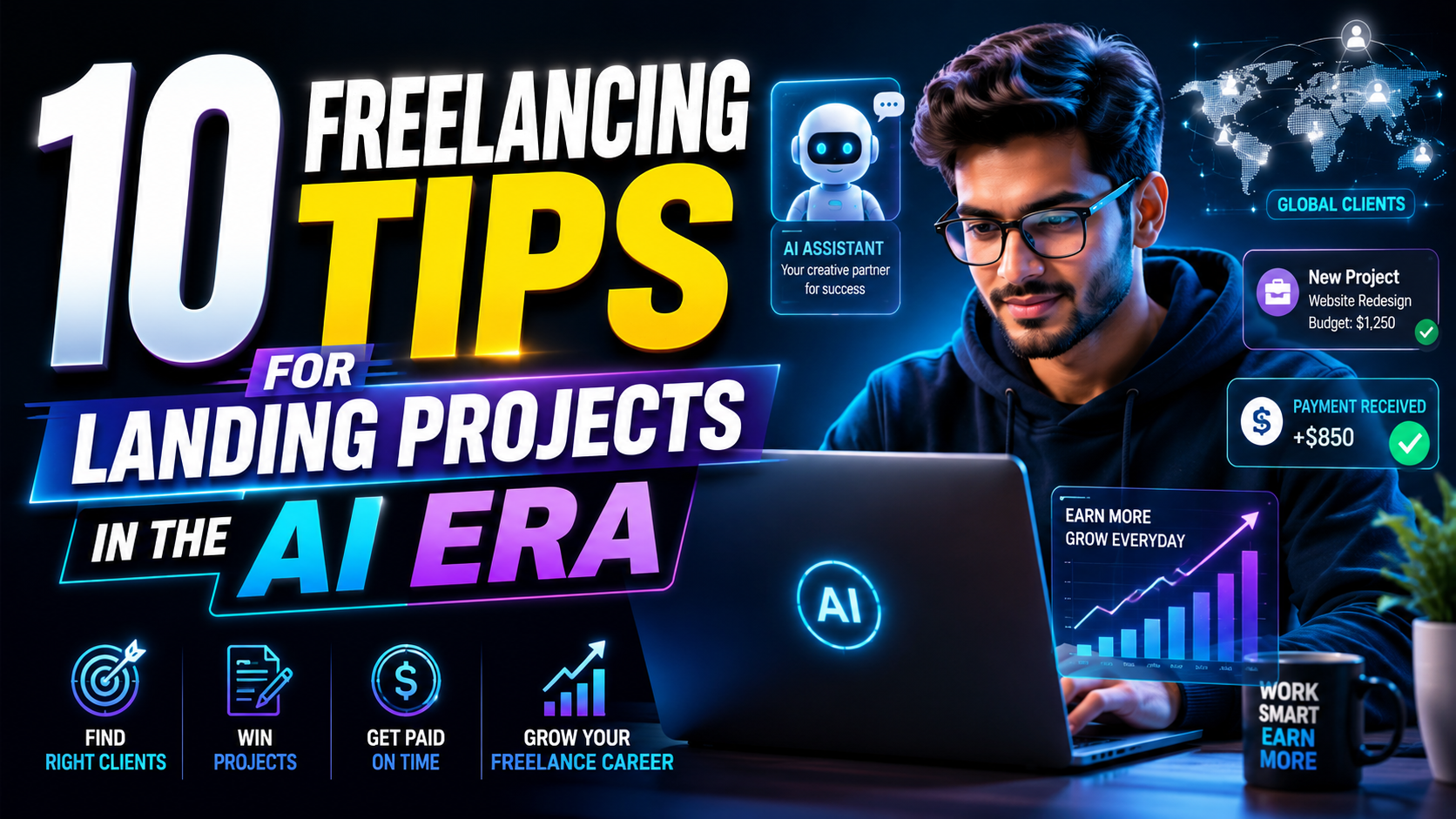
The Market Split No One Warned You About
In February 2026, a mid-career graphic designer in Austin posted to a freelance forum that her monthly income had collapsed from $8,400 to under $2,000 in 18 months. Three weeks later, a prompt engineer in the same city posted that she’d just closed her fourth $15,000 AI integration contract of the year. Same city. Same gig economy. Entirely different trajectories. That gap — between the freelancer being automated and the freelancer doing the automating — is the defining story of independent work right now. How you land on one side of that line isn’t a matter of luck or timing. It’s strategy, positioning, and a willingness to treat this disruption as a restructuring rather than a catastrophe.
The Landscape Has Changed Faster Than Most Freelancers Have
The numbers make the bifurcation unmistakable. A landmark study by researchers at Imperial College London, Harvard Business School, and the German Institute for Economic Research found that within eight months of ChatGPT’s launch, demand for freelance writing jobs fell roughly 30% — the steepest single-category decline they tracked. Software development dropped about 21%. Graphic design fell 17%. The Vollna Upwork Market Report confirmed that trend was accelerating into 2025. Mediabistro
Yet the same market is generating historically high rates at the specialist end. AI-related freelance skills on Upwork grew 109% year-over-year in 2025, with the platform reporting that demand for top AI skills more than doubled across completed job earnings. AI-specialised freelancers command 25–60% higher rates than general practitioners in the same field. HeroHuntJobbers
The US independent workforce already stands at approximately 72.9 million freelancers, with projections indicating that number could reach 86.5 million by 2027 — roughly half the national labor force. Volume is growing. But raw volume disguises a quality split that is becoming harder to straddle. Generic skills are being commoditised fast. Specialised, AI-augmented professionals are experiencing the opposite: a seller’s market, elevated rates, and a client base that can’t hire full-time talent fast enough to meet demand. Autofaceless
That context matters, because the ten strategies that follow aren’t motivational advice. They’re structural responses to a structural shift.
1 — The Core Moves: What You Must Do First
1. Pick a lane narrow enough to own
The first thing most freelancers get wrong in the AI era is staying general. Generalists now compete directly with tools that can perform broad, mid-quality tasks at near-zero marginal cost. The market is rewarding the opposite move — surgical specialisation in an area where the human layer is genuinely irreplaceable.
Clients prefer niche expertise in 68% of cases, and specialists earn 40% higher rates as a result. The question worth sitting with isn’t “what can I do?” It’s “what can I do that becomes harder, not easier, to replicate as AI improves?” The answer usually lies at the intersection of deep domain knowledge, interpersonal judgment, and execution fluency — qualities that take years to develop and don’t compress into a training dataset. Bestjobsearchapps
A UX researcher who specialises in healthcare patient workflows, an accountant who audits AI-generated financial models, a technical writer who documents enterprise ML systems — these aren’t fringe niches. They’re premium ones.
2. Build your portfolio around outcomes, not outputs
Clients in 2026 have become more risk-averse and more data-literate simultaneously. They’re not buying deliverables; they’re buying certainty of result. A portfolio that says “I wrote 50 blog posts” is being passed over for one that says “I built a content infrastructure that reduced a client’s lead acquisition cost by 34%.” Specificity is the currency. “Increased email conversion rates by 47%” lands harder than any description of your creative process.
According to Upwork research, 74% of executives now consider degrees irrelevant when hiring freelancers, focusing instead on proven expertise. In fact, 78% of CEOs assert that their top freelancers contribute more value than degree-holding employees. That signals a hiring culture built on demonstrable results, not credentials. Your portfolio should read like an evidence file. Upwork Inc.
3. Treat AI tools as a multiplier, not a shortcut
Upwork’s research found that 54% of freelancers report advanced AI proficiency compared to just 38% of full-time employees — a gap that clients are increasingly factoring into their decisions. Freelancers who deploy AI tools to deliver faster, more refined work aren’t undercutting themselves; they’re compressing timelines and expanding the scope of what they can credibly promise. The danger lies in using AI as a shortcut to mediocrity — offloading judgment rather than amplifying it. TechTarget
The freelancers winning right now are running AI as a co-pilot while keeping human oversight of quality, strategy, and client relationships. That combination produces deliverables that AI alone cannot match and that unaugmented humans cannot produce at the same speed.
4. Certify what you know — visibly
Prompt engineering certifications from DeepLearning.AI, machine learning specialisations on Coursera, AWS AI practitioner credentials — these are increasingly appearing as threshold requirements in high-value project postings. Prompt engineering has grown 240% since ChatGPT’s launch, AI content editing 180%, and AI tool training 165%, according to Upwork’s research. Credentials in these areas function less as proof of capability and more as filtering mechanisms: they’re a signal that you’ve committed seriously enough to a specialisation to formalise it. Jobbers
Visible certification also shortens the discovery-to-trust arc with new clients. A potential client who can verify your skills before the first call arrives with a materially different posture than one who’s reading your self-description for the first time.
2 — The Analytical Layer: Positioning and Visibility
What AI skills do freelancers need to land clients in 2026?
The answer isn’t a single skill set — it’s a layered combination. Freelancers who command the highest rates are those who can do something a business genuinely needs, then use AI to execute it faster and at higher quality. Specifically: prompt engineering within a defined domain, AI workflow automation using tools like Zapier, Make, and n8n, and the ability to fine-tune or critically evaluate AI outputs in context. Those three capabilities, paired with verifiable domain expertise, consistently produce rate premiums above $100 per hour.
5. Build in public — and be specific about what you’re doing
Thought leadership is among the most underused client-acquisition channels available to independent professionals. In 2026, 56% of freelancers acquire new work through professional and personal networks — a substantial jump from 30% in 2024. This shift is attributed to clients being more risk-averse and relying on trusted referrals, and to the saturation of freelance platforms. Accio
That number didn’t move by accident. It reflects a market in which clients have grown suspicious of cold platform pitches and are defaulting to referrals from people they already trust. The freelancer who publishes a detailed LinkedIn post walking through an AI workflow they built for a real client, or writes a case study explaining why a particular automation saved a client 12 hours a week, is compressing their sales cycle dramatically. Generic visibility doesn’t achieve this. Specific, documented competence does.
6. Position yourself as an AI translator, not just an AI user
Most businesses know they need to adopt AI. Very few know where to start, what tools integrate with their existing stack, or how to measure the return on investment. McKinsey research found that only 1% of companies have successfully scaled AI across their enterprises, leaving an enormous operational gap between executive ambition and ground-level implementation. Freelancers who can bridge that distance — explaining AI capabilities in business terms, scoping realistic projects, delivering measurable results — are filling a role that currently has more demand than supply. TechTarget
This position isn’t purely technical. It requires the kind of communicative and consultative fluency that no AI tool currently replicates. Senior AI consultants operating in this space are billing $150–$300 per hour for enterprise engagements that can run from $25,000 to $500,000 in total contract value.
7. Diversify across platforms while developing relationships that don’t need them
Platform concentration is a risk that experienced freelancers understand but newer ones underestimate. Fiverr recorded a 4% marketplace decline and a 10% drop in active buyers in 2025. Upwork’s active buyer numbers have shown volatility. Commission-free platforms — Contra, Braintrust, Jobbers — are gaining traction among experienced practitioners who want to retain a greater share of their earnings. The asymmetric move is to maintain a presence across multiple platforms while simultaneously building direct client relationships that aren’t mediated by any platform’s algorithm. Autofaceless
Direct relationships are slower to establish and more durable once formed. They’re also where the best work tends to live.
3 — Implications and Second-Order Effects
8. Price to your actual market position — not your anxiety
The structural economics here deserve honest attention. A February 2026 study from Ramp found that more than half of businesses that spent on freelance platforms in 2022 had stopped entirely by 2025. Freelance marketplace spending as a share of total company spend dropped from 0.66% to 0.14%. AI model spending went from zero to 2.85%. Mediabistro
For generalists, that’s alarming. For specialists, it clears the market of competition. There are now effectively two freelance economies running in parallel. One is a commodity market competing on price and speed, inhabited by volume-seeking generalists and increasingly by AI-generated deliverables. The other is a premium market competing on expertise, client trust, and measurable outcomes. Many capable freelancers are operating in the commodity market not because their skills belong there, but because their pricing and positioning haven’t caught up with the value they deliver.
Entry-level prompt engineers bill $50–$80 per hour; experienced ML developers command $100–$200; senior AI consultants clear $150–$300. Those ranges don’t apply universally, but they signal what the top of the market currently pays — and how far below it most qualified freelancers are operating. Jobbers
9. Convert one satisfied client into three
Over 99% of major employers plan to continue or increase their use of freelancers throughout 2025 and 2026. That’s not a statistic to file and forget — it’s a pipeline signal. The clients who already trust you are the fastest path to new, better-paying work, through expanded project scope, contract renewals, and direct referrals to peers in their networks. The freelancers compounding fastest right now aren’t the ones sending the highest volume of cold proposals; they’re the ones delivering so precisely that their clients become the most effective marketing channel they have. DemandSage
One concrete tactic: at project close, send a concise impact summary — three or four data points quantifying what you delivered. It gives the client the language to describe you to a colleague, it reinforces your value before the next budget conversation, and it signals the kind of professional rigour that separates a repeat contractor from a one-off vendor.
4 — The Counterargument Worth Taking Seriously
10. Don’t mistake positioning for pretending
There’s a dissenting view that deserves a fair hearing. Ethan Mollick, professor at the Wharton School of the University of Pennsylvania and a careful analyst of AI’s labour market effects, has argued that the apparent safety of many “AI-adjacent” roles may be shorter-lived than current enthusiasm suggests. The roles that seem like natural refuges today — AI trainer, prompt consultant, automation specialist — are themselves subject to capability improvement as models become more agentic. What looks like a moat at current AI capability levels may not hold at the next.
That framing matters because the advice to “specialise in AI” can tip from strategy into performance if it isn’t grounded in genuine skill development. A freelancer who markets themselves as an “AI integration specialist” after completing a handful of online courses is not the same as one who has deployed a working automation for a real client and can document the result. Upwork reported that AI-related freelance work crossed $300 million in annualized value by late 2025, but that total is concentrated among a relatively small pool of established practitioners. New entrants are competing for visibility against incumbents with verified track records, review histories, and client networks that platform algorithms actively favour. Mediabistro
There’s also a quieter concern: the freelancers most likely to thrive long-term aren’t necessarily those who’ve pivoted hardest toward AI, but those who’ve found the specific intersection where their existing expertise and AI fluency make them genuinely difficult to replace. The sustainable answer, then, is to specialise in something you’d want to know deeply even if it didn’t pay exceptionally well — because that depth is what survives the next wave of capability expansion, and the one after that.
The Gap Is Fixable
The freelance market in 2026 isn’t contracting. It’s bifurcating. On one side: a narrowing commodity tier where price competition is intensifying and AI tools are credible substitutes for many standard deliverables. On the other: an expanding, better-compensated tier of specialists who combine genuine domain knowledge, AI fluency, and client relationships that don’t reduce to a platform rating.
Landing consistently in that second tier requires a clear-eyed assessment of where your actual value lies — and the discipline to say no to work that pulls you in the wrong direction. The freelancers positioned to compound aren’t necessarily the ones who’ve adopted the most tools; they’re the ones who’ve used AI to execute their core work more precisely, made that execution visible, and built the kind of trust that converts a single contract into a multi-year working relationship.
The gap between the Austin designer and the Austin prompt engineer isn’t talent. It’s positioning. That, at least, is fixable.
Discover more from Remote Work Tips
Subscribe to get the latest posts sent to your email.


Best AI Tools for Freelancers in 2026: A Workflow-Based Guide
A freelancer should compare total workflow value, exportability, privacy and client consent before subscribing to multiple AI tools. Free trials...


Freelance Taxes and 1099 Forms in 2026: A Practical U.S. Recordkeeping Guide
Freelancers sometimes assume that income is not taxable unless a platform sends a 1099. The Internal Revenue Service explicitly says...


Modern Freelance Tools in 2026: How to Build an AI-Assisted Workflow That Clients Trust
An effective freelance tool stack should reduce mistakes and administration, not merely add more subscriptions. Modern workflows might combine an...


Freelance Careers in 2026: In-Demand Skills, Portfolio Proof and Getting First Clients
A sustainable freelance career starts with a demonstrable client problem, a transparent portfolio and a written project scope—not just a...


Freelancing in 2026: The Tools, Projects and Positioning That Win High-Ticket Clients
Freelancing has split into two markets. Commodity work is getting cheaper, while expert work is getting more valuable. The tools...


How to Calculate Your Freelance Day Rate (& Raise It Without Losing Clients)
Setting your freelance day rate is one of the most critical commercial decisions you will make. Set it too low,...


Optimizing for AI Overviews: The Freelancer’s Guide to Schema Markup & Generative Engine Optimization (GEO)
Traditional search engine optimization is undergoing a seismic shift. As Google AI Overviews, Perplexity, and SearchGPT handle millions of daily...


Top 6 Payment Solutions for Freelancers Faster Than Banks
Midway through a project in Milan, a freelance UX designer named Elena watched her rent payment bounce. The client’s bank...
-

 blogging5 years ago
How to Use Social Media to Promote Your Blog
-

 freelance5 years ago
6 Future-Focused Skills Freelance Creatives Can’t Afford to Ignore
-

 social media5 years ago
How to Learn Social Media Without Getting Scammed
-

 freelance11 months ago
The Economics of Remote Work: How Hybrid Models Are Reshaping Global Productivity
-

 blogging5 years ago
20 Best Freelance Marketplaces for Freelancers in 2022 to Make Money
-

 freelance5 years ago
7 Highest Paying Freelance Jobs For Earning A Steady Income
-

 Digital Banking5 years ago
Pakistan Consumer Confidence Index increased by 8.8% in Q4 2021
-

 freelance11 months ago
Best Alternatives to Fiverr and Upwork: 5 Best Freelance Marketplaces