
AI
Challenges to Freelancers in the Age of 5G and AI in 2026


The Morning the Rates Dropped
At 6:47 on a Tuesday morning in Bengaluru, Arjun Mehta refreshed his Upwork dashboard and felt the familiar tightening in his chest. The UX design brief he’d spent three hours crafting the night before had drawn eleven bids overnight — six of them from other humans, five from AI-augmented “studios” offering the same deliverable at 40 percent less. He lowered his rate. Then lowered it again. By the time he accepted the contract, his effective hourly had fallen to roughly what he’d charged in 2021.
Across the planet, variations of this scene play out in Nairobi, Warsaw, Manila, and São Paulo — millions of times a day. The freelance economy, which now encompasses an estimated 76.4 million workers in the United States alone and approaches 1.5 billion people globally, is being reshaped by two forces that arrived almost simultaneously: generative artificial intelligence capable of producing draft-quality creative and analytical work in seconds, and fifth-generation wireless networks that have effectively dissolved the friction once associated with remote collaboration. The result is not merely a technological upgrade. It is a structural reorganization of independent work — one that is simultaneously liberating and punishing, and that poses the most significant challenges to freelancers in the age of 5G and AI in 2026 that the gig economy has ever confronted.
The irony runs deep. The same infrastructure that allows a copywriter in Lagos to pitch a client in London without a dropped frame also allows that London client to bypass both of them and deploy an AI agent for a fraction of the cost. The same latency improvements that make real-time collaboration seamless have accelerated the deployment of autonomous AI systems that can complete those collaborations without human input at all.
Section 1: The AI Substitution Wave — Who Gets Compressed, and Who Gets Left Behind
The data is now unambiguous, if still politically inconvenient. A landmark study published in Organization Science — using Upwork’s platform as a real-time labor market proxy — found that freelancers in occupations more exposed to generative AI experienced a 2% decline in contracts and a 5% drop in earnings following the release of major AI software. Brookings More strikingly, the study found that high-skill freelancers were disproportionately affected — not insulated, as conventional wisdom would have predicted. Brookings A specialist is no longer protected by expertise alone; AI has become a generalist that reads like a specialist.
The writing category is, by now, the canonical example. Job postings for automation-prone roles in writing and coding fell by 21% within eight months of major AI tool releases, Brookings a compression that has not meaningfully reversed. The freelance challenges from AI in 2026 are not abstract — they are legible in platform earnings data and in the growing anxiety of workers who built careers on craft.

Yet supply-side pressure is only half the story. The demand side has undergone an equally dramatic restructuring. Upwork’s 2026 In-Demand Skills Report found that demand for AI-related skills grew 109% year-over-year, with AI video generation and editing surging 329% and AI integration work rising 178%. Quiver Quantitative This is not a story of unambiguous displacement — it is a story of bifurcation. Freelancers who have absorbed AI into their workflow are commanding a 56% wage premium over peers offering traditional services. Those who have not are facing what economists call rate compression: a downward squeeze on prices as AI-produced outputs flood the supply curve.
The World Economic Forum’s Future of Jobs Report 2025, drawing on surveys of over 1,000 employers representing 14 million workers across 55 economies, projects that 92 million roles will be displaced by 2030, while 170 million new ones will be created — a net gain of 78 million, but a transition that will be anything but smooth. World Economic Forum For freelancers, who lack the institutional buffers — reskilling programs, internal mobility tracks, severance — that cushion employed workers during such transitions, the gap between displacement and re-employment can be catastrophic.
The WEF report notes that 39% of job skills are expected to change by 2030, and that 63% of employers already cite the skills gap as their primary barrier to transformation. World Economic Forum For independent workers operating without HR departments or corporate learning-and-development budgets, navigating that gap is a self-funded, self-directed, often solitary endeavor. The gig economy was sold as flexibility; in 2026, it increasingly resembles exposure.
Section 2: 5G’s Double-Edged Sword — Connectivity Utopia and the New Dependencies
If AI is the demand shock, 5G is the infrastructure that amplifies every consequence — positive and negative — of the platform economy. The technology’s practical gifts to the freelance community are genuine. Fifth-generation networks deliver expanded bandwidth that allows multiple devices to operate simultaneously without congestion, with particular benefit for remote professionals handling large file transfers, cloud-based computing, and real-time AI applications. Capitaworks The buffering, the pixelated Zoom calls, the dropped handshakes between client and contractor across continents — these frictions are, in well-served markets, largely gone.
The 5G impact on freelancers is most tangibly felt in emerging markets, where mobile-first connectivity has historically been the only option. A graphic designer in Kigali who once struggled to upload high-resolution assets now does so in seconds. A video editor in Medellín who could not reliably join real-time review sessions can now collaborate with a Los Angeles studio in real-time. 5G has, in the narrow sense, democratized access to the infrastructure of remote work.
But the technology also creates new dependencies — and, critically, a new geography of advantage. By the end of 2025, private LTE and 5G networks had reached approximately 6,500 deployments worldwide, representing a market value of $2.4 billion, Computer Weekly concentrated overwhelmingly in North American, Western European, and East Asian enterprise environments. Global private cellular network revenue is projected to reach $12.2 billion by 2028, growing 114% — but this growth remains largely confined to enterprise and government applications, Computer Weekly not the co-working spaces, home offices, and rural villages where most of the world’s freelancers actually work.
The digital divide is, therefore, not disappearing — it is being redrawn. The old divide was between those with broadband and those without. The new divide is between those with access to high-performance, low-latency private 5G infrastructure and those dependent on variable public network quality. An independent contractor attempting to run real-time AI inference on a client’s proprietary model stack — increasingly the standard workflow in 2026 — needs not just 5G, but reliable 5G. The distinction matters enormously when your income depends on responsiveness.
There is a further structural concern that has received insufficient attention: the gig economy’s growing dependence on platform intermediaries whose own infrastructure increasingly runs on 5G-enabled edge computing. As platforms like Upwork, Fiverr, and Toptal integrate AI matching algorithms and real-time performance analytics that leverage network speed, they also accumulate greater power over the terms on which freelancers participate. Connectivity has become a threshold condition — not merely for doing the work, but for being visible within the algorithmic architecture that assigns it.
Section 3: The 5G + AI Convergence — New Threats at the Intersection
The most consequential development of 2026 is not AI alone, nor 5G alone, but their convergence — the emergence of ultra-fast AI agents capable of executing complex multi-step workflows in real time, enabled by the low-latency backbone that 5G provides. The gig economy AI 5G intersection is producing capabilities that would have seemed implausible three years ago.
Consider what this means in practice. An AI agent in 2024 could draft a document. An AI agent in 2026, running on edge infrastructure enabled by private 5G, can draft the document, review it against the client’s brand guidelines stored in a cloud API, revise it based on real-time audience analytics, submit it for approval via a workflow platform, and incorporate feedback — all within a single working session, at a cost that renders human alternatives economically irrational for commodity work. McKinsey’s November 2025 report on agents, robots, and skill partnerships estimates that AI agents and automated systems can now technically automate roughly 57% of U.S. work hours Fortune — a figure that understates the speed of change in knowledge work categories.
VR collaboration, made fluid by 5G’s bandwidth, is adding a further layer of disruption. Platforms are beginning to offer immersive client-freelancer review environments in which AI avatars participate alongside human participants — generating options, running analyses, flagging inconsistencies — at a pace that changes the nature of what it means to “collaborate.” Freelancers who have not developed the capacity to work within these environments will find themselves outside an increasingly standard professional workflow.
There is also the surveillance dimension, which warrants candor. 5G-enabled platforms are gathering behavioral data — keystroke cadences, response times, active hours, cursor movement — at a granularity that was technically impossible on earlier infrastructure. This data feeds algorithmic reputation systems that determine which freelancers appear on the first page of client searches. The result is a form of surveillance capitalism in which the terms of competition are set not by craft alone, but by compliance with platform-defined performance signals that workers neither negotiated nor, in most cases, consented to.
Section 4: Three Lives at the Intersection
Chisom, Lagos, Nigeria. A brand strategist who built her practice over five years servicing European e-commerce clients, Chisom began losing work in early 2025 when several clients shifted to AI-generated brand decks. She pivoted toward AI-augmented strategy consulting — offering not execution but interpretation. Her rates fell 20% before stabilizing. Today she earns less per brief but completes more briefs, and she has developed a secondary income stream training other African freelancers in AI tool literacy. The 5G rollout across Lagos has been patchy; she works from a co-working space with a private network connection. She represents a model of adaptation — successful, but costly in time and capital.
Karolina, Warsaw, Poland. A senior software developer who once commanded premium rates on Upwork, Karolina found that the introduction of agentic coding assistants in 2025 compressed rates for mid-complexity tasks by roughly 30%. She has repositioned as an AI systems integrator — the human who tells the agent what to build and validates that it built it correctly. Her income has recovered. But she is acutely aware that her current positioning depends on a window of comparative advantage that may close as AI systems become better at self-validation. She describes her career strategy not as a solution but as a “running negotiation with obsolescence.”
Raúl, Medellín, Colombia. A video producer who services Latin American advertising agencies, Raúl has benefited most visibly from 5G. His ability to collaborate in real time with clients in Bogotá and Mexico City — uploading and receiving large video files without delay — has allowed him to double his client base in eighteen months. But he has also noticed that AI-generated video is eating into the lower end of his market: explainer videos, social content, templated advertising. He has moved deliberately upmarket, focusing on narrative work that requires human judgment and cultural specificity. His conclusion: “The machine doesn’t understand what makes a Colombian grandmother laugh. Yet.”
Section 5: A Survival Blueprint for 2026 and Beyond
The contours of a viable freelance strategy in 2026 are becoming clearer — not through wishful thinking, but through analysis of where AI substitution has and has not penetrated.
Develop AI fluency, not just AI familiarity. The Upwork 2026 data is unambiguous: demand for AI-enabled skills grew 109% in a single year, while human expertise remained strong across all categories Quiver Quantitative — but only among practitioners who integrated AI into their workflow rather than resisting it. The threshold distinction is no longer “do you use AI?” but “can you produce outcomes that AI alone cannot?” Prompt engineering, AI output curation, and multi-tool orchestration are not optional competencies. They are table stakes.
Specialize toward the edges of human judgment. AI systems are, by design, trained on past data and existing distributions. They are predictably weak at cultural nuance, strategic ambiguity, ethical reasoning, and novel synthesis. Freelancers who position at these edges — the brand strategist who understands a specific regional market, the developer who can define the problem before solving it, the writer whose voice is irreducibly individual — are building moats that compound rather than erode.
Invest in connectivity infrastructure. The 5G divide is real, and the cost of being on the wrong side of it is not merely inconvenience — it is competitive disadvantage. Where private network access is not available, investing in the best available alternative is not a luxury; it is a business necessity. Co-working spaces with enterprise-grade connectivity are, in 2026, as professionally significant as the quality of one’s portfolio.
Demand portable benefits and platform transparency. Only 40% of gig economy workers in the U.S. currently have access to health insurance, OysterLink a figure that has barely moved despite years of advocacy. Policy reform is overdue. The European Union’s Platform Work Directive, which requires all member states to implement full employment rights for platform workers by December 2026, represents a meaningful precedent. Independent workers in other jurisdictions should organize, individually and collectively, around the same demands: algorithmic transparency, portable health and retirement benefits, and protection against arbitrary platform de-platforming.
Build direct client relationships. The platform layer is convenient and will remain so. But the degree of dependency on any single platform’s algorithmic priorities is a structural vulnerability. Freelancers who develop direct client relationships — who own their own distribution, in the language of the attention economy — are far less exposed to the kind of rate compression that platform competition enables.
Conclusion: The Terms of the Negotiation
The challenges to freelancers in the age of 5G and AI in 2026 are neither a temporary disruption nor an existential endpoint. They are the terms of a renegotiation between human labor and technological capability — a negotiation that has been ongoing for two centuries, with episodes of intense dislocation and, historically, eventual rebalancing.
What is different this time is the speed of the transition, the simultaneity of the infrastructure change, and the asymmetry of power between individual workers and the platforms and AI systems that mediate their economic lives. The freelancer is not powerless — the Upwork data, the wage premiums for AI-literate practitioners, the evidence of successful adaptation from Lagos to Warsaw to Medellín all testify to that. But agency requires information, capital, and time — resources distributed as unequally as the 5G signal itself.
The freelance economy in 2026 is not dying. It is sorting. The question is not whether independent work survives the age of AI and 5G. It is who gets to survive it on their own terms.
Sources: World Economic Forum Future of Jobs Report 2025 · Upwork In-Demand Skills Report 2026 · Brookings Institution / Organization Science: Is Generative AI a Job Killer? · McKinsey Global Institute: Agents, Robots, and Us (2025) · Computer Weekly: Private LTE/5G Networks 6,500 Deployments · MBO Partners State of Independence 2025 · HRStacks Gig Economy Statistics 2026 · DemandSage Gig Economy Statistics 2026
Discover more from Remote Work Tips
Subscribe to get the latest posts sent to your email.

A freelancer should compare total workflow value, exportability, privacy and client consent before subscribing to multiple AI tools. Free trials do not automatically mean unrestricted commercial use. Source. Historical material further below is contextual and must not be mistaken for a live quotation or price.
What changed since the original research cutoff
A freelancer should compare total workflow value, exportability, privacy and client consent before subscribing to multiple AI tools. Free trials do not automatically mean unrestricted commercial use. The publication date and observation time are crucial: market prices, competition results and government announcements cannot be extrapolated from an earlier snapshot. A more useful reader question is what remains current today and what requires verification at the moment of a financial or travel decision. The new development should be checked against the primary or contemporary reference rather than assumed from an older headline.
What is happening and why readers are searching
An effective freelance tool stack should reduce mistakes and administration, not merely add more subscriptions. Modern workflows might combine an AI research assistant, a project tracker, a document editor, time tracking, invoicing and secure file delivery. Each component has costs and privacy implications. A tool that saves ten minutes on drafting but creates an hour of fact-checking does not improve productivity. Sources: Upwork research and Google Search Central.
The important context competitors can overlook
Upwork’s 2026 research indicates clients increasingly buy work that embeds AI into familiar professional disciplines. That raises the standard for quality assurance: source checking, human review, version control and clear disclosure where contractually required. Never paste a client’s confidential documents into a third-party service without permission and a suitable data-processing arrangement. For primary-source checks and current reporting, see Upwork research and FTC job scam guidance. The key distinction is use-case comparison without fictitious feature benchmarks.
A practical way to use this information
Start with a workflow audit: list repetitive tasks, identify bottlenecks and choose one change to test for two weeks. Compare output quality, total time, error rate, recurring cost and client satisfaction. Keep a human final sign-off on legal, financial, medical or publicly attributed content. Useful tool reviews describe where automation fails as carefully as where it excels.
What to verify before making a decision
The right next step is to identify the source, timestamp and applicable market or jurisdiction. Check whether a number is a historical observation, official announcement, target, forecast or scenario. If you intend to act financially, legally or commercially, use the relevant provider’s current terms and obtain professional advice where appropriate. The sources cited here establish context; they are not a substitute for live prices, individual eligibility checks or binding agreements.
Reader questions
Should freelancers disclose AI use? Follow client agreements, platform rules and any legal obligations, and disclose when the nature of the work requires it.
What is the best AI tool? The best choice depends on the workflow, privacy requirements and verified output quality.
Think in workflows rather than a shopping list of AI apps
An effective freelance stack is a sequence: receive a brief, clarify requirements, research, create, verify, deliver, invoice and archive. Software should make the handoff between steps easier. Buying five AI subscriptions before defining the workflow often produces duplicated tools and scattered information. Start with the most time-consuming repeat task and test whether a tool reduces overall effort after review time is included. If a draft is produced quickly but requires extensive correction, the apparent time saving may be illusory.
For a content writer, an assistant might help brainstorm outlines while the writer confirms every factual claim through original sources. For a designer, AI-assisted concept exploration may speed early iterations, but final assets still require licensing checks, manual refinement and client approval. For a developer, code suggestions can accelerate boilerplate work while creating a need for tests, dependency review and security checks. The value comes from disciplined human oversight, not the promise of a fully automatic business.
A practical stack with clearly separated roles
A project manager records deadlines, client approvals and deliverables. A document or design environment stores the actual working files. A research assistant supports discovery, while direct source websites remain the authority for claims. Time tracking helps price future projects. Invoicing software maintains payment records. A password manager and secure file-sharing system protect client credentials and confidential work. The right products depend on client needs, collaboration requirements and whether data is permitted to leave the client’s systems.
A freelancer working mainly with spreadsheet analysis may prioritize reliable spreadsheet tools and reproducible calculations over expensive graphics software. A video editor needs storage, transcription review and rendering performance. A consultant may care more about secure meeting notes, contracts and proposals. “Best tools for freelancers” is therefore too broad to have one winner without naming the use case.
Privacy, contracts and client data
Before uploading a customer’s materials into an AI service, check the contract and the service’s data-processing terms. Client information may include employee names, private financial details, unreleased product plans or protected personal data. Even if a tool has a strong public reputation, it may not be approved for a particular customer’s information. Remove unnecessary identifiers where possible, apply least-privilege access and ask for written permission when external processing is required. Do not use a personal account to bypass a client’s restrictions.
Confidentiality also affects screenshots, portfolio samples and demo videos. A convincing case study can show the method and outcome without revealing private records. Rights to AI-assisted outputs, reused templates and licensed stock assets deserve attention in the service agreement. Technical convenience does not override legal or ethical duties.
Measure productivity using finished work
The relevant metric is not “prompts per hour.” It is usable deliverables that meet the brief after quality checks, revisions and communication. Track the time to complete a task before introducing a tool, then measure it again under similar conditions. Include setup, subscription cost, correction time and any new workflow risk. If a paid service saves two hours monthly but costs more than those hours are worth to the business, it may not be a sensible purchase.
Check quality with a sample-based review. For a writing workflow, inspect source accuracy, originality and tone. For design, inspect dimensions, accessibility and brand adherence. For programming, run automated tests and review generated code. Document the repeatable steps so the process remains functional when a service changes its pricing or features.
Avoid vendor lock-in and subscription creep
Choose exportable formats such as Markdown, CSV and common image or document formats when possible. Preserve your work outside any single application, following appropriate security controls. Review renewals quarterly and remove subscriptions that have stopped earning their place. A robust backup and clear file-naming convention can be more valuable than an additional generative AI tool.
For 2026 and beyond, the freelancers who benefit most from automation will likely be those who combine specialized judgment, good client relationships and measurable delivery improvements. Tools are useful leverage; they are not a substitute for a professional service with accountable outcomes.
Questions before paying for another tool
Can an AI assistant replace a human fact-checker?
No. AI-generated text can include invented sources, false dates or confident but incorrect claims. The freelancer remains responsible for verifying source documents and meeting a client’s quality standard. For research-heavy assignments, a reproducible citation trail may be more valuable than faster first-draft generation.
Should freelancers use free plans or paid plans?
Evaluate feature limits, privacy terms, collaboration needs and time savings. A paid service may be justified for work that repeatedly uses its specialist capabilities, while a free tool may be sufficient for occasional tasks. Subscription cost should be measured against the net value of work completed, not the sophistication of a marketing demonstration.
What if a vendor changes its model or pricing?
Preserve deliverables in accessible formats and document repeatable workflows. Review alternative services before a critical deadline, but avoid migrating sensitive client data without authorization. A resilient freelancer maintains ownership of appropriate business records and can continue work even if one service becomes temporarily unavailable.
Discover more from Remote Work Tips
Subscribe to get the latest posts sent to your email.
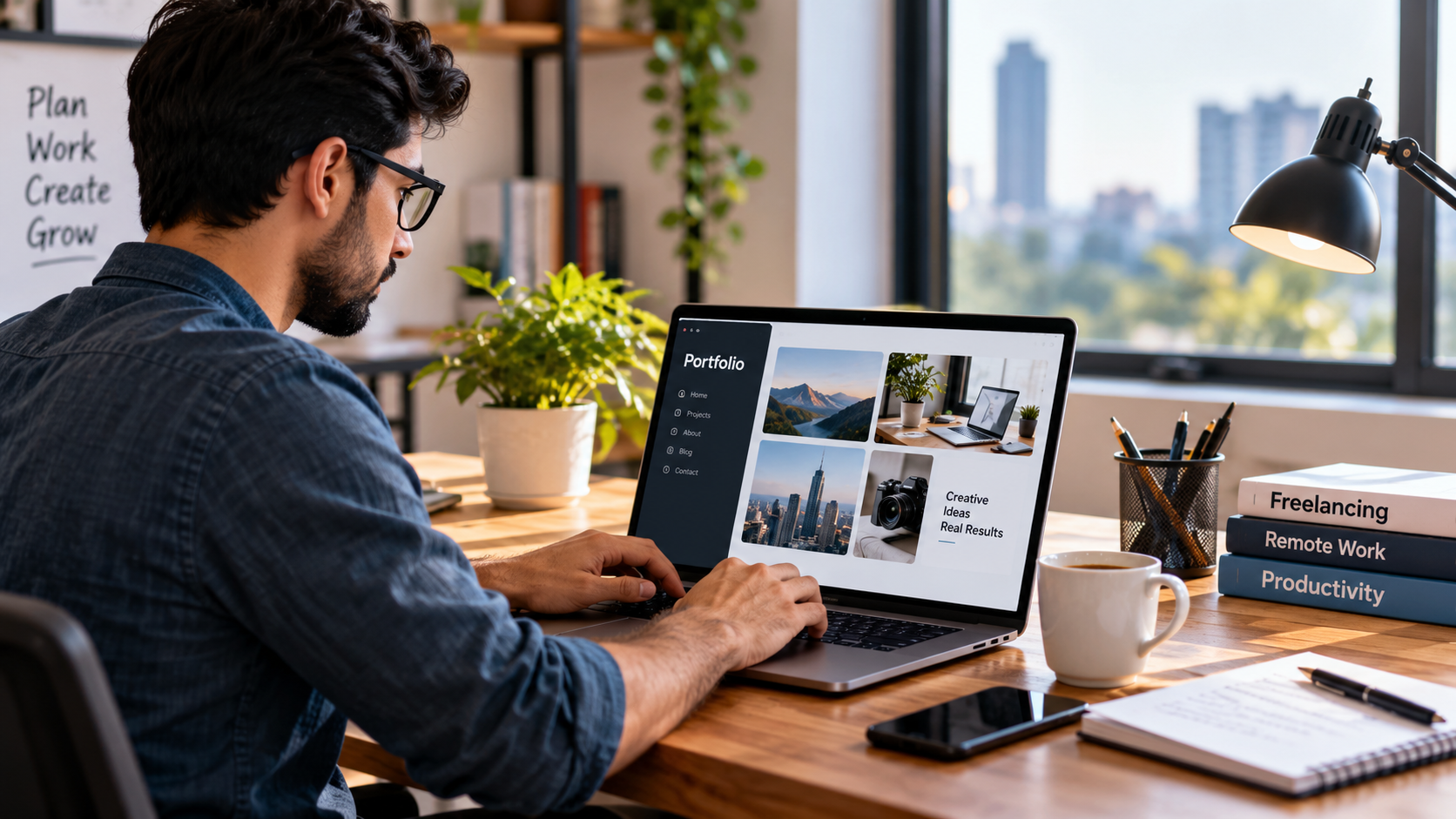
An effective freelance tool stack should reduce mistakes and administration, not merely add more subscriptions. Modern workflows might combine an AI research assistant, a project tracker, a document editor, time tracking, invoicing and secure file delivery. Each component has costs and privacy implications. A tool that saves ten minutes on drafting but creates an hour of fact-checking does not improve productivity. Sources: Upwork research and Google Search Central.
The important context competitors can overlook
Upwork’s 2026 research indicates clients increasingly buy work that embeds AI into familiar professional disciplines. That raises the standard for quality assurance: source checking, human review, version control and clear disclosure where contractually required. Never paste a client’s confidential documents into a third-party service without permission and a suitable data-processing arrangement. For primary-source checks and current reporting, see Upwork research and FTC job scam guidance. The key distinction is use-case comparison without fictitious feature benchmarks.
A practical way to use this information
Start with a workflow audit: list repetitive tasks, identify bottlenecks and choose one change to test for two weeks. Compare output quality, total time, error rate, recurring cost and client satisfaction. Keep a human final sign-off on legal, financial, medical or publicly attributed content. Useful tool reviews describe where automation fails as carefully as where it excels.
“Modern freelance tools pay off when they reduce actual time to a verified deliverable. Protect client data and measure net productivity. Research cutoff: October 12, 2026; confirm developing facts before publication.“
What to verify before making a decision
The right next step is to identify the source, timestamp and applicable market or jurisdiction. Check whether a number is a historical observation, official announcement, target, forecast or scenario. If you intend to act financially, legally or commercially, use the relevant provider’s current terms and obtain professional advice where appropriate. The sources cited here establish context; they are not a substitute for live prices, individual eligibility checks or binding agreements.
Reader questions
Should freelancers disclose AI use?
Follow client agreements, platform rules and any legal obligations, and disclose when the nature of the work requires it.
What is the best AI tool?
The best choice depends on the workflow, privacy requirements and verified output quality.
Think in workflows rather than a shopping list of AI apps
An effective freelance stack is a sequence: receive a brief, clarify requirements, research, create, verify, deliver, invoice and archive. Software should make the handoff between steps easier. Buying five AI subscriptions before defining the workflow often produces duplicated tools and scattered information. Start with the most time-consuming repeat task and test whether a tool reduces overall effort after review time is included. If a draft is produced quickly but requires extensive correction, the apparent time saving may be illusory.
For a content writer, an assistant might help brainstorm outlines while the writer confirms every factual claim through original sources. For a designer, AI-assisted concept exploration may speed early iterations, but final assets still require licensing checks, manual refinement and client approval. For a developer, code suggestions can accelerate boilerplate work while creating a need for tests, dependency review and security checks. The value comes from disciplined human oversight, not the promise of a fully automatic business.
A practical stack with clearly separated roles
A project manager records deadlines, client approvals and deliverables. A document or design environment stores the actual working files. A research assistant supports discovery, while direct source websites remain the authority for claims. Time tracking helps price future projects. Invoicing software maintains payment records. A password manager and secure file-sharing system protect client credentials and confidential work. The right products depend on client needs, collaboration requirements and whether data is permitted to leave the client’s systems.
A freelancer working mainly with spreadsheet analysis may prioritize reliable spreadsheet tools and reproducible calculations over expensive graphics software. A video editor needs storage, transcription review and rendering performance. A consultant may care more about secure meeting notes, contracts and proposals. “Best tools for freelancers” is therefore too broad to have one winner without naming the use case.
Privacy, contracts and client data
Before uploading a customer’s materials into an AI service, check the contract and the service’s data-processing terms. Client information may include employee names, private financial details, unreleased product plans or protected personal data. Even if a tool has a strong public reputation, it may not be approved for a particular customer’s information. Remove unnecessary identifiers where possible, apply least-privilege access and ask for written permission when external processing is required. Do not use a personal account to bypass a client’s restrictions.
Confidentiality also affects screenshots, portfolio samples and demo videos. A convincing case study can show the method and outcome without revealing private records. Rights to AI-assisted outputs, reused templates and licensed stock assets deserve attention in the service agreement. Technical convenience does not override legal or ethical duties.
Measure productivity using finished work
The relevant metric is not “prompts per hour.” It is usable deliverables that meet the brief after quality checks, revisions and communication. Track the time to complete a task before introducing a tool, then measure it again under similar conditions. Include setup, subscription cost, correction time and any new workflow risk. If a paid service saves two hours monthly but costs more than those hours are worth to the business, it may not be a sensible purchase.
Check quality with a sample-based review. For a writing workflow, inspect source accuracy, originality and tone. For design, inspect dimensions, accessibility and brand adherence. For programming, run automated tests and review generated code. Document the repeatable steps so the process remains functional when a service changes its pricing or features.
Avoid vendor lock-in and subscription creep
Choose exportable formats such as Markdown, CSV and common image or document formats when possible. Preserve your work outside any single application, following appropriate security controls. Review renewals quarterly and remove subscriptions that have stopped earning their place. A robust backup and clear file-naming convention can be more valuable than an additional generative AI tool.
For 2026 and beyond, the freelancers who benefit most from automation will likely be those who combine specialized judgment, good client relationships and measurable delivery improvements. Tools are useful leverage; they are not a substitute for a professional service with accountable outcomes.
Questions before paying for another tool
Can an AI assistant replace a human fact-checker?
No. AI-generated text can include invented sources, false dates or confident but incorrect claims. The freelancer remains responsible for verifying source documents and meeting a client’s quality standard. For research-heavy assignments, a reproducible citation trail may be more valuable than faster first-draft generation.
Should freelancers use free plans or paid plans?
Evaluate feature limits, privacy terms, collaboration needs and time savings. A paid service may be justified for work that repeatedly uses its specialist capabilities, while a free tool may be sufficient for occasional tasks. Subscription cost should be measured against the net value of work completed, not the sophistication of a marketing demonstration.
What if a vendor changes its model or pricing?
Preserve deliverables in accessible formats and document repeatable workflows. Review alternative services before a critical deadline, but avoid migrating sensitive client data without authorization. A resilient freelancer maintains ownership of appropriate business records and can continue work even if one service becomes temporarily unavailable.
Discover more from Remote Work Tips
Subscribe to get the latest posts sent to your email.
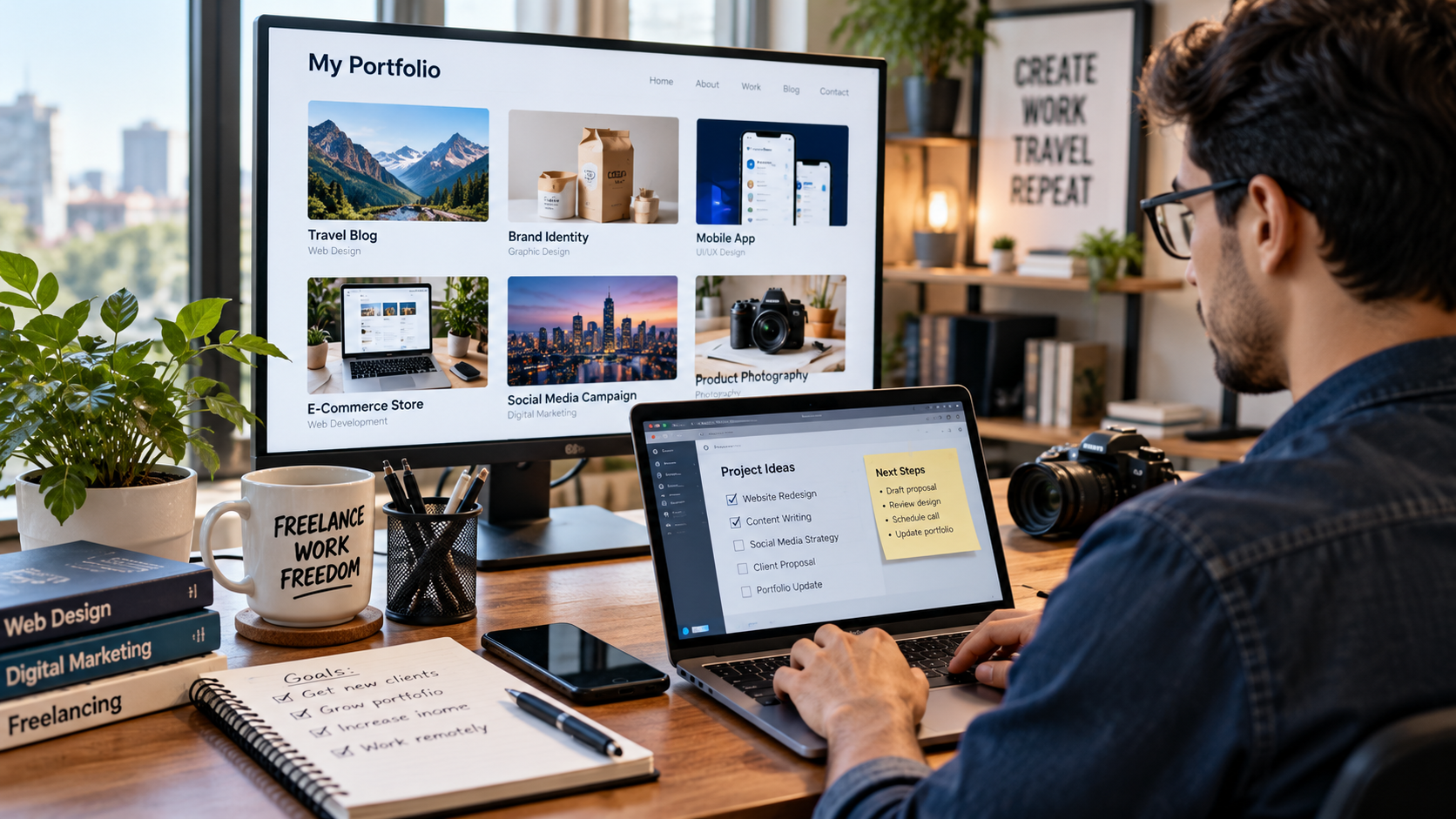
A sustainable freelance career starts with a demonstrable client problem, a transparent portfolio and a written project scope—not just a fashionable skill label. Research cutoff: October 12, 2026; confirm developing facts before publication.
What is happening and why readers are searching
Freelancing in 2026 rewards a credible problem-solving portfolio more than a generic promise to “work from anywhere.” Upwork’s February 2026 skills report found sustained demand in full-stack development, virtual assistance, data analytics and graphic design, while some AI-specific services expanded quickly. Its evidence comes from platform activity, so it should not be presented as a census of the entire labor market. Sources: Upwork research and FTC job scam guidance.
The important context competitors can overlook
The most durable freelance offers combine a technical or creative capability with a measurable business outcome. A web developer may improve checkout speed; an analyst may reconcile marketing data; a designer may build conversion-tested assets. Clients often purchase reduced uncertainty, not hours. That is why proof of previous work, clear project scopes and responsive communication can matter more than buzzwords in a profile. For primary-source checks and current reporting, see Upwork research and IRS Gig Economy Tax Center. The key distinction is evidence-led market demand plus realistic client-acquisition plan.
A practical way to use this information
Pick one niche, produce two original portfolio examples, publish a transparent service package and contact prospective clients with a brief problem-specific proposal. Track inquiries, meetings, closes and repeat revenue. Calculate unpaid administration time before quoting a rate. Beginners should be skeptical of job ads demanding deposits or advance purchases of equipment.
What to verify before making a decision
The right next step is to identify the source, timestamp and applicable market or jurisdiction. Check whether a number is a historical observation, official announcement, target, forecast or scenario. If you intend to act financially, legally or commercially, use the relevant provider’s current terms and obtain professional advice where appropriate. The sources cited here establish context; they are not a substitute for live prices, individual eligibility checks or binding agreements.
Reader questions
Which freelance skills were in demand in 2026?
Upwork reported demand for established areas such as full-stack development, virtual assistance and analytics.
Do I need an expensive certification before applying?
Often a relevant work sample and strong project communication matter more, although some regulated tasks require qualifications.
Start with a client problem rather than a fashionable skill label
A freelance career begins with a problem someone is willing to pay to solve. “I use AI” is a weak service description; “I organize a company’s weekly support reports into an accurate dashboard” is specific. The latter identifies a buyer, an output and a result that can be reviewed. In-demand skills lists are helpful for identifying markets, but platform surveys do not guarantee that every new freelancer will secure clients in a listed category. Experience, language, portfolio quality, reliability and competition influence the outcome.
Choose an initial service where you can produce a tangible sample: a redesigned product page, a reconciled spreadsheet, a short video with captions, a translation with terminology notes, or a software test report. For regulated topics such as legal advice, medicine or investment recommendations, credentials and professional obligations matter. A beginner should not market unqualified specialist advice simply because an online marketplace contains buyers asking for it.
Build a three-piece portfolio that proves capability
The first sample should demonstrate the basic service. The second should show a difficult or realistic constraint, such as correcting an inconsistent dataset or adapting a design for mobile readability. The third should tell a short case-study story: the initial problem, the actions taken, the tools used and the result. If a sample was created without a paying client, label it as a demonstration. Never invent customer testimonials, sales improvements or company permission. Credibility rises when a prospective client can inspect actual work and understand its limitations.
For writers and marketers, a strong sample can include an outline, source verification, original data interpretation and a final article. For developers, a small documented application with a working demo may be more convincing than a long list of programming languages. For virtual assistants, an anonymized process checklist or sample project board can communicate professionalism without revealing anyone’s private information. Focus on quality and clear explanation, not sheer quantity.
Pricing: hourly, fixed-project and retainer tradeoffs
Hourly pricing is convenient when the scope is uncertain, but clients need confidence that time will be recorded fairly. Fixed pricing can reward an efficient freelancer but becomes risky when revision requirements are vague. A monthly retainer creates predictable income when responsibilities and limits are clearly written. For example, a $400 fixed-price assignment that takes eight hours provides $50 per working hour before taxes, business expenses and time spent finding the job. If unexpected revisions double the work, the effective rate falls to $25. Freelancers should calculate their true workload, not just the proposed invoice amount.
Ask for a written scope including deliverables, deadlines, feedback rounds, necessary client inputs, payment terms and what counts as extra work. When a project requires third-party software or licensed images, specify who pays. An agreement should also address confidentiality, ownership and permitted use of the finished work. Complex contracts may warrant legal advice, but even a short written agreement prevents many basic misunderstandings.
Where the first clients can come from
Marketplaces can help beginners find buyers, but applications compete with experienced sellers. Other paths include referrals, professional communities, relevant local businesses and direct outreach based on a clearly identified need. A useful introductory message refers to the client’s situation and includes one relevant sample; mass messages claiming guaranteed results are unlikely to build trust. Track each outreach attempt, reply, call and proposal so that you can learn which offers attract serious interest.
Do not spend weeks perfecting a website if no one has yet validated demand for the service. A simple portfolio, defined offer and a few respectful conversations can provide more information than an elaborate brand package. Equally, do not underprice indefinitely to win reviews; low fees can make it impossible to allocate time for quality and client communication.
Turn delivery into repeat work
A professional freelancer confirms milestones, communicates delays early and documents handover. Include a concise explanation of how the client can use the deliverable and what support, if any, is included afterward. Ask permission before displaying confidential work in a public portfolio. A satisfied client may return for updates, adjacent projects or introductions, making retention an important part of earning a sustainable income.
Track utilization, unpaid administrative hours, late payments and client concentration. If one customer accounts for nearly all revenue, a missed renewal can put the business at risk. Building reserves and maintaining a pipeline are as important as mastering the latest software tool. A freelance career is an operating business, not simply a collection of online gigs.
Frequently asked questions for first-time freelancers
Should a beginner specialize immediately?
Begin with a reasonably narrow service to make your offer clear, while remaining open to adjacent needs. “I improve product-listing descriptions for small online stores” is easier for a buyer to assess than “I do everything digital.” As work accumulates, the freelancer can expand into analytics, design or customer support if the skill and demand justify it.
How do I get experience without inventing clients?
Build demonstration projects using fictional or publicly available data where permitted, contribute to genuine community efforts, or volunteer for a limited, transparently defined assignment. Label samples honestly. Employers and clients often value a clean explanation of a real approach more than a fabricated claim about a famous brand.
Should I accept work without a contract?
At minimum, secure a written agreement on deliverables, deadlines, payment, revisions and usage rights. The detail needed depends on project scale and jurisdiction. An unclear arrangement increases the possibility of scope creep, disputes or late payments. Keep client communications professional and preserve approvals.
Discover more from Remote Work Tips
Subscribe to get the latest posts sent to your email.


Best Countries for Digital Nomads in 2026: Visas, Costs and Safety
The best country for a digital nomad in 2026 is not necessarily the cheapest or the country with the longest...


Best AI Tools for Freelancers in 2026: A Workflow-Based Guide
A freelancer should compare total workflow value, exportability, privacy and client consent before subscribing to multiple AI tools. Free trials...


Freelance Taxes and 1099 Forms in 2026: A Practical U.S. Recordkeeping Guide
Freelancers sometimes assume that income is not taxable unless a platform sends a 1099. The Internal Revenue Service explicitly says...


Modern Freelance Tools in 2026: How to Build an AI-Assisted Workflow That Clients Trust
An effective freelance tool stack should reduce mistakes and administration, not merely add more subscriptions. Modern workflows might combine an...


Freelance Careers in 2026: In-Demand Skills, Portfolio Proof and Getting First Clients
A sustainable freelance career starts with a demonstrable client problem, a transparent portfolio and a written project scope—not just a...


Freelancing in 2026: The Tools, Projects and Positioning That Win High-Ticket Clients
Freelancing has split into two markets. Commodity work is getting cheaper, while expert work is getting more valuable. The tools...


How to Calculate Your Freelance Day Rate (& Raise It Without Losing Clients)
Setting your freelance day rate is one of the most critical commercial decisions you will make. Set it too low,...


Optimizing for AI Overviews: The Freelancer’s Guide to Schema Markup & Generative Engine Optimization (GEO)
Traditional search engine optimization is undergoing a seismic shift. As Google AI Overviews, Perplexity, and SearchGPT handle millions of daily...
-

 blogging5 years ago
How to Use Social Media to Promote Your Blog
-

 social media5 years ago
How to Learn Social Media Without Getting Scammed
-

 freelance5 years ago
6 Future-Focused Skills Freelance Creatives Can’t Afford to Ignore
-

 freelance11 months ago
The Economics of Remote Work: How Hybrid Models Are Reshaping Global Productivity
-

 blogging5 years ago
20 Best Freelance Marketplaces for Freelancers in 2022 to Make Money
-

 freelance5 years ago
7 Highest Paying Freelance Jobs For Earning A Steady Income
-

 Digital Banking5 years ago
Pakistan Consumer Confidence Index increased by 8.8% in Q4 2021
-

 freelance11 months ago
Best Alternatives to Fiverr and Upwork: 5 Best Freelance Marketplaces