
Digital Nomads
10 Reasons How Slow Internet Is Crushing Pakistan’s Gig Economy and Freelancers in 2026

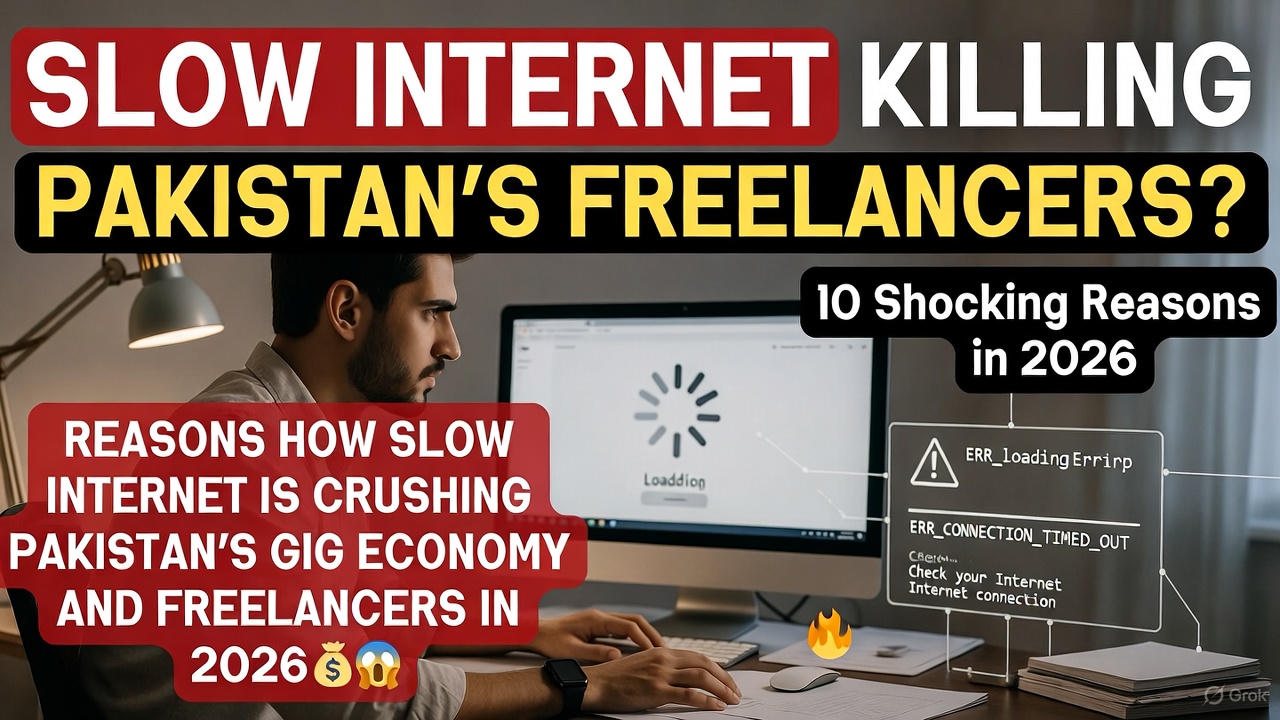
In 2025-26, Pakistan’s painfully slow internet speeds are devastating freelancers and the gig economy—costing millions in lost earnings and driving talent away. Here are 10 shocking reasons why, backed by real stories and data.
Slow internet impacts Pakistan’s gig economy and freelancers in 2026 by causing chronic missed deadlines from sluggish uploads, unreliable video calls eroding client trust, direct financial losses (up to $700,000 daily during major slowdowns), reduced productivity leading to burnout, clients shifting to faster countries like India and the Philippines, VPN restrictions further throttling speeds, barriers to online skill-building, compounded effects from frequent power outages, accelerated brain drain as young talent emigrates for better connectivity, and stifled innovation in startups—all threatening a sector poised to exceed $1 billion in annual earnings.
A Loading Bar That Never Ends
It’s 2 a.m. in Karachi, and 28-year-old web developer Ahmed stares at his laptop screen. The progress bar for uploading a client’s revised website crawls forward—38%… 39%… then freezes. The deadline is in four hours. His client in California is already asleep, but Ahmed knows what comes next: an apologetic email, a frustrated response, and possibly the loss of a long-term contract. This isn’t a one-off nightmare; it’s a nightly reality for thousands of Pakistani freelancers in 2026.
Pakistan has long punched above its weight in the global gig economy. With a young, English-speaking population and platforms like Upwork and Fiverr, the country has become a freelancing powerhouse. Experts estimate that Pakistani freelancers could generate over $1 billion in annual earnings if trends continue, contributing massively to foreign remittances and IT exports that crossed $3.8 billion in FY 2024-25.
Yet, as we enter 2026, this digital dream is under siege. Internet speeds remain among the world’s slowest, with Pakistan ranking 146th in fixed broadband as recently as November 2025, according to Ookla’s Speedtest Global Index. Ongoing slowdowns—reportedly linked to firewalls, cable faults, and surging VPN usage—have persisted into January 2026, frustrating users nationwide.

Slow internet isn’t just an inconvenience; it’s systematically dismantling one of Pakistan’s brightest economic stories. From missed opportunities to mental exhaustion, the ripple effects are profound. Here are 10 hard-hitting reasons why sluggish connectivity is crushing Pakistan’s freelancers and gig economy in 2026.
- Chronic Delays in Uploads and Downloads: The Deadline Killer For freelancers, time is literally money. A graphic designer uploading high-resolution files or a video editor sharing 4K renders can wait hours on Pakistan’s average fixed broadband speeds, which hover around sub-30 Mbps in many areas. “I once lost a $5,000 project because a 2GB file took 12 hours to upload,” shares Sara, a Lahore-based motion graphics artist (name changed for privacy). Clients expect quick turnarounds; when deliveries lag, trust erodes. Repeated delays mean lower ratings on platforms, fewer invitations, and ultimately lost income. In a competitive global market, reliability wins contracts—slow internet hands them to competitors. The economic ripple? Freelancers report routine 20-30% productivity drops, translating to thousands in forgone earnings per person annually.
- Unreliable Video Calls and Virtual Meetings: Breaking Client Relationships Zoom, Google Meet, and Slack calls are the lifeblood of remote work. But with packet loss and jitter common in Pakistan, freelancers often appear frozen or garbled. Imagine pitching to a U.S. startup while your video stutters—professionalism takes a hit. Many freelancers resort to audio-only, limiting their ability to build rapport. One Islamabad-based content writer told researchers he lost 70% of potential opportunities due to unreliable connections. This unreliability pushes clients toward freelancers in regions with stable high-speed internet, weakening Pakistan’s hard-earned reputation.
- Direct Financial Losses: Billions on the Line When nationwide slowdowns hit, the damage is immediate and massive. In late 2025, online businesses risked losing nearly $700,000 per day due to throttled speeds. Freelancers bear the brunt: canceled gigs, refunded payments, and idle hours. Scaled across hundreds of thousands of workers, this adds up to billions in potential annual losses—especially painful when the sector was on track to hit $1 billion. IT firms handling foreign projects face similar hits, stalling growth in a vital export sector.
- Reduced Productivity and Burnout: The Human Toll Constant buffering, retries, and workarounds drain energy. Freelancers spend hours troubleshooting instead of creating. “You start refreshed, but by evening you’re exhausted from fighting the connection,” says a Karachi UI/UX designer. Burnout rates are rising, with many reporting anxiety over unreliable tools. Long-term, this leads to lower quality work, fewer hours billed, and talented professionals leaving freelancing altogether.
- Client Migration to Faster Competitors Global clients prioritize efficiency. When Pakistani freelancers repeatedly cite “internet issues” as excuses, businesses look elsewhere—to India (with far superior broadband rankings) or the Philippines. This shift is already happening: slowdowns have accelerated client loss, contracting Pakistan’s share of the global gig market.
- VPN Slowdowns Worsening the Problem Many freelancers rely on VPNs to bypass restrictions or access blocked tools. Ironically, widespread VPN use—and occasional blocks—further congests networks, dropping speeds even lower. In 2025-2026, this created a vicious cycle: workers need VPNs to work effectively, but they exacerbate the slowdowns they’re trying to escape.
- Barriers to Skill-Building and Online Learning Upskilling via YouTube, Coursera, or Udemy requires streaming and downloads. Slow connections make buffering tutorials the norm, hindering career growth. Younger freelancers, eager to learn AI tools or advanced coding, fall behind global peers—perpetuating Pakistan’s position lower in high-value gigs.
- Power Outages Compounding Connectivity Woes Frequent loadshedding means even when internet works, it’s interrupted. Backup generators help the wealthy, but most freelancers lose hours daily. This double whammy makes consistent work nearly impossible in many areas.
- Accelerated Brain Drain: Talent Fleeing for Better Internet Frustrated professionals are emigrating to Dubai, Canada, or Europe—places with reliable high-speed broadband. “Why struggle here when I can earn the same abroad without the hassle?” asks one former Islamabad developer now in the UAE. This talent exodus robs Pakistan of its digital future.
- Stifled Innovation and Startup Growth The gig economy fuels startups, but slow internet hampers testing, collaboration, and cloud-based development. Aspiring tech entrepreneurs delay launches or abandon ideas, slowing Pakistan’s broader digital transformation.
Solutions and Future Outlook: Is There Light at the End of the Tunnel?
Hope isn’t lost. The government has announced 5G spectrum auctions for early 2026, promising faster services in major cities within months.
Starlink has received temporary approvals and could launch soon, bringing satellite internet to remote areas.
Freelancers are adapting too: investing in fiber where available (PTCL and others), using offline tools, or scheduling around peak hours.
Policy changes—transparent infrastructure investment, reduced restrictions—could unlock potential. If addressed urgently, Pakistan’s gig economy could rebound stronger.
Conclusion: Time to Act Before the Connection Drops Permanently
Slow internet in 2026 isn’t just frustrating Pakistani freelancers—it’s eroding a vital economic engine. From daily losses to long-term brain drain, the costs are mounting. Policymakers, ISPs, and the international community must prioritize reliable connectivity. Pakistan’s young talent deserves a fighting chance in the global digital arena. The loading bar can’t spin forever.
The author is a syndicated Columnist and Premium Tech Journalist specializing in digital economies and remote work in emerging markets. With over a decade covering infrastructure challenges for digital nomads across Asia and Africa.
Sources
- Speedtest Global Index – Pakistan
- Arab News: Online businesses risk $700,000 in losses
- Dawn: Pakistan’s Internet Recession
- Express Tribune: Digital economy stumbles
- ProPakistani: Freelancers $1B potential
- Profit Pakistan Today: 5G auction
- Recent internet issues reports
- VPN and slowdowns
- Ookla H1 2025 Report
- LUMS Report on shutdowns
Discover more from Remote Work Tips
Subscribe to get the latest posts sent to your email.



Here is a number worth sitting with: AI-enabled freelancers now save an average of eight hours per week and earn 40% more per hour than their non-AI-using counterparts. Jobbers In a profession where time is the only non-renewable resource, that gap is not merely a competitive advantage — it is the difference between a freelance practice that scales and one that quietly stagnates.
The global freelance economy has never been larger or more consequential. Over 64 million Americans were freelancing as of 2023, contributing more than $1.27 trillion to the U.S. economy — and freelancers are 2.2 times more likely to regularly use generative AI than their salaried peers. High 5 Test By March 2026, that lead has only widened. Freelancers with specialized AI and prompt engineering skills are commanding a 56% wage premium over traditional roles, as “Agentic AI” becomes a standard workplace tool. DemandSage
Yet the uncomfortable truth is that most independent professionals are still leaving enormous value on the table — not because they lack skill, but because they are burying billable hours beneath a slow avalanche of admin. The right AI stack, deployed intelligently, is the fastest structural change a freelancer can make to their income in 2026. What follows is a rigorous look at the five tools producing the biggest, most measurable gains right now.
The 40% Problem Nobody Talks About
Ask most freelancers where their day goes and you will hear a familiar litany: client emails, project briefs, invoice chasing, meeting notes, proposal drafts, scheduling threads. Freelancers today are no longer just service providers; they are project managers, marketers, accountants, customer support agents, and strategists all at once. FreelancingGig
Research consistently shows that knowledge workers spend between 40 and 60 percent of their working hours on tasks that are, in economic terms, non-productive — activities that consume time without directly generating revenue. For a freelancer billing $100 per hour who works a standard eight-hour day, that translates to $320 to $480 in theoretical daily earnings lost to overhead. Across a working year, the math becomes quietly devastating.
The promise of AI is not that it replaces your expertise — it is that it eliminates the administrative friction taxing that expertise at an invisible rate. Realistic expectations for drafting and ideation put time savings at 30 to 60 percent on first drafts, outlines, and idea generation. Asrify Stack that across five categories of daily work, and the compounding effect approaches — and in many documented cases exceeds — 50%.
[Link to related FT article: How AI is reshaping the economics of independent work]
The Top 5 AI Tools Unlocking 50% More Billable Hours in 2026
1. Claude (Anthropic) — The Strategic Thinking Partner
Value proposition: A long-context AI assistant that handles complex drafts, deep client research, and nuanced multi-document analysis with a consistency that rivals a senior research associate.
At the operational core of many six-figure freelance practices in 2026 sits Claude, Anthropic’s flagship model. Unlike general-purpose chatbots optimized for breadth, Claude has carved out a reputation for sustained reasoning across lengthy, complex material. Claude now offers a one-million-token context window, Agent Teams, and Claude Code Nxcode — meaning a freelance consultant can feed an entire client contract, three years of market reports, and a competitor analysis into a single session and receive synthesis that would have taken a junior analyst a full week to produce.
The productivity mechanics are concrete. Access to AI assistants of Claude’s caliber reduced the time employees needed for writing tasks by 40 percent, while the quality of output increased by 18 percent. ClickForest For a consultant producing six deliverables per month, that compression alone recovers roughly two full working days.
Real-world impact: A content creator using Claude to edit final drafts halved her content production time. 2727coworking A freelance consultant reported using Notion AI (powered partly by Claude Opus 4.1) to auto-generate client onboarding templates from bullet points, reducing prep time from two hours to 30 minutes per client. 2727coworking
Pricing context: Claude Pro is $20/month — the same price as a single billable hour for most mid-range freelancers. The return on that investment becomes positive within the first afternoon of serious use.
The economist’s take: Claude’s real structural advantage is asymmetric leverage. A solo freelancer using Claude effectively is not working harder than a boutique consultancy with three staff — they are working at the same cognitive bandwidth. That changes pricing power, not just output speed.
2. Notion AI — The Operating System for Your Entire Practice
Value proposition: An all-in-one workspace that turns project management, meeting notes, client databases, and strategic documents into a single AI-queryable knowledge base.
If Claude is the thinking partner, Notion AI is the institutional memory. The September 2025 launch of Notion 3.0 introduced autonomous AI Agents that can execute multi-step workflows, marking a fundamental shift from passive tools to active digital assistants that genuinely work alongside you. Max Productive AI
For freelancers juggling multiple clients across different time zones, the killer feature is Notion AI’s ability to surface information from your own workspace in response to natural-language questions. Ask “What were the key deliverables we agreed with Acme Corp last quarter?” and the system retrieves the relevant meeting notes, contract terms, and action items — not a generic internet answer, but your specific institutional knowledge. Users report saving 50 to 100 hours in just three months for repetitive writing tasks, and companies like Zapier reduced post-meeting admin time by 40 percent using Notion AI for converting raw meeting transcripts into organized notes. booststash
The autonomous Agent can work for up to 20 minutes performing multi-step tasks across hundreds of pages simultaneously — building comprehensive project launch plans, compiling client feedback from multiple sources, drafting detailed reports, and creating interconnected page structures. Max Productive AI
Pricing context: The Business plan at $20/user/month now includes full Notion AI — making it, as one analysis put it, the cost of a single ChatGPT subscription for an entire integrated workspace including AI access to GPT-5, Claude Opus 4.1, and o3.
The economist’s take: Notion AI solves a problem economists call “context switching cost” — the productivity tax paid every time a knowledge worker shifts between disconnected applications. By collapsing CRM, project management, note-taking, and AI writing into one queryable system, it eliminates the friction that compounds invisibly throughout the workday.
[Link to related FT article: The rise of AI-native knowledge management in the gig economy]
3. Zapier — The Invisible Infrastructure Layer
Value proposition: No-code automation that connects over 5,000 apps, letting AI handle repetitive cross-platform workflows while you focus exclusively on billable work.
Automation is the compounding interest of productivity. In 2026, freelancers who ignore automation often struggle to scale, while those who embrace it can handle more clients without increasing hours. FreelancingGig Zapier sits at the infrastructure layer of most high-performing freelance operations, quietly executing the administrative choreography that would otherwise consume hours per week.
The tool’s 2025-2026 AI upgrades are substantial. With Zapier’s latest AI upgrade, freelancers can now build automations using plain English — its multi-step “Zaps” reduce manual work, especially for those managing client onboarding or marketing funnels. Social Champ Practical applications range from automatically routing new client inquiry emails into a CRM, generating a first-draft proposal, and notifying via Slack — all without human intervention — to triggering invoice creation the moment a project milestone is marked complete in a project management tool.
Featured snapshot — what Zapier actually automates for top freelancers:
- New client form submission → auto-create Notion project page + send welcome email sequence
- Completed project milestone → generate invoice draft in FreshBooks + alert client via email
- Meeting scheduled → create agenda template + add follow-up reminder to Asana
- New testimonial received → format and publish to portfolio website
- Monthly financial data → compile into standardized reporting dashboard
A freelance consultant using Zapier’s AI automations reduced cross-platform administrative work by building “Zaps” that parse email content, summarize it, and route action items automatically 2727coworking — eliminating what had previously been a daily 45-minute triage ritual.
Pricing context: Free tier covers basic Zaps; the Professional plan at $19.99/month unlocks multi-step automations and AI features. For any freelancer billing above $40/hour, recovering even one hour per month justifies the cost within weeks.
The economist’s take: Zapier doesn’t save time — it creates time that never existed before, by executing work at machine speed during hours when you are asleep, in client meetings, or doing the creative work that actually commands premium rates.
4. Timely — AI-Powered Time Intelligence
Value proposition: An automatic time-tracking tool that logs your entire workday without manual input, ensuring every billable minute is captured, analyzed, and converted to revenue.
This is the most underestimated tool in the freelance stack, and arguably the one with the most immediate financial impact. AI-powered billable hours trackers like Timely use smart AI to remember your whole day without manual input — and users say these tools find 20% more billable time they had previously missed. apps365
For a freelancer billing $80 per hour who works approximately 100 hours per month, recovering 20% more billable time represents $1,600 in additional monthly revenue — from a tool that costs under $20/month. That is a return on investment that would make a private equity analyst blush.
Timely’s “memory” architecture runs passively in the background, tracking which applications, documents, and websites you engage with throughout the day, then reconstructing a timeline of your work that can be reviewed, edited, and converted to invoice-ready timesheets. In 2026, many freelancers rely on AI summaries from time-tracking tools to identify inefficiencies, suggest better pricing models, and even recommend when to raise rates based on workload trends. FreelancingGig
The behavioral insight dimension is equally valuable. Patterns in time data reveal which client relationships are actually profitable once admin overhead is accounted for, which project types produce scope creep, and where your most valuable peak-productivity hours are currently being allocated to low-value tasks.
Pricing context: Starter plans from approximately $9/month; professional tiers with full AI analysis from $16/month.
The economist’s take: In economics, what isn’t measured isn’t managed. Most freelancers operate with a systematic measurement gap between hours worked and hours billed — Timely closes that gap with a precision that manual tracking never achieves. The revenue uplift is real and immediate.
[Link to related Forbes article: The hidden billing gap costing freelancers thousands annually]
5. Perplexity AI — The Research Engine That Eliminates Dead Time
Value proposition: A real-time AI search and synthesis engine that compresses hours of research into minutes, complete with cited primary sources — the 2026 breakout tool for knowledge-intensive freelancers.
Every freelancer who does research-intensive work — consultants, writers, strategists, analysts — understands the invisible tax of information gathering. Building a solid base of evidence for a client deliverable can absorb two to four hours of a workday that should have been billable. Perplexity AI is the 2026 breakout tool attacking this specific bottleneck with striking effectiveness.
Unlike standard AI assistants that synthesize from training data, Perplexity conducts live web research and returns synthesized answers with source citations — functioning as a research assistant that works at fifty times human reading speed. Productivity research documents a 45% time reduction in research tasks for AI-enabled freelancers, Jobbers and Perplexity is the primary driver of that compression in knowledge work.
For a market research consultant charging $150/hour, compressing a four-hour research phase to two hours per project adds two billable hours per engagement. Across 12 projects per month, that is 24 additional billable hours — approximately $3,600 in monthly revenue uplift from a single tool costing $20/month in its Pro tier.
A 2025 McKinsey Global Institute report noted that AI-driven automation could boost global productivity by up to 40% by 2035, with early adopters in creative industries already seeing efficiency gains of 30%. Blockchain News Perplexity users in knowledge-intensive freelance fields are consistently at the leading edge of that adoption curve.
Pricing context: A generous free tier exists; Perplexity Pro at $20/month unlocks unlimited real-time search, advanced models, and API access for workflow integration.
The economist’s take: Research is a classic “threshold task” — you must complete it before any billable output can exist. Perplexity compresses the threshold, not the creative work itself. That asymmetry is exactly where AI delivers its highest marginal return.
[Link to related Economist article: How AI research tools are reshaping the knowledge economy]
Comparative Summary: Time Saved vs. Traditional Methods
| Tool | Primary Function | Documented Time Saving | Estimated Monthly Revenue Impact* | Price/Month |
|---|---|---|---|---|
| Claude | Research, drafting, analysis | 40–60% on writing tasks | $640–$960 | $20 |
| Notion AI | Knowledge management, project ops | 40–50% on admin & documentation | $320–$480 | $20 |
| Zapier | Cross-app workflow automation | 4–6 hrs/week eliminated | $480–$720 | $20 |
| Timely | Automatic time capture & billing | 20% more billable time recovered | $1,200–$1,600 | $16 |
| Perplexity AI | Research synthesis | 45% time reduction in research | $800–$1,200 | $20 |
*Estimates based on a freelancer billing $80/hour working 25 billable hours/week. Individual results vary.
The Compounding Effect and the Ethical Dimension
Deploy all five tools coherently — not as disconnected subscriptions but as an integrated system — and the aggregate impact approaches and frequently exceeds the 50% billable-hour uplift the headline promises. The math is not additive; it is compounding. Time saved by Timely reveals where to focus. Perplexity compresses research. Claude converts that research into polished deliverables. Notion AI manages the client relationship and institutional memory. Zapier runs the administrative infrastructure in the background while you sleep.
The global gig economy is projected to reach a valuation of $674.1 billion in 2026 DemandSage, and the professionals capturing an outsized share of that growth share one common characteristic: they treat AI not as a novelty, but as operational infrastructure.
The ethical considerations deserve equal seriousness. Transparency with clients about AI-assisted workflows is not merely good practice — it is the foundation of sustainable professional trust. Clients benefit from AI-enabled freelancers through faster delivery, more reliable quality, and clearer communication throughout projects, Useme but that value proposition holds only when the human expert remains genuinely in the loop, exercising judgment, catching errors, and bringing the contextual intelligence that no model can replicate.
There is also a structural concern worth naming. Basic writing job postings have decreased 21%, simple graphic design 17%, and data entry 35% since ChatGPT’s launch — but AI content editing grew 180%, prompt engineering 240%, and AI tool training 165%. Jobbers The market is not shrinking; it is bifurcating. Freelancers who position themselves at the expert layer — using AI to amplify rather than replace their specialized judgment — are on the right side of that divide.
The Next Step: Start With One, Not Five
The most common mistake in building an AI-powered freelance practice is attempting a wholesale transformation overnight. A more durable approach is sequential adoption: identify your single largest time drain, match it to the tool most precisely targeting that drain, measure the impact over 30 days, and then layer the next tool onto a stable foundation.
Start with one general tool and one specialist tool. Track ROI explicitly: estimate hours saved per week and new revenue generated from AI-assisted services. Upgrade only when you hit bottlenecks. Asrify
For most freelancers, the sequence that delivers the fastest measurable return is: Timely first (you cannot optimize what you cannot measure), Claude second (the highest-leverage creative amplifier), and Zapier third (the infrastructure that systematizes your gains). Notion AI and Perplexity follow naturally as your practice scales.
The 50% uplift in billable hours is not a marketing abstraction. It is a structural reality — documented, measurable, and increasingly separating the freelancers who thrive in the 2026 economy from those who remain caught in the administrative gravity of the old one.
The tools exist. The data is clear. The only remaining question is whether you will use the next hour to plan the adoption, or spend it on work that a well-configured AI could have handled before breakfast.
Discover more from Remote Work Tips
Subscribe to get the latest posts sent to your email.

How remote workers are reshaping global economies. Countries compete for $787B in nomad spending. Data-driven analysis of the work revolution.
When Maria Chen logged into her blockchain startup’s Slack channel from a beachside café in Bali last Tuesday, she wasn’t just another tourist checking emails. She was part of a 35-million-strong global workforce representing an economic powerhouse worth approximately $787 billion annually—a figure that positions digital nomads as an economic force rivaling mid-sized nations.
Three decades ago, a group of computer engineers in Berlin founded C-Base, one of the first modern coworking spaces designed as a “hacker space” for sharing technology and techniques. That modest beginning has evolved into a sophisticated global infrastructure where 18.1 million Americans alone identify as digital nomads in 2025, and nations worldwide are locked in fierce competition to attract this mobile, highly skilled workforce.
This isn’t merely a lifestyle trend—it’s a fundamental restructuring of how capital, talent, and tax revenue flow across borders. And governments are taking notice.
From Coding Lofts to Economic Strategy: The Transformation of Digital Nomadism
The digital nomad movement has undergone a remarkable metamorphosis. What began as a fringe lifestyle for tech-savvy adventurers has become a strategic priority for national economic planners from Tallinn to Dubai.
The numbers tell a compelling story. The global digital nomad population has roughly doubled from around 20 million just a few years ago to 40 million by 2025. In the United States alone, the trajectory has been explosive: from 4.8 million in 2018 to 18.1 million in 2024, representing sustained year-over-year growth even as pandemic restrictions eased.
But the demographic composition reveals something more nuanced than a simple work-from-anywhere trend. Most digital nomads belong to Gen Z (35%) and Millennials (40%), with Gen Z’s dramatic rise from less than 1% in 2019 positioning them to potentially surpass Millennials within two to three years. This isn’t temporary—it’s generational.
Perhaps most striking is the shift in employment patterns. Contrary to the freelancer stereotype, 66% of digital nomads in 2022 held traditional full-time jobs with companies, a 22% increase from 2019. The pandemic didn’t just enable remote work temporarily—it permanently altered employer-employee relationships and expectations around physical presence.
The Crypto-Coworking Convergence
The intersection of cryptocurrency culture and digital nomadism represents one of the most fascinating developments in this evolution. In Chiang Mai, Thailand, Yellow Coworking launched in 2020 as a blockchain-oriented collaborative space, attracting former Silicon Valley workers, Russian and Ukrainian coders, and crypto enthusiasts following mass layoffs at Twitter, Meta, Coinbase, and Microsoft.
These aren’t traditional offices—they’re innovation incubators. Biometric fingerprint scanners grant access to spaces where ethereum creator Vitalik Buterin’s vision of borderless living becomes tangible reality. In Lisbon, The Block Lisboa accepts cryptocurrency payments and hosts weekly Crypto Fridays for networking, culminating in the 2023 Ethereum Block Summit that explored groundbreaking advancements in decentralized finance.
CV Labs has taken this concept global, building a blockchain ecosystem spanning Lisbon, Vaduz, Zug (Switzerland’s “Crypto Valley”), Berlin, and Cape Town. These spaces don’t just provide desks and Wi-Fi—they create micro-clusters that facilitate knowledge diffusion, attract entrepreneurs, and bridge nomadic professionals with local firms.
The marriage of cryptocurrency and nomadism makes ideological sense. Both movements champion decentralization, borderless operation, and freedom from traditional institutional constraints. As one Yellow Coworking staff member explained, Chiang Mai’s lower costs give startups developing their minimum viable products “a longer runway” to achieve solvency—a geographic arbitrage strategy that’s become standard practice in the nomad economy.
The Great Global Competition: Nations Vie for Mobile Talent
If there’s a single metric that captures why governments care about digital nomads, it’s this: the average digital nomad spends $22,500 annually, money that flows into local economies without requiring governments to provide employment, social services, or long-term infrastructure commitments.
This represents what economists might call the perfect guest: high spending, low burden, and a tendency to fill hotels and apartments during off-peak tourism seasons.
The Visa Wars: A Race to the Bottom (in Regulations)
The response has been swift and competitive. At least 40 million digital nomads exist worldwide as of 2025, and over 70 countries now offer digital nomad visa programs, each designed to capture a share of this mobile workforce.
Consider the diversity of approaches:
Estonia pioneered early with its Digital Nomad Visa and e-residency program, targeting high-skilled workers with a one-year renewable permit. The strategy positioned Estonia as the entry point for nomads seeking European Union access.
Portugal’s D8 Visa requires minimum monthly earnings around $3,480 and offers a clear path to permanent residency and citizenship after five years—a long-game strategy to convert temporary residents into permanent taxpayers.
Croatia extended its visa duration to 18 months as of August 2025 and exempts digital nomads from local income tax—a direct fiscal incentive that’s proven highly attractive.
Italy launched its program in April 2024, requiring $30,000 annual income but compensating with access to the entire Schengen Area and Italian quality of life.
United Arab Emirates took the premium approach, requiring $5,000 monthly income but offering zero income tax, world-class infrastructure, and political stability—appealing to high earners prioritizing luxury and security.
Even traditionally restrictive Japan introduced its digital nomad visa in 2024, allowing six-month stays for high-income earners—a remarkable policy shift for a nation historically cautious about foreign workers.
The competition extends beyond Europe and Asia. Kazakhstan announced its “Neo Nomad Visa” in November 2024, Kyrgyzstan finalized a framework offering status for up to 10 years, and Bulgaria introduced a dedicated digital nomad residence permit in July 2025.
This isn’t coordination—it’s competition. Nations recognize that in an increasingly digital economy, attracting mobile high-earners represents a zero-sum game with significant economic stakes.
The Economic Impact: Beyond Tourism Revenue
The crude calculation—multiply nomad numbers by average spending—undersells the actual economic impact. Digital nomads generate multiplier effects that ripple through local economies in ways traditional tourism cannot match.
Direct Economic Contributions
The global digital nomad community’s annual spending is estimated at $787 billion, positioning it as the 38th most prosperous country by gross national income per capita, ranking between Portugal and Saudi Arabia. If digital nomads constituted a nation, they’d rank 41st globally by population.
But these figures represent only the visible spending: housing, food, coworking memberships, transportation, and entertainment. The indirect effects prove equally significant.
The Coworking Economy
The coworking market, valued at roughly $8 billion in 2024, is expected to double by 2030, with some projections suggesting even faster growth. Extended-stay hotels, aparthotels, travel eSIMs, cross-border payment systems, and professional relocation services all scale alongside digital nomad growth—each converting longer stays into steadier revenue streams.
Real estate markets in nomad-favored cities have experienced notable transformations. Lisbon, Barcelona, Mexico City, and Chiang Mai have all seen increased demand for furnished apartments, flexible lease terms, and high-speed internet infrastructure—investments that benefit local residents and businesses beyond serving transient workers.
Knowledge Transfer and Local Innovation
Perhaps the most underappreciated contribution comes through knowledge diffusion. Research on Chiang Mai found that digital nomads contribute to knowledge sharing and engagement of locals in work activities, job creation and recruitment within the local community. When a former Silicon Valley engineer develops a startup prototype in Thailand or Portugal, local developers, designers, and marketers gain exposure to cutting-edge practices, international client expectations, and startup methodologies.
Coworking spaces function as micro-clusters where entrepreneurial know-how transfers organically through daily interactions. A blockchain developer from Berlin mentoring a local programmer in Cape Town creates value that transcends any tourism multiplier calculation.
Studies show coworking hubs operate as micro-clusters that diffuse know-how, attract entrepreneurs, and bridge nomads with local firms. This positions digital nomads as carriers not just of foreign currency but of human capital and entrepreneurial intention—what some governments now treat as foreign direct investment-adjacent activity.
The Tax Revenue Paradox: Wealth Without Obligations
Here’s where the digital nomad phenomenon becomes economically complex and politically contentious.
Traditional economic development follows a predictable pattern: attract businesses, which hire local workers, who pay income taxes, while businesses pay corporate taxes. Everyone’s incentives align. Digital nomads break this model entirely.
The Fiscal Reality
A Grant Thornton review of 21 countries found 79% of digital nomad visas provide no relief from individual income tax while 85% have no exemption from corporate tax risk. This creates a peculiar situation: nomads spend money locally but may owe taxes to home countries, while their employers face potential permanent establishment concerns in host nations.
For American digital nomads, the situation involves particular complexity. The U.S. taxes citizens on worldwide income regardless of residence, though the Foreign Earned Income Exclusion allows eligible individuals to exclude up to $126,500 of foreign-earned income in 2024. Combined with the Foreign Housing Exclusion and strategic use of tax treaties, many American nomads legally reduce their tax liability to near zero.
But host countries rarely benefit from this arrangement. In national accounts, nomad spending is logged as tourism services, not foreign direct investment, yet many governments strategically treat nomads as FDI-adjacent actors carrying foreign income, human capital, and entrepreneurial intention.
Some nations have attempted to close this gap through aggressive tax optimization strategies. Spain’s Beckham Law offers foreigners the option to be taxed under a favorable non-resident framework for six years. Thailand reformed its system so that starting in 2024, only remitted foreign income faces taxation. Portugal eliminated its Non-Habitual Resident program in January 2024, effectively raising taxes on new arrivals after years of generous treatment.
The Permanent Establishment Problem
From a corporate perspective, the risks extend beyond individual tax compliance. When employees work remotely from foreign jurisdictions, companies face the specter of inadvertently creating a “permanent establishment”—a tax term meaning the company now has taxable presence in that country. In worst-case scenarios, this could subject entire corporate profits to foreign taxation.
As remote work normalizes, international tax frameworks designed for fixed physical operations struggle to address perpetually mobile workers. The 183-day rule—the traditional threshold for tax residency—becomes obsolete when nomads change countries quarterly. Double taxation agreements, negotiated for traditional expatriates with clear home and host countries, fail to address perpetual movement across multiple jurisdictions.
Demographic Deep Dive: Who Are These Global Workers?
Understanding who digital nomads are reveals why they’ve become strategic priorities for governments and why their influence will likely grow.
Age and Experience
The average digital nomad in 2025 is 36 years old, with most falling between 30 and 39 years old. This represents prime earning years—professionals with established skills and career momentum but before family obligations typically anchor people geographically.
Interestingly, Baby Boomer participation dropped from 11% in 2024 to just 6% in 2025, primarily due to workforce aging out, while Gen Z surged. This generational transition suggests digital nomadism will become more entrenched, not less, as younger cohorts prioritize flexibility and experiences over traditional career stability.
Education and Skills
More than half of digital nomads worldwide hold at least a bachelor’s degree, with 52% of American digital nomads holding college degrees—significantly higher than the 35% of all American adults. This isn’t remote call center work—it’s high-skilled professional services.
The professional breakdown confirms this. The top fields include information technology (19%), creative services, consulting and coaching (7%), sales and marketing, and finance—precisely the knowledge work most amenable to location independence and most valuable in modern economies.
79% of digital nomads rely on technology to be more competitive at their work, compared to just 44% of non-digital nomads, and 78% report their job depends on technology, versus only 56% of traditional workers. These are tech-native professionals whose skills remain in high demand globally.
Income and Spending Power
Nearly four out of five digital nomads earn more than $50,000 annually, while a small but striking 2% earn over $1 million, with the average annual salary reaching $124,416 in 2025. This affluence, combined with the impending $84 trillion wealth transfer from Baby Boomers to Millennials and Gen Z over the coming decade, suggests the digital nomad economy will grow more sophisticated and influential.
Geographic Origins and Destinations
The United States accounts for 43% of all digital nomads, while only two developing countries—Russia and Brazil—make the global top ten origins. This concentration means digital nomadism currently represents primarily a flow of Western currency and expertise into developing and middle-income nations—a form of voluntary, market-driven wealth transfer with fascinating geopolitical implications.
As for destinations, cost of living and fast, accessible internet connections rank as the main factors in destination choice for 2022, with safety cited as significant by around 15% when making decisions. The United States, Thailand, and Spain emerged as most visited countries, with London, Bangkok, and New York City topping city rankings.
Gender Dynamics
Men represent around 79% of the digital nomad community while women are 21%, though this has grown by 3% from 2024 to 2025. While still male-dominated, the gradual increase in female participation reflects both growing remote work acceptance and initiatives like women’s digital nomad communities and mentorship programs working to close the gap.
The Future Landscape: 2025-2030 Projections
Multiple trend lines suggest digital nomadism will expand dramatically in scale and economic significance over the next five years.
Growth Projections
Conservative estimates suggest continued steady growth. More ambitious projections, such as Nomad List founder Pieter Levels’ forecast that digital nomad numbers could reach 1 billion by 2035, represent nearly 3,000% growth from current figures. While ambitious, this reflects the fundamental drivers: generational preference for flexibility, continued normalization of remote work, and improving global digital infrastructure.
Current $787 billion annual spending could grow to $2.7 trillion by 2030 as the population expands from 40 million to 147 million projected location-independent workers. If realized, this would position the digital nomad economy among the world’s largest.
Infrastructure Evolution
The response from real estate, hospitality, and technology sectors indicates market confidence in sustained growth. Mitsubishi Estate announced plans to supply 10,000 rental homes for foreigners by 2030 in Japan, specifically targeting digital nomad demand, with a target revenue of 20 billion yen and operating profit of 3 billion yen.
Coworking spaces continue proliferating, from 19,000 locations globally to a projected 41,000 by 2030. But beyond quantity, they’re evolving in specialization—blockchain-focused spaces, wellness-oriented facilities, family-friendly environments, and industry-specific hubs catering to increasingly diverse nomad demographics.
Policy Maturation
The number of countries offering digital nomad visas is expanding rapidly, from 40 countries in 2025 toward a projected 150+ nations as governments recognize the competitive disadvantage of abstaining. Early movers like Estonia and Portugal gained first-mover advantages; late entrants must offer more attractive terms to compete.
But policy sophistication is advancing beyond simple visa access. PwC emphasizes that governments using digital nomad visas as economic development tools must integrate them with labor, tax, and investment frameworks rather than leaving them as short-term tourism substitutes. Successful programs will embed nomads into local innovation ecosystems, not merely extract tourism spending.
Countries that offer paths to permanent residency or citizenship—like Portugal, Spain, and Italy—position themselves for long-term benefits as some nomads eventually settle. Those offering only temporary presence capture short-term spending but miss opportunities for lasting economic integration.
Technological Enablers
Several technological developments will accelerate nomad growth:
5G proliferation eliminates connectivity concerns in previously marginal destinations, expanding the geographic opportunity set.
Cryptocurrency adoption for cross-border payments reduces friction and banking barriers, particularly in developing nations where traditional finance infrastructure lags.
AI-powered translation breaks language barriers that previously limited nomad destinations primarily to English-speaking or major metropolitan areas.
Blockchain-based identity verification could streamline visa applications and compliance, reducing bureaucratic friction.
Challenges and Criticisms: The Dark Side of Digital Nomadism
No economic trend worth $787 billion annually operates without generating tensions and tradeoffs. Digital nomadism faces legitimate criticisms that policymakers must address.
Gentrification and Housing Affordability
As nomad concentrations increase in previously affordable cities, local housing markets face pressure. Lisbon, Barcelona, and Mexico City have all experienced rent increases correlated with digital nomad influx. Property owners, recognizing nomads’ ability to pay Western prices, adjust rates accordingly—pricing out local residents.
The phenomenon mirrors traditional gentrification but operates at international scale and increased velocity. A Lisbon apartment that housed a local family for €800 monthly might rent for €2,000 to a German nomad earning Berlin wages—economically rational for landlords but socially destabilizing for communities.
Cities must balance welcoming high-spending temporary residents against protecting housing affordability for permanent populations. Some have implemented zoning restrictions, differential tax rates, or caps on short-term rentals—blunt instruments that reduce symptoms without addressing underlying housing supply constraints.
Tax Avoidance Concerns
The specter of wealthy professionals living in countries while paying taxes nowhere generates understandable resentment. While most digital nomads operate legally within complex international tax frameworks, the optics of highly educated, affluent individuals contributing minimally to local public services while utilizing infrastructure bothers many observers.
This represents genuine policy challenge. Traditional tax systems assume people earn where they live or live where they earn. Digital nomads break both assumptions, revealing that 20th-century tax frameworks poorly address 21st-century work mobility. Updating international tax coordination to capture fair contributions from mobile workers without double taxation or discouraging legitimate location independence requires sophisticated multilateral cooperation.
Environmental Impact
While digital nomads produce 75% less CO2 than the average American despite flying between destinations, the aggregate environmental impact of millions flying internationally multiple times yearly deserves scrutiny. The efficiency gains from eliminating daily commutes and office buildings must be weighed against increased aviation emissions.
Cultural Homogenization
Perhaps the most subtle concern involves cultural impact. When digital nomad concentrations reach critical mass, destination cities risk becoming homogenized international spaces optimized for transient workers rather than authentic local cultures. The coworking-cafe-coworking-apartment routine looks remarkably similar whether in Chiang Mai, Lisbon, or Medellín.
Some longtime nomads express nostalgia for earlier eras when they represented small minorities genuinely engaging with local cultures rather than dwelling in bubble communities of other Westerners. As nomadism scales, maintaining authentic cross-cultural exchange becomes harder.
Strategic Implications: What This Means for Stakeholders
For Governments
Nations face a strategic choice: compete aggressively for nomad spending through favorable visas and tax treatment, or maintain restrictive policies and forgo revenue.
Winners will likely be those that move beyond tourism-substitute thinking toward genuine ecosystem integration. This means:
- Linking nomad visas to startup incubators and local innovation hubs
- Creating mentorship programs pairing nomads with local entrepreneurs
- Developing transition pathways from temporary nomad status to entrepreneurial permanent residency
- Implementing progressive tax structures that capture fair contributions while remaining competitive
- Investing in bilingual education and cultural exchange programs that facilitate genuine integration
For Businesses
Remote-first companies like GitLab (1,300 employees across 65 countries), Automattic (running WordPress with fully distributed teams), and Zapier (billion-dollar valuation without offices) demonstrate that remote-first operation provides competitive advantage, not compromise.
Companies must develop sophisticated global mobility policies addressing tax compliance, permanent establishment risks, and employee support. Those treating nomad arrangements as informal personal decisions rather than strategic talent access programs will lose ground to competitors offering structured location-independent work.
For Aspiring Nomads
The window of opportunity remains wide but evolving. As visa programs proliferate and remote work normalizes, competition for the most desirable destinations and positions will intensify. Skills in high-demand fields—particularly technology, blockchain, and creative services—provide the strongest foundation.
Financial preparation matters. While geographic arbitrage enables comfortable living in many destinations, most successful nomads maintain income streams sufficient to qualify for visa programs (typically $30,000-50,000 annually) and handle unexpected costs. The romantic vision of working from beaches must be balanced with practical considerations around healthcare, taxes, and retirement planning.
For Local Communities
Destinations experiencing nomad influx should proactively shape the relationship rather than reacting to problems as they emerge. This includes:
- Establishing community integration programs that connect nomads with local residents and businesses
- Creating transparent frameworks for nomad contributions to local public goods
- Protecting housing affordability through supply expansion rather than access restriction
- Developing cultural exchange initiatives that ensure mutual benefit rather than extractive tourism
Conclusion: The Borderless Economy Takes Shape
Thirty years after Berlin hackers created C-Base as an experimental space for sharing technology, digital nomadism has evolved from countercultural experiment into strategic economic priority for dozens of nations. The transformation of coworking spaces from techno-utopian hacker enclaves into crypto-enabled innovation hubs worth billions annually symbolizes broader economic restructuring.
Coworking spaces have become an increasingly important aspect of cities’ tourism calculations, given further allure by the rise of crypto nomads. But this understates the phenomenon. Digital nomadism represents a fundamental challenge to assumptions about how economic value is created, where people must live to work, and how nations compete for talent and capital in an increasingly digital economy.
The $787 billion that 40 million digital nomads spend annually exceeds the GDP of many nations. The knowledge transfer, entrepreneurial energy, and global connections they facilitate create spillover effects that multiply their direct economic contributions. As Millennials and Gen Z inherit $84 trillion over coming decades, the sophistication and scale of location-independent living will only expand.
The question facing policymakers isn’t whether to engage with digital nomadism—that ship has sailed. The question is whether to compete effectively for a share of this mobile, high-skilled, affluent demographic, or watch as more agile competitors capture the benefits.
For individual workers, digital nomadism offers not merely travel opportunity but potentially transformative geographic arbitrage: earning in strong currencies while living in affordable locales, all while experiencing diverse cultures and building global networks impossible in traditional career paths.
The evolution from high-tech hacker spaces to crypto coworking represents more than infrastructure development. It symbolizes humanity’s advancing capability to decouple work from place, citizenship from residence, and earnings from expenditure location. In doing so, it forces reexamination of social contracts, tax systems, and economic development strategies built for an era when people, businesses, and borders aligned neatly.
That era is over. The borderless economy is here, and digital nomads are its shock troops—showing what’s possible when technology, policy, and individual agency combine to transcend traditional geographic constraints. Nations wise enough to attract, integrate, and learn from this mobile workforce will position themselves advantageously for an increasingly location-independent economic future.
The competition has begun. The nomads are coming. The only question is: are you ready?
Sources:
- MBO Partners State of Independence Reports (2024-2025)
- Nomad List 2025 State of Digital Nomads
- Global Digital Nomad Report 2025, Global Citizen Solutions
- Grant Thornton Global Mobility Tax Review
- World Economic Forum Digital Nomad Research
- Harvard Business Review Remote Work Studies
- A Brother Abroad Global Digital Nomad Study
- Various national immigration authorities and policy documents
Discover more from Remote Work Tips
Subscribe to get the latest posts sent to your email.


Unlock 50% More Billable Hours: Top 5 AI Tools Every Freelancer Needs in 2026
Here is a number worth sitting with: AI-enabled freelancers now save an average of eight hours per week and earn...


Challenges to Freelancers in the Age of 5G and AI in 2026
The Morning the Rates Dropped At 6:47 on a Tuesday morning in Bengaluru, Arjun Mehta refreshed his Upwork dashboard and...


The New Talent Arbitrage: Top 10 Freelance Startups for Investment in 2026
The $5 trillion global gig economy has reached its “Execution Era.” In 2026, the speculative hype surrounding generalist marketplaces like...


Top 15 AI-Powered Freelance Marketplaces for Massive Projects in 2026
The enterprise freelance landscape has undergone a seismic transformation. What began as a tactical hiring solution has evolved into a...


Top 10 AI Tools for Coders to Deliver Projects on Time
In the relentless world of software development, deadlines define success. Imagine a mid-level engineer at a fintech startup in late...


Top 10 Project Management Tools for Freelancers to Succeed in 2026
Discover the 10 best project management tools helping freelancers thrive in 2026. AI-powered platforms, pricing insights, and expert analysis from...


The Future of Work is Here: Mark Your Calendars for the Global Freelancers Festival 2026!
The gig economy is no longer just a trend; it is the backbone of the modern workforce. If you are...


Top 20 Freelance Jobsites and Boards for Opinion Writers for Massive Growth
Explore the definitive guide to 20 premium freelance platforms where opinion writers can scale their careers, backed by authoritative research...
-

 blogging4 years ago
How to Use Social Media to Promote Your Blog
-

 freelance4 years ago
6 Future-Focused Skills Freelance Creatives Can’t Afford to Ignore
-

 social media4 years ago
How to Learn Social Media Without Getting Scammed
-

 blogging4 years ago
20 Best Freelance Marketplaces for Freelancers in 2022 to Make Money
-

 freelance4 years ago
7 Highest Paying Freelance Jobs For Earning A Steady Income
-

 Digital Banking4 years ago
Pakistan Consumer Confidence Index increased by 8.8% in Q4 2021
-

 blogging4 years ago
30 “Proven” Ways to Make Money Online Blogging with WordPress
-

 Startups4 years ago
Private equity is buying up America’s newspapers