
AI
The 15 Biggest Challenges Facing Freelancers in an AI-Powered World

How Independent Workers Can Navigate—and Thrive—in the Age of Automation
The freelance economy is experiencing an unprecedented transformation. With over 70 million Americans engaged in independent work and freelancers contributing $1.5 trillion to the U.S. economy in 2024, the gig workforce has evolved from a fringe career choice into a mainstream economic powerhouse. Yet beneath these impressive numbers lies a more complex reality: freelancers are navigating their most disruptive era yet, one defined by artificial intelligence, platform dependency, and rapidly evolving client expectations.
The intersection of AI and freelancing presents a paradox. AI-related work on Upwork grew 60% year-over-year in 2024, signaling explosive demand for AI-literate talent. Simultaneously, research reveals that freelancers in occupations more exposed to generative AI experienced a 2% decline in contracts and a 5% drop in earnings following ChatGPT’s launch in late 2022. This isn’t a simple story of technology replacing humans—it’s a nuanced reshaping of what freelance work means, who succeeds, and what skills command premium rates.
For the 1.57 billion global freelancers charting their course through this transformation, understanding these challenges isn’t just academic—it’s essential for survival and growth. Here are the fifteen most critical obstacles freelancers face in an AI-powered world, backed by data, expert analysis, and actionable insights.
1. The Commoditization Crisis: When Your Work Becomes “Good Enough”
The most insidious challenge facing freelancers isn’t that AI does their job better—it’s that AI does it “good enough” for clients willing to sacrifice quality for speed and cost savings.
Demand for substitutable skills like writing and translation decreased by 20-50% relative to pre-ChatGPT trends, with the sharpest declines hitting short-term projects lasting one to three weeks. This data reveals a harsh market reality: clients increasingly view certain freelance services as interchangeable commodities rather than specialized expertise.
The commoditization effect particularly impacts entry-level and mid-tier freelancers who built their businesses on volume rather than specialization. When a marketing manager can generate ten blog outlines in minutes using ChatGPT instead of hiring a content strategist for $500, the calculus changes dramatically. The work still needs human refinement, but the perceived value—and therefore the price clients will pay—has fundamentally shifted.
This creates a bifurcated market where generalists struggle while specialists thrive. Freelance writers earn around $42,000 annually on average, but this range varies dramatically based on specialization and AI integration. Those offering generic “blog writing” services face downward pricing pressure, while technical writers in AI, machine learning, or cybersecurity command premium rates as 55% of leaders express concern about having enough talent to fill specialized roles.
2. The Race to the Bottom: Pricing Pressure in AI-Saturated Markets
Related to commoditization but distinct in its mechanism, pricing pressure represents the downward spiral when too many providers compete on cost rather than value. AI hasn’t just made some freelance work easier to automate—it’s flooded markets with low-cost alternatives that reset client expectations.
The data paints a sobering picture. While writing jobs declined 33% on Upwork from November 2022 to February 2024, those remaining showed slight wage increases, suggesting a counterintuitive dynamic: as simple tasks disappear, the complex work that remains becomes more valuable—but only for freelancers positioned to capture it.
The pricing pressure manifests in three ways. First, clients increasingly expect faster turnarounds at lower costs, assuming freelancers now use AI assistants. Second, the barrier to entry has lowered, with novices using AI to produce passable work, increasing competition. Third, platform algorithms often surface lower-priced options prominently, forcing experienced freelancers to either match questionable rates or invest heavily in differentiation.
This challenge compounds in global markets where freelancers in Kenya and other developing nations saw demand plummet and pay decline as clients turned to AI for tasks previously outsourced internationally. The race to the bottom becomes global when technology enables anyone, anywhere, to compete on the same playing field.
3. Skill Obsolescence at Warp Speed: The Treadmill of Perpetual Learning
The half-life of professional skills has always been finite, but AI has accelerated obsolescence to unprecedented speeds. What took a decade to become outdated now shifts in eighteen months. For freelancers whose marketability depends on current expertise, this creates an exhausting treadmill of perpetual upskilling.
Among Upwork freelancers, 71% of Gen Z and 67% of millennials have received AI skills training, compared to just 21% of baby boomers. This generational divide reveals how skill obsolescence increasingly correlates with learning agility rather than experience. The veteran graphic designer with fifteen years of client relationships faces displacement not from lack of talent, but from unfamiliarity with AI-powered design tools that younger competitors wield fluently.
The challenge extends beyond acquiring new technical capabilities. 66% of business leaders say they wouldn’t hire someone without AI skills, and 71% would rather hire a less experienced candidate with AI skills than a seasoned professional without them. This preference fundamentally rewrites the value proposition of experience, forcing established freelancers to prove they’re not only skilled but also adaptable.
Research shows freelancers spend significantly more time learning than traditional employees—some estimates suggest ten times more—yet this investment yields diminishing returns as the knowledge they acquire becomes outdated faster. The psychological toll compounds the practical challenge: constant learning fatigue, imposter syndrome from always feeling behind, and the fear that today’s hard-won skills will be tomorrow’s obsolete baggage.
4. The Expectation Explosion: Doing More With Less Time
AI’s promise of productivity gains has created a perverse side effect: clients expect superhuman output from human freelancers. If AI can write a draft in ninety seconds, why should a freelance writer need three days? This logic, however flawed, increasingly shapes project timelines and client demands.
The expectation explosion manifests in compressed deadlines, expanded scope without proportional compensation, and assumption that freelancers use AI to achieve impossible productivity. Freelancers using AI save about eight hours per week on average, but these gains often don’t translate to higher earnings—they simply enable meeting accelerated client demands.
This creates a troubling dynamic where freelancers must maintain AI-assisted productivity levels to remain competitive, even when human judgment, creativity, and strategic thinking require time that algorithms can’t compress. A brand strategist might use AI to analyze market data faster, but developing an authentic brand voice still requires extended human contemplation and iteration.
The expectation explosion also extends to availability. The “always-on” culture, amplified by AI’s 24/7 accessibility, pressures freelancers to respond instantly and deliver continuously. Clients accustomed to ChatGPT’s immediate responses unconsciously apply the same standards to human contractors, eroding boundaries and fueling burnout.
5. Quality Differentiation in an AI-Saturated Marketplace
When every freelancer claims to deliver “high-quality, professional work,” and AI can produce serviceable outputs in seconds, how does a skilled independent worker demonstrate genuine value? This challenge of quality differentiation has become the defining question for freelance sustainability.
The problem is partly perceptual: clients increasingly struggle to distinguish between AI-generated content and human-crafted work, leading some to unfairly accuse legitimate freelancers of using AI or to question whether paying premium rates makes sense when “AI can do it free.” This suspicion erodes trust, forcing freelancers into defensive positions where they must prove their humanity and value simultaneously.
Quality differentiation requires what economists call “costly signaling”—investments that genuinely skilled professionals can afford but imposters cannot. This might include specialized certifications, published thought leadership, case studies with measurable results, or video portfolios that demonstrate process and expertise. Yet these signals themselves require time and resources that many freelancers, especially those already struggling with income volatility, can barely spare.
More than 60% of freelance writers now incorporate AI into their work, making the line between “AI-assisted” and “AI-generated” increasingly blurry. Successful freelancers navigate this by positioning AI as an amplifier of human expertise rather than a replacement, but communicating this nuance to clients proves difficult when procurement decisions focus on deliverables rather than process.
6. Platform Algorithm Changes That Favor Automation
Freelance platforms—the digital marketplaces where billions in independent work gets transacted—increasingly deploy AI algorithms to match clients with contractors. While theoretically neutral, these systems often favor characteristics that disadvantage human freelancers competing in AI-influenced markets.
Upwork’s revenue from ads and monetization increased 35% year-over-year in Q3 2024, reflecting platforms’ growing emphasis on algorithmic promotion rather than organic discovery. Freelancers who don’t pay for enhanced visibility find themselves buried beneath competitors who do, creating a pay-to-play dynamic that favors those with capital over those with purely merit.
Platform algorithms also tend to prioritize metrics like response time, acceptance rate, and pricing—factors easily optimized by less experienced freelancers using AI tools to maintain constant availability and quick turnarounds. Meanwhile, seasoned professionals who carefully vet projects and maintain sustainable work boundaries get penalized by systems that mistake selectivity for unresponsiveness.
The rise of AI-powered platform assistants like Upwork’s Uma creates another layer of algorithmic influence. While these tools help freelancers with administrative tasks, they also standardize proposal writing and communication, potentially reducing the differentiation that previously helped skilled freelancers stand out. When everyone uses the same AI assistant to craft pitches, proposals become homogenized, and clients default to price as the primary differentiator.
7. Vanishing Entry Points: The Disappearing Junior Freelancer
One of AI’s most underappreciated impacts on freelancing is the elimination of entry-level opportunities that historically served as career launchpads. The junior copywriter who cut her teeth on routine blog posts, the novice coder who learned by building simple websites, the apprentice designer who refined skills on small logo projects—these developmental pathways are evaporating.
Demand for novice workers in complementary AI clusters declined despite overall growth in those categories. This means even in expanding fields like machine learning, entry-level positions disappear as AI handles the basic tasks that once trained new professionals.
The disappearing entry point creates a cruel paradox: freelancers need experience to command rates that support sustainable careers, but the routine work that builds that experience no longer exists or pays too little to justify the investment. This forces aspiring freelancers into a catch-22 where they’re either overqualified for automated tasks or underqualified for the complex work that remains valuable.
The impact extends beyond individual career trajectories to threaten the entire freelance ecosystem’s sustainability. If newcomers can’t enter and learn progressively, the pipeline of skilled independent workers dries up, potentially creating future talent shortages even as current workers face displacement. This dynamic particularly impacts underrepresented groups who traditionally used freelancing’s lower barriers to entry as pathways to economic mobility.
8. Income Volatility on Steroids: Financial Insecurity Amplified
Freelancers have always faced income unpredictability, but AI-driven market disruption has amplified volatility to unprecedented levels. The traditional “feast or famine” cycle has become more extreme, with boom periods shorter and bust periods deeper.
Income volatility is a defining characteristic of the gig economy, with workers struggling to predict or rely on steady income streams. Research indicates freelancers experience dramatic income fluctuations month to month, severely disrupting financial stability. This volatility compounds in AI-influenced markets where client needs shift rapidly and project types emerge and disappear within months rather than years.
The amplified volatility manifests in several ways. First, the project pipeline becomes less predictable as clients experiment with AI alternatives before returning to human freelancers for specific needs. Second, pricing negotiations intensify as clients benchmark against AI costs, leading to greater variation in rates achieved. Third, skill-based income differences widen, with AI-complementary specializations commanding premiums while substitutable skills face depression.
Gig workers must pay both employer and employee portions of Social Security and Medicare taxes, totaling 15.3% of net income, and without employer-sponsored benefits, freelancers bear the full burden of health insurance, retirement contributions, and emergency funds. When income fluctuates violently, saving for these necessities becomes nearly impossible, creating a downward spiral where financial insecurity prevents the investments needed to achieve stability.
The tax implications particularly sting. Gig workers should allocate 20-25% of profits for federal taxes and 5% for state taxes, but this becomes unmanageable when income swings dramatically quarter to quarter. Many freelancers face difficulties obtaining loans or credit due to irregular income, limiting their ability to smooth consumption or invest in business development during lean periods.
9. The Continuous Learning Treadmill: Education as Full-Time Job
While skill obsolescence (Challenge #3) addresses what needs learning, the continuous learning treadmill focuses on the exhausting process of constant education itself. For freelancers, professional development isn’t a periodic investment—it’s become an unending second job that competes with income-generating work.
The numbers reveal the scale of this commitment. 65% of freelancers upgraded their skills in 2023, and 42% intended to do so in 2024. Nearly 90% of freelancers report clients want specialized expertise, forcing continuous upskilling. Research suggests freelancers spend ten times more time learning new skills than full-time employees, yet this investment comes entirely from personal time and resources.
The AI era intensifies this challenge exponentially. Each new AI tool, platform update, or algorithmic shift potentially requires mastery. 73% of freelancers use generative AI tools in their work, but effective integration demands learning proper prompting, understanding output limitations, and developing workflows that leverage AI’s strengths while compensating for weaknesses. This education never appears in client budgets but becomes mandatory for competitiveness.
The continuous learning treadmill creates opportunity costs that traditional employment doesn’t impose. A full-time employee might attend a company-sponsored training during work hours, receiving education as part of their salary. Freelancers forgo billable hours to learn, essentially paying double—once in lost income, again in course fees or subscription costs. This creates a regressive dynamic where successful freelancers can afford continuous education while struggling ones cannot, widening inequality.
10. Mental Health Under Siege: Isolation, Anxiety, and Burnout in Digital Workspaces
The freelance mental health crisis predates AI, but algorithmic disruption and platform dependency have dramatically worsened psychological challenges. The data paints an alarming picture of independent workers under severe stress.
45% of freelancers saw their mental health decline in 2024, with multiple contributing factors including increased cost of living, global conflict, and ongoing challenges finding work. 31% were unable to work for three or more days during the year due to poor mental health, and two-thirds felt less able to work due to psychological challenges at some point, directly affecting productivity and income.
The isolation component particularly devastates freelancers. 90% of freelancers felt isolated, disconnected or lonely during 2024—nearly three times higher than the national average for traditional workers. 71.9% felt isolated or lonely sometimes or frequently, highlighting how remote work’s flexibility comes at significant social cost.
AI amplifies these challenges in unexpected ways. The constant pressure to prove human value against algorithmic alternatives creates existential anxiety. 48% of freelancers are very concerned about AI taking their jobs, with this percentage reaching 58% among U.S. freelancers—the highest among regions surveyed. This sustained anxiety compounds with income volatility and skill obsolescence fears to create overwhelming psychological burden.
The burnout epidemic reaches crisis proportions. 54% of workers experienced burnout or mental health challenges due to work in the past year, with rates even higher in finance (58%) and IT (55%). For freelancers lacking traditional workplace support structures, burnout spirals unchecked. 91% of workers reported extreme stress compared to 46% in 2021, and a quarter feel unable to manage this pressure.
Financial stress intertwines with psychological challenges. 72% experienced ghosting during 2024, with 60% saying this negatively affected their mental health. Additionally, 71% experienced late payments and had to chase them, with 55% reporting negative mental health impacts. These practical challenges compound isolation and anxiety into debilitating psychological conditions.
Perhaps most concerning: 70% of freelancers don’t feel they have adequate support for their mental health at work, and similar percentages don’t know where to turn for help. 82% did not feel supported by government in self-employment, leaving independent workers without the safety nets or institutional support that might mitigate these challenges.
11. The Verification Vacuum: Trust, Authenticity, and Proving Human Value
In an era where AI can generate convincing portfolios, fabricate testimonials, and even conduct initial client consultations, establishing authentic credentials and trustworthiness has become increasingly complex. The verification vacuum represents the growing challenge of proving genuine expertise when digital fraud becomes trivially easy.
This challenge cuts both ways. Clients struggle to verify whether freelancers truly created their portfolio work or used AI to generate it. Meanwhile, freelancers face unfounded accusations of using AI even when work is entirely human-crafted. Clients increasingly struggle to distinguish between AI-generated content and human work, creating a climate of suspicion that erodes the trust foundation essential for successful freelance relationships.
The verification challenge extends to credentials themselves. Traditional markers of expertise—degrees, certifications, years of experience—carry diminishing weight when AI can help novices produce work that superficially resembles expert output. Clients increasingly question whether impressive portfolios represent genuine capability or clever AI assistance, making differentiation based on demonstrated work less effective.
Some freelancers respond by creating verification systems: video documentation of their process, time-lapse recordings of work creation, or detailed case studies explaining decision-making. Yet these solutions impose additional labor burdens on already stretched independent workers, essentially requiring freelancers to prove their humanity and value continuously rather than letting their work speak for itself.
The verification vacuum also enables fraudulent actors to proliferate. AI makes it easier for scammers to impersonate legitimate freelancers, create convincing fake portfolios, and deliver AI-generated work while claiming human authorship. This degrades overall market trust, harming all freelancers regardless of their actual integrity.
12. Intellectual Property Nightmares: Copyright, Ownership, and AI Collaboration
The intersection of AI, freelancing, and intellectual property creates unprecedented legal and ethical complexities. When freelancers use AI tools in their work, who owns the output? What happens when AI training datasets include copyrighted material? How should contracts address AI assistance?
These questions lack clear answers, creating an intellectual property minefield that freelancers navigate without adequate guidance. Medium no longer allows AI-generated content to be paywalled as part of their Partner Program, beginning May 2024, reflecting platforms’ struggle to establish consistent policies. Substack takes different approaches, and client expectations vary widely, forcing freelancers to negotiate IP terms on a case-by-case basis.
The copyright challenges operate on multiple levels. First, freelancers must determine whether using AI tools in their process affects the work’s copyright status. Can you claim full authorship of content that AI helped create? Second, clients increasingly include contract clauses prohibiting AI use or requiring disclosure of any AI assistance, but these provisions often lack precision about what constitutes prohibited “AI use” versus acceptable “AI-assisted workflow.”
Third, the question of downstream liability looms large. If a freelancer unknowingly delivers content that AI generated by incorporating copyrighted material from its training data, who bears legal responsibility? Many contracts leave this ambiguous, creating exposure for independent workers who lack legal departments to review agreements.
The intellectual property nightmare extends to defensive considerations. Freelancers’ own work may be scraped to train AI models without consent or compensation, effectively allowing technology companies to profit from their creative output. Some freelancers attempt to protect their work through licensing restrictions or watermarking, but enforcement remains nearly impossible at internet scale.
13. Global Competition on AI-Leveled Playing Fields
AI’s democratizing effect on skill deployment has paradoxically intensified global competition by reducing traditional advantages that differentiated freelancers across markets. When language barriers diminish, geographic arbitrage erodes, and access to cutting-edge tools equalizes, freelancers compete not regionally but globally.
The data reveals this intensification. The global freelancing workforce reached 1.57 billion people in 2025, representing 46.6% of the total workforce. This massive talent pool, increasingly interconnected through digital platforms, creates unprecedented competition where pricing, expertise, and responsiveness must satisfy global benchmarks rather than local standards.
AI particularly affects global competition by neutralizing language advantages. Translation tools enable freelancers who previously couldn’t access English-language markets to compete effectively, expanding the talent pool clients can choose from. While this benefits clients seeking cost-effective talent, it pressures freelancers in high-cost regions who previously commanded premiums partly based on native fluency.
Geographic wage differences, once a source of competitive advantage for freelancers in lower-cost regions, begin compressing. As work becomes increasingly digital and AI-assisted, clients focus less on where freelancers are located and more on their ability to deliver results efficiently. Freelancers in the United States earned an average of $47.71 per hour as of October 2025, but growing competition from skilled international freelancers willing to work for less creates downward pressure on these rates.
The global competition dynamic creates winners and losers based largely on specialization depth rather than geographic location. Generalists face intense pressure from worldwide competition, while deep specialists in emerging technologies or niche industries maintain pricing power regardless of their physical location.
14. Platform Dependency and the Extraction Economy
The rise of freelance platforms created valuable marketplaces connecting independent workers with clients globally, but this convenience comes with significant costs. Platform dependency has evolved into a form of digital feudalism where independent workers pay substantial fees for access to opportunities they theoretically should be able to capture directly.
The numbers reveal the scale of this dependency. The freelance platform market is projected to reach $16.54 billion by 2030, growing from $7.65 billion in 2025. This explosive growth reflects both market expansion and platforms’ increasing ability to extract value from transactions between freelancers and clients. Upwork holds 61.25% market share, giving it enormous influence over how millions of freelancers access work.
Platform dependency manifests in multiple ways. First, the direct costs: platforms typically charge freelancers 5-20% of earnings, a substantial cut from already-tight margins. Second, the indirect costs of platform-specific reputation systems that don’t transfer between marketplaces, locking freelancers into platforms where they’ve built credibility. Third, the algorithmic control platforms exert over visibility and opportunities, forcing freelancers to optimize for platform metrics rather than client value.
AI intensifies platform dependency by making platforms increasingly essential for work discovery. As clients grow more comfortable with algorithmic matching rather than personal networking, freelancers who aren’t platform-visible become effectively invisible to potential clients. Upwork’s revenue from Freelancer Plus subscriptions increased 48% year-over-year in Q3 2024, indicating freelancers increasingly pay premiums for enhanced platform features because not doing so means falling behind competitors who do.
The extraction economy also manifests in data asymmetry. Platforms collect comprehensive data about freelancer performance, client preferences, and market trends, using these insights to optimize their algorithms and business models. Freelancers, meanwhile, operate with limited visibility into how these systems work or how they can succeed within them, creating an imbalanced power dynamic.
15. Work-Life Boundaries in “Always-On” AI Environments
The final challenge represents perhaps the most insidious: the erosion of work-life boundaries in digital workspaces where AI creates expectations of constant availability and instant response. The flexibility that attracted many to freelancing paradoxically becomes a trap when clients expect 24/7 accessibility and AI-assisted productivity.
The data reveals concerning patterns. 36% of freelancers took less than 14 days of voluntary leave during the year, and 32% felt additional stress or negative impact to their mental health by taking time off. This reflects how freelancing’s lack of paid time off combines with market pressures to create conditions where rest becomes a luxury many can’t afford.
The always-on culture manifests through multiple channels. Email, Slack, project management platforms, and freelance marketplaces create an expectation of rapid response. Clients accustomed to ChatGPT’s immediate answers unconsciously apply similar standards to human contractors, creating pressure to check messages constantly and respond quickly regardless of the hour. 74% of respondents planning to or currently freelancing said freelancing has or will improve their mental health through flexibility, yet this same flexibility becomes problematic when boundaries dissolve entirely.
The challenge intensifies as global client bases span time zones, creating continuous demands that prevent true disconnection. A freelancer serving clients in New York, London, and Singapore faces a reality where someone always needs something, making traditional “end of workday” boundaries meaningless.
AI paradoxically worsens this dynamic despite promising productivity gains. Because AI enables faster turnarounds, clients assume compressed timelines and immediate availability are reasonable. The freelancer who once needed three days to complete a project now faces pressure to deliver in one day because “you’re using AI anyway, right?” This assumption ignores that human elements—strategy, creativity, judgment—still require time, but the expectation persists.
31% of respondents said having more flexibility in work hours/schedule would help improve their well-being, along with 26% wanting to work from home more often. Yet achieving this flexibility requires actively defending boundaries against clients, platforms, and one’s own internalized pressure to remain constantly productive in uncertain markets.
The always-on environment creates a cruel irony: freelancers chose independent work partly for autonomy and work-life balance, but market forces powered by AI expectations conspire to eliminate these benefits, leaving freelancers working longer hours under greater stress than traditional employees without the benefits or security employment provides.
Finding Opportunity in Disruption: The Path Forward
These fifteen challenges paint a sobering picture, but they’re not deterministic. The same AI transformation creating these obstacles also generates unprecedented opportunities for freelancers who adapt strategically.
Demand for machine learning programming grew 24%, and demand for AI-powered chatbot development nearly tripled after ChatGPT’s launch. 4.7 million independent workers in the U.S. earned over $100,000 in 2024, a significant increase from 3 million in 2020. These numbers reveal that while some freelance categories decline, others explode—and skilled workers positioned correctly thrive.
The winning strategy combines three elements: deep specialization in areas where human judgment remains essential, fluent AI literacy that treats algorithms as amplifiers rather than replacements, and relentless focus on demonstrable value creation that transcends commoditized deliverables.
Freelancers excelling in this environment don’t compete on cost—they compete on outcomes. They don’t resist AI—they master it. They don’t chase every opportunity—they build authority in narrow domains where their expertise commands premium rates. They don’t tolerate exploitative platform terms or client demands—they establish boundaries that make their work sustainable.
Skilled freelancers lead in continuous learning, problem-solving (71% high proficiency compared to 49% overall), critical thinking (67% versus 43%), and adaptability (53% versus 41%). These capabilities—quintessentially human attributes that AI cannot replicate—represent the foundation for freelance success in an automated world.
The future of freelancing isn’t about surviving AI disruption but about leveraging it. The freelancers who embrace these challenges, adapt their skills and positioning, and maintain the resilience to weather turbulent transitions will find themselves not just surviving but thriving in the world’s largest and most dynamic workforce segment.
Key Takeaways
- AI creates a bifurcated freelance market: Demand for specialized, complex work grows while routine tasks face automation, widening the gap between thriving and struggling freelancers.
- Continuous adaptation is non-negotiable: The half-life of professional skills has compressed dramatically, requiring freelancers to invest heavily in ongoing education simply to maintain competitiveness.
- Mental health represents a critical vulnerability: With 45% of freelancers reporting declining mental health in 2024 and minimal support structures, psychological resilience becomes as important as technical skills.
- Quality differentiation demands costly signaling: In AI-saturated markets, freelancers must invest significant resources in demonstrating genuine expertise through portfolios, certifications, and thought leadership.
- Platform dependency creates structural vulnerability: While freelance platforms provide valuable market access, their growing dominance and fee extraction raises questions about long-term sustainability for independent workers.
- The human advantage lies in judgment, strategy, and relationships: Technical skills increasingly require AI augmentation, but uniquely human capabilities—creative problem-solving, strategic thinking, emotional intelligence, and relationship building—remain valuable and difficult to automate.
- Success requires specialization, AI fluency, and boundary-setting: Thriving freelancers focus on narrow expertise domains, master AI as a productivity amplifier, and establish sustainable work practices that prevent burnout.
Sources:
- Upwork Research Institute – Future Workforce Index 2025
- Mellow – Freelance Statistics and Trends 2025
- Medium Analysis – AI’s Impact on Creative Freelancer Income 2024
- Upwork – The State of AI: Statistics and Facts for 2024
- Notta – Upwork Statistics for 2025
- Skillademia – Freelancer.com Statistics 2025
- Accio – Freelancing Trends 2025
- Quantumrun – Freelancing Statistics and Trends 2025
- Brookings Institution – Generative AI and the Freelance Market
- Journal of Economic Behavior & Organization – Winners and Losers of Generative AI
- ResearchGate – Gig Economy Financial Challenges
- World Economic Forum – The Gig Economy and Workers
- Upwork – Gig Economy Statistics and Market Trends
- The Interview Guys – State of Gig Economy 2025
- International Journal of Research – Financial Challenges for Freelancers
- ClearVoice – Gig Economy Future 2024 & Beyond
- Carry – 2025 Gig Economy Trends
- Drishti IAS – Rise and Challenges of India’s Gig Economy
- Fidelity – Freelance Work and the Gig Economy
- WGU – Pros and Cons of the Gig Economy
- Elna Cain – AI and Freelance Writing Industry
- AIContentfy – Impact of AI on Content Creation Jobs
- Medium – How AI Impacted Freelance Writing Career
- Freelance Writing Coach – Will AI Replace Writers?
- Location Rebel – Future of Freelance Writing 2024
- Damilola Jonathan – AI-Generated Content and Freelance Jobs
- Single Catholic Writer – How AI Affected Multi-Platform Writing
- Imperial Business School – How AI Affects Freelance Jobs
- GravityWrite – Will AI Replace Writers?
- Nectafy – Will AI Replace Content Writers?
- GlobeNewswire – Employee Burnout Crisis 2024
- Freelance Informer – How to Spot
Discover more from Remote Work Tips
Subscribe to get the latest posts sent to your email.



AI
Optimizing for AI Overviews: The Freelancer’s Guide to Schema Markup & Generative Engine Optimization (GEO)

Traditional search engine optimization is undergoing a seismic shift. As Google AI Overviews, Perplexity, and SearchGPT handle millions of daily queries, the traditional “blue links” are giving way to synthetic AI summaries. For SEO freelancers, relying solely on keyword density and backlink building is no longer enough to secure visibility. To deliver high-tier value for your clients in 2026, you must master Generative Engine Optimization (GEO) and advanced Schema.org markup.
Generative Engine Optimization (GEO) is the strategy of structuring content so that artificial intelligence search models can easily parse, understand, and cite your site in zero-click summaries. Freelancers can execute GEO by pairing nested JSON-LD schema markup with an “answer-first” content architecture, entity-dense vocabulary, and authoritative data citations.
Traditional SEO vs. Generative Engine Optimization (GEO)
While traditional SEO optimizes for web crawlers that index pages based on keywords and page rank, GEO optimizes for Large Language Models (LLMs) and Retrieval-Augmented Generation (RAG) systems that analyze entities, facts, and relationships.
Feature Traditional SEO Generative Engine Optimization (GEO) Primary Goal Rank #1–#3 on Search Engine Result Pages (SERPs) Earn citation links inside AI-generated summaries Core Target Web Crawlers & Indexing Bots LLM Encoders, Vector Databases & RAG Pipelines Optimization Focus Keyword density, title tags, page speed Entity clarity, structured data, direct-answer hierarchy Success Metric Organic Click-Through Rate (CTR) Brand Impression Share & AI Citation Frequency
Why Schema Markup (JSON-LD) is the Foundation of GEO
Artificial intelligence models excel at understanding context, but they rely on structured data to eliminate ambiguity. According to Google Search Central, structured data provides explicit clues about the meaning of a page, transforming unstructured text into machine-readable facts.
By implementing Schema.org standards using JSON-LD (JavaScript Object Notation for Linked Data), you directly feed the search engine’s knowledge graph.
Critical Schema Types for GEO Freelancers:
- Article / TechArticle: Defines the author, publishing entity, and canonical subject matter.
- FAQPage: Provides clean, prompt-and-response text nodes ideal for LLM extraction.
- HowTo: Breaks complex processes down into strict sequential steps.
- Organization / Person: Establishes E-E-A-T (Experience, Expertise, Authoritativeness, and Trustworthiness) by linking social profiles, credentials, and institutional affiliations.
To help you audit client sites quickly, use this interactive GEO & Schema Readiness Calculator:
3 Steps to Optimize Content for AI Citations
Groundbreaking research from Princeton, Georgia Tech, and Allen Institute for AI demonstrated that incorporating specific GEO methods can boost a website’s visibility in generative search engine responses by up to 40%.
1. Implement the “Pyramid” Content Structure
AI engines prefer content that delivers immediate value before diving into nuances.
- H1: Clear, descriptive topic title.
- H2 (Immediate Answer): Place a 50–70 word direct definition or summary immediately below the main topic heading.
- H2/H3 (Deep Dive): Follow up with bulleted data, step-by-step methodologies, and comparison tables.
2. Nest JSON-LD Schema Correctly
Never separate your schemas into disconnected code blocks. Instead, nest entities within one another to show relationships. For example, nest the Person author schema inside the TechArticle schema.
{
  "@context": "https://schema.org",
  "@type": "TechArticle",
  "headline": "Optimizing for AI Overviews with GEO",
  "author": {
    "@type": "Person",
    "name": "Jane Doe",
    "jobTitle": "Technical SEO Consultant",
    "sameAs": "https://www.linkedin.com/in/janedoe"
  },
  "publisher": {
    "@type": "Organization",
    "name": "Remote Work Tips",
    "url": "https://remoteworktips.blog"
  }
}
3. Cite High-Authority Data Sources
LLMs are trained to prioritize factually grounded information. Incorporating statistics, primary research, and direct quotes from authoritative institutions—such as the World Wide Web Consortium (W3C) or Mozilla Developer Network (MDN)—signals high citation value to RAG algorithms.
Actionable Next Steps for Freelancers
- Conduct a GEO Audit: Use Google’s Rich Results Test and Schema Markup Validator to identify missing structured data on your clients’ top-performing pages.
- Package a “GEO Upsell”: Offer existing clients a $1,500 “AI Overview Readiness Package” that updates their top 10 articles with nested JSON-LD schemas and direct-answer snippets.
- Monitor AI Impressions: Track brand queries in Perplexity and SearchGPT manually or via specialized tracking platforms to measure citation growth month-over-month.
Frequently Asked Questions (FAQ)
Does implementing JSON-LD guarantee inclusion in Google AI Overviews?
No protocol guarantees inclusion, but valid JSON-LD drastically increases the probability by reducing the computational effort required for search engines to parse and verify your site’s facts.
What is the single most effective GEO tactic?
According to academic studies on GEO, adding authoritative citations and statistics, combined with clean structured data, yields the highest increase in AI search visibility.
Can I automate JSON-LD generation for large sites?
Yes. You can write custom PHP hooks in WordPress, use dedicated SEO plugins, or write Python scripts to dynamically map CMS metadata into valid JSON-LD schemas.
Discover more from Remote Work Tips
Subscribe to get the latest posts sent to your email.
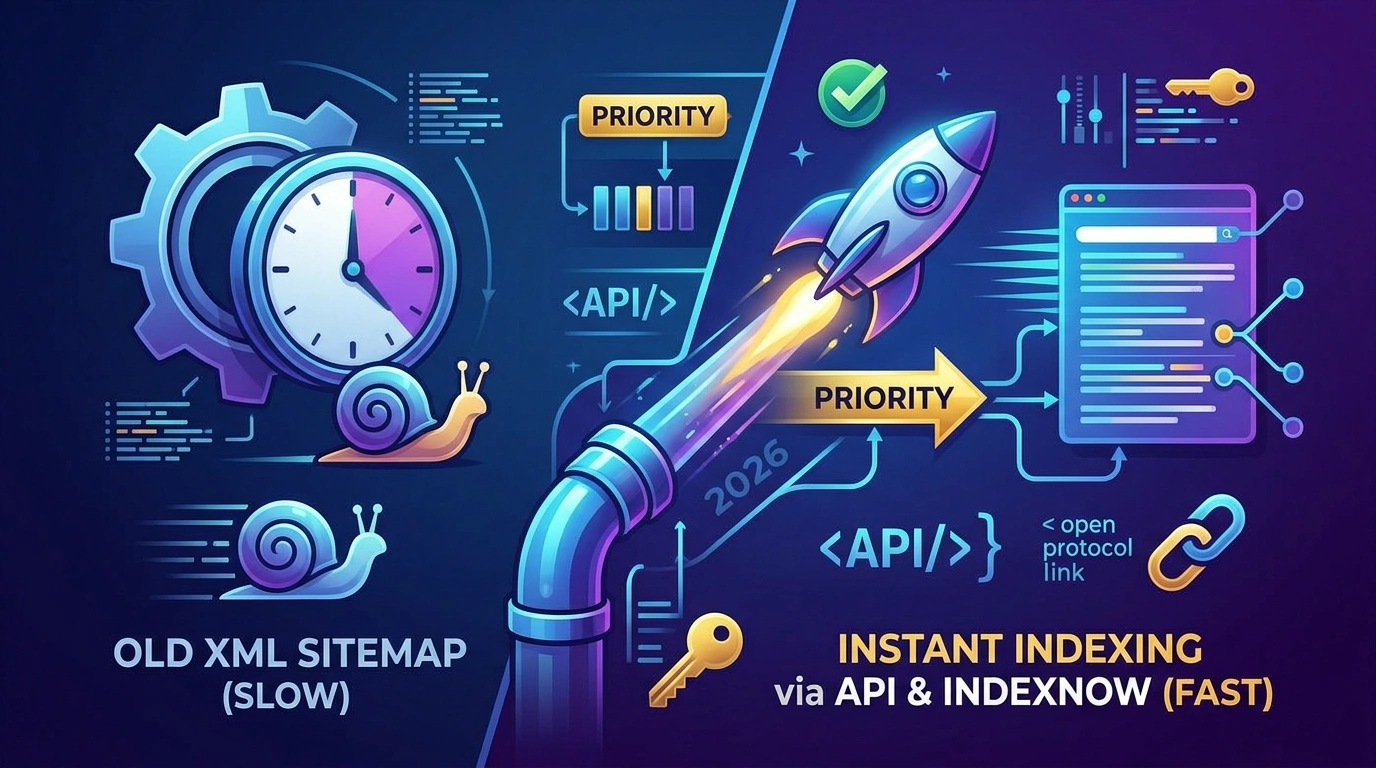
The traditional SEO model of publishing a post and passively waiting weeks for Googlebot to crawl your XML sitemap is dead. In the fast-paced 2026 digital landscape, search engines are allocating their crawl budgets more strictly than ever. For freelance developers and SEO consultants, this shift presents a highly lucrative opportunity: businesses are actively seeking technical specialists who can guarantee their new products, news, and generative AI content are indexed and ranking within hours, not weeks.
By mastering programmatic indexing protocols like the Google Indexing API and IndexNow, you can transition from selling standard “SEO optimization” to offering high-ticket “Instant Indexing Infrastructures.” This guide breaks down exactly how to implement these protocols for your clients, the technical nuances to navigate, and how to monetize this highly demanded skill.
How Do You Achieve Instant SEO Indexing in 2026?
To instantly index website content in 2026, webmasters must bypass passive XML sitemap crawling by programmatically pushing URL updates directly to search engines. For Google, this involves utilizing the Google Cloud Indexing API via a verified Service Account to trigger immediate crawls. For Microsoft Bing, Yahoo, and Yandex, implement the IndexNow protocol by hosting a verification .txt key at the server root and sending HTTP POST requests to automatically notify participating engines of new or updated content.
The Google Indexing API: Pushing Content to the Top
The Google Indexing API allows site owners to directly notify Google’s servers the exact moment a page is added, updated, or removed. Rather than waiting for a scheduled crawl, this API places your URLs in a high-priority queue.
Official vs. Unofficial Capabilities
According to official Google Search Central documentation, the Indexing API is strictly intended for pages containing JobPosting or BroadcastEvent structured data. For sites with highly volatile inventory (like daily job boards or livestream schedules), it keeps search results fresh by pushing updates individually.
However, technical SEO communities have long documented that implementing the API across standard eCommerce products and news articles frequently triggers successful, rapid indexing. While doing this operates in a gray area of Google’s official guidelines, the underlying mechanics remain the same.
Step-by-Step Implementation Framework
- Google Cloud Provisioning: Create a new project within the Google Cloud Console and enable the “Web Search Indexing API.”
- Service Account Creation: Generate a new Service Account and download the JSON key file. This file contains the cryptographic keys your script (or WordPress plugin) needs to authenticate.
- Search Console Authentication: This is the step most beginners miss. You must add the Service Account’s email address as an Owner in the Google Search Console property of the target domain.
- Sending the Payload: Using Node.js, Python, or a CMS plugin, send a POST request to
[https://indexing.googleapis.com/v3/urlNotifications:publish](https://indexing.googleapis.com/v3/urlNotifications:publish)with the target URL and theURL_UPDATEDorURL_DELETEDtype.
Quota Limitations: Google provisions a strict default limit of 200 API calls per day per project. For enterprise clients, you must request quota increases directly through the Cloud Console.
IndexNow: The Open-Source Future of Crawling
While Google maintains its proprietary API, the rest of the search landscape has unified under IndexNow. Supported by Microsoft Bing, Yandex, Seznam.cz, Naver, and Yep, IndexNow is an open-source ping protocol.
The defining advantage of IndexNow is its co-sharing mechanism. Search engines adopting the protocol agree to automatically share submitted URLs with all other participating search engines. You ping one; you update them all.
Implementing the IndexNow Protocol
Setting up IndexNow is significantly lighter than Google’s API, making it an easy “quick win” to offer clients:
- Key Generation: Generate an API key (a minimum of 8 and a maximum of 128 hexadecimal characters).
- Server Root Verification: Host a UTF-8 encoded text file named
{your-key}.txtat the root directory of the client’s website (e.g.,[https://www.example.com/3f2fa233444b4e87a5c40277499c4be4.txt](https://www.example.com/3f2fa233444b4e87a5c40277499c4be4.txt)). The file must contain the exact key string inside. - Triggering the Ping: To submit a single URL, you can fire a simple HTTP GET request.
- Example:
[https://www.bing.com/indexnow?url=https://www.example.com/product-page&key=your-key](https://www.bing.com/indexnow?url=https://www.example.com/product-page&key=your-key)
- Example:
- Batch Submissions: For bulk updates, you can submit up to 10,000 URLs per POST request using a JSON payload containing the
host,key, and anurlListarray.
Actionable Next Steps: Monetizing Your Indexing Skills
Do not sell “Google Indexing API setup” as an hourly task. Package this as a high-value technical infrastructure upgrade.
- The “Instant Index” Audit ($250 – $500): Audit a client’s current indexation ratio (pages published vs. pages indexed in Google Search Console).
- The Technical Implementation ($500 – $1,200): Set up the Google Cloud project, configure the Service Account, generate the IndexNow key, place it on their server, and configure their CMS (via custom PHP or headless architecture) to trigger pings on publish.
- The Retainer ($150/mo): Monitor API error logs, manage the 200-URL daily quota limitations, and maintain the JSON key security.
Frequently Asked Questions (FAQ)
Can I use the Google Indexing API for any type of website?
Officially, Google states the API is only for JobPosting and BroadcastEvent data. Any attempt to abuse the API to spam the index could result in your access being revoked. However, many technical SEOs successfully use it for standard pages, provided the content is high quality and not manipulative.
Do I still need XML sitemaps if I use IndexNow and the Indexing API?
Yes. Both Google and the IndexNow consortium explicitly state that APIs are meant to supplement, not replace, traditional sitemaps. The APIs handle rapid updates for volatile content, while XML sitemaps provide a comprehensive map for the complete structural coverage of your site.
How do I know if my IndexNow ping was successful?
A successful HTTP GET or POST request to the IndexNow endpoint will return an HTTP 200 response code. This confirms the search engine has received the URL, though it does not guarantee immediate inclusion in search engine results pages (SERPs).
Discover more from Remote Work Tips
Subscribe to get the latest posts sent to your email.

The launch of advanced large language models triggered a predictable collapse in the market for mediocre text. Content mills vanished, and freelance platforms saw rates for baseline SEO copy crater practically overnight. Yet, the death of the human writer was vastly overstated. What actually died was the commercial viability of regurgitation. For editors managing the desks at top-tier publications and corporate strategy units, the resulting flood of algorithmic prose has only clarified the value of what machines cannot execute. The market has rapidly bifurcated, placing an unprecedented premium on the specific freelance writing skills AI cannot replace.
The structural shift we are witnessing is not the end of commercial writing, but the automation of the consensus median. An algorithm trains on what has already been published, calculating the most probable next word to generate a perfectly average amalgamation of historical thought. According to global investment research from Goldman Sachs, generative AI could expose the equivalent of 300 million full-time jobs to automation, with administrative and mechanical text generation taking the heaviest initial hit.
Writing as the mere act of stringing grammatically correct sentences together is effectively a solved computational problem. Still, writing as an act of original synthesis and structural persuasion remains strictly human terrain. The economic value for independent writers no longer lies in producing the median. It lies in generating the alpha—the analytical edge that deviates from algorithmic predictability. Editors and brand directors are rapidly adjusting their budgets. They refuse to pay for competent summaries, instead directing capital toward investigative rigor, lived context, and the deliberate friction of human thought.
The Core Development: Moving Beyond Probability
To understand where freelance writers hold an insurmountable advantage, one must understand how generative models fail. AI operates on statistical probability, not truth, memory, or physical reality. It cannot pick up a phone, secure an off-the-record briefing, or read the nervous body language of a chief executive during an earnings call.
The first irreplaceable skill is primary source extraction. Algorithms summarize the internet; elite freelancers interview the people building it. The ability to identify the right human source, build sudden rapport, and extract a candid quote that has never been digitized is a moat AI cannot cross. The Reuters Institute for the Study of Journalism notes that original reporting and exclusive human sourcing remain the primary drivers of subscriber trust and retention.
Closely tied to this is strategic omission. Generative models are inherently additive. They default to comprehensiveness, listing every possible factor in a bulleted sequence because they lack the editorial confidence to leave things out. Human writers know that what you cut is as important as what you keep. Deciding to ignore three valid data points because they dilute the core narrative tension requires a discerning judgment that probability matrices do not possess.
That leads directly to subtextual analysis. AI reads text literally. It cannot read the room. Consider an editorial chief managing a digital finance publication in Sindh. When assigning a column on the latest IMF policy interventions or regional inflation metrics, they know an algorithm will merely summarize the official press release. It takes a human economist to read the deliberate silences within a central bank’s sterile prose, translating bureaucratic hesitation into a localized forecast on energy subsidies.
The Analytical Layer: Generating the Alpha
If the baseline of content is now perfectly competent and entirely unoriginal, the premium shifts to structural interpretation. This is where high-income freelancers transition from writers to analysts.
Why does AI fail at analytical writing? Generative models are designed to find the safest mathematical consensus within their training data. They average out competing viewpoints to avoid hallucinations or controversy. Analytical writing requires taking a definitive, original stance, relying on inductive reasoning and critical leaps that algorithms are explicitly programmed to avoid.
This introduces the fourth skill: counter-narrative generation. When the entire digital ecosystem is parroting the same trend, the valuable freelance writer constructs a well-defended contrarian thesis. If the market consensus is that a new technology will streamline logistics, the human analyst looks at the historical labor relations of the sector and predicts a union strike.
Fifth is institutional critique. Algorithms are heavily guardrailed by their parent companies to avoid offending governments, corporations, or protected groups. They struggle to formulate biting, structural criticisms of powerful entities. A human writer can identify systemic hypocrisy—for instance, tracking how a specific regulatory framework quietly benefits the very monopolies it claims to police.
Sixth is the mastery of asymmetric synthesis. AI is excellent at comparing two highly related concepts. It is remarkably poor at connecting two seemingly unrelated disciplines to form a new thesis. A human writer can draw a structural parallel between 19th-century maritime insurance law and modern cryptocurrency exchanges, creating a conceptual bridge that no algorithmic training data has previously linked.
Implications and Second-Order Effects: The Emotional Economy
The downstream consequences of the AI content flood are already visible in corporate marketing and digital publishing. As the volume of synthetic text approaches infinity, the cost of generating words falls to zero. Consequently, reader trust is plummeting. Businesses are discovering that while AI copy can fill a webpage instantly, it often fails to convert at the bottom of the funnel because it lacks edge, conviction, and emotional resonance.
This brings us to the seventh skill: emotional pacing. Algorithms write at a single, unrelenting cadence. They do not understand how to build intellectual suspense, when to deploy a fragmented sentence for blunt impact, or how to let a devastating statistic sit alone on a line to force the reader to pause. Human writers manipulate rhythm to control the reader’s breathing and emotional state.
Eighth is the application of irony and calculated irreverence. Sarcasm, wit, and irony require a shared understanding of cultural context and human absurdity. When AI attempts humor, it defaults to algorithmic puns or safe, sterile jokes. A human writer can deploy a dry, cynical observation about a failing tech startup that resonates perfectly with a frustrated audience.
Ninth is the capacity for ethical framing. Data does not exist in a vacuum. According to the Bank for International Settlements, while artificial intelligence can process macroeconomic data at unprecedented speeds, the interpretation of that data carries profound ethical implications. When writing about poverty metrics, job displacement, or public health, a human writer frames the statistics with an innate understanding of human suffering and dignity—something an algorithm can only pantomime.
The Counterargument: The Illusion of Algorithmic Context
Tech determinists argue this view is shortsighted. They suggest the limitations of current LLMs are temporary engineering problems, not permanent philosophical boundaries. Proponents of autonomous agents argue that the next generation of models will possess infinite contextual memory and the ability to execute multi-step research workflows independently.
According to researchers at MIT Technology Review, autonomous AI agents will soon be capable of scraping localized databases, monitoring real-time financial feeds, and generating localized analysis without human prompting. From this perspective, the idea that only humans can synthesize complex data or execute macroeconomic contextualisation is a romantic delusion. The machine, they argue, will eventually simulate empathy, irony, and analytical reasoning so flawlessly that the end consumer will neither notice nor care about the distinction.
Yet, this argument fundamentally misunderstands the economics of attention. Even if a machine perfectly simulates a controversial opinion, it remains a simulation. A machine cannot put its reputation on the line. The tenth and most critical skill is skin in the game. Readers value a bold piece of analysis because a human being risked their professional credibility to publish it. An algorithm cannot be brave, because an algorithm has nothing to lose. When a freelancer attaches their byline to a fierce institutional critique, the value stems entirely from the fact that a human mind took a verifiable risk.
The Enduring Premium on Human Friction
The paradox of the generative era is that the more flawless machine text we produce, the higher the market premium on verified human thought. The skills that will sustain high-income freelancers over the next decade have very little to do with typing speed, grammatical perfection, or baseline SEO optimization.
Those capabilities have been permanently commoditized. The future belongs to the editors, the economists, the investigative reporters, and the analysts who treat writing merely as the final delivery mechanism for their thinking. The algorithm can perfectly summarize what happened yesterday. The human writer’s job is to explain why it matters, who is lying about it, and what will inevitably break tomorrow.
Discover more from Remote Work Tips
Subscribe to get the latest posts sent to your email.


How to Calculate Your Freelance Day Rate (& Raise It Without Losing Clients)
Setting your freelance day rate is one of the most critical commercial decisions you will make. Set it too low,...


Optimizing for AI Overviews: The Freelancer’s Guide to Schema Markup & Generative Engine Optimization (GEO)
Traditional search engine optimization is undergoing a seismic shift. As Google AI Overviews, Perplexity, and SearchGPT handle millions of daily...


Top 6 Payment Solutions for Freelancers Faster Than Banks
Midway through a project in Milan, a freelance UX designer named Elena watched her rent payment bounce. The client’s bank...


10 Freelancing Tips for Landing Projects in the AI Era
The Market Split No One Warned You About In February 2026, a mid-career graphic designer in Austin posted to a...


The Sovereign Developer: The 5 Most Lucrative Coding Jobs in 2026 (And Why They Pay So Well)
For the past three years, the prevailing tech narrative has been dominated by a singular, slightly hysterical prediction: AI is...


Top 10 Most Demanded Freelance Skills in 2026
The Trillion-Dollar Talent Shift Nobody Is Talking About Honestly There is a number that should stop every career-minded professional in...


Fiverr Denies ‘Major Security Lapse’ Despite Private User Data Appearing in Google Search
Imagine logging into Google on a Tuesday morning to check your own name — a routine vanity search, the kind...


4 Must-Have Skills Every Nomadic Founder Needs to Build a Successful Online Business
Want to work from anywhere? I know this because I’ve been on both sides of that line. From Trucking Routes...
-

 blogging5 years ago
How to Use Social Media to Promote Your Blog
-

 freelance5 years ago
6 Future-Focused Skills Freelance Creatives Can’t Afford to Ignore
-

 social media5 years ago
How to Learn Social Media Without Getting Scammed
-

 freelance9 months ago
The Economics of Remote Work: How Hybrid Models Are Reshaping Global Productivity
-

 blogging5 years ago
20 Best Freelance Marketplaces for Freelancers in 2022 to Make Money
-

 freelance5 years ago
7 Highest Paying Freelance Jobs For Earning A Steady Income
-

 Digital Banking5 years ago
Pakistan Consumer Confidence Index increased by 8.8% in Q4 2021
-

 blogging5 years ago
30 “Proven” Ways to Make Money Online Blogging with WordPress