
freelance
10 Ways to Discover if Freelancing is for You


Freelancing is a popular career choice for many people, especially those with an entrepreneurial spirit and a desire to escape a boring 9-to-5 office job. Yet while a freelancing career can be liberating in many ways, it’s also a very difficult route to take. Not everyone is suited to this way of working.
There are a number of character traits and natural tendencies you need in order to succeed as a freelance professional. If you don’t have at least some of these characteristics, then you’ll soon find working for your own clients is even more grueling than working for a boss.
Being self-employed and growing your own business is a lot harder than people imagine. A lot of people try freelancing but end up returning to a more traditional job after a year or two. In most cases, this is because they were not really suited to a freelance way of working in the first place.
So how can you tell whether you’ll love freelancing or soon find it an anxiety-inducing struggle?
Here are 10 questions to help you discover whether a freelancing career is for you:
Do you mind working alone?
Freelancing is more often than not a solitary career. Freelancers do come together to collaborate sometimes and also to meet with clients, but usually, you’ll be working alone. If you’re content spending many hours by yourself, usually working in your home office/studio, then freelancing will be an ideal career choice.
Are you good at organizing your time?
As a freelancer, you’re in full control of how many hours you work. This is liberating in one sense but also a big responsibility in another. The majority of successful freelancers micromanage their time, using time-tracking tools, to ensure they’re making use of each and every minute.
If you have an eye for details and you are naturally an organized person, then freelancing will suit your personality. If not, then you’ll very quickly be in trouble.
Can you wear many hats?
Part of being organized as a freelancer is the ability to do many different things, often in a single day. It’s easy to picture freelancing as simply working on a client’s project but there’s a lot more to it than that.
Freelancers are business owners. You’ll need to carry out tasks related to marketing, invoicing, bookkeeping, contract negotiating, website upkeep, networking, ongoing self-learning, and more.
Can you focus when in any surroundings?
A big draw of the freelance lifestyle is the ability to potentially work just about anywhere with an internet connection. You can spend your mornings in your favorite coffee shop and your afternoons in a co-working space. You can even run a freelancing business while traveling the world.
This is all possible but only if you have the ability to focus on your work wherever you go. Distractions are huge when you’re out and about but if you can still hone in on what needs to be done, and get it done, then freelancing is ideal.
Can you self-motivate yourself?
Everyone is motivated when they begin a new business or adventure. It’s easy to be excited and hardworking in those early days. The problems arise weeks and months later when work becomes a little monotonous or clients are still hard to come by.
Successful freelancing requires self-motivation. It means ignoring the temptations of television, social media, phones, and unnecessary visits to the local store. If you’re good at motivating yourself to reach your targets, then freelancing is a sound career choice.
Are you comfortable with risk and uncertainty?
There are absolutely no guarantees you’ll succeed when you start down the freelancing path. In fact, for many people who try, freelancing ends in frustration. However, with hard work, determination, and intelligent planning, there’s a decent chance you’ll do well. But you’ll never really known until you reach your goals.
You just have to be comfortable with that uncertainty and plough on regardless. It takes time to build a lucrative freelancing career. And the fact is, even when you make it, you’re not guaranteed clients all the time even then.
Do you have self-confidence?
As well as having the ability to live with uncertainty, a successful freelancer also needs a lot of self-confidence. You have to believe in yourself and your worth, especially when it comes to being paid what you deserve. Negotiating rates and contracts, and dealing with any bad clients, requires guts and self-belief.
If you’re severely lacking in self-confidence, then you might find a freelance career difficult, especially when it comes to earning decent fees.
Are you a good communicator?
A big part of self-confidence comes across in communications with your clients. Phone conversations are often necessary, which can be a little uncomfortable even for experienced professionals. Whether nervous or not, you’ll need to be able to convey confidence, control, and likeability.
You can be exceptional at what you do but if you come across as a nervous wreck in that first phone call, then you’ll probably lose the prospect. If you’re reasonably comfortable chatting on the phone, then freelancing clients will be relatively easy to come by.
Do you enjoy flexibility?
No two clients are alike. You often need to adapt your services to fit a client’s unique requirements. This needs creativity and flexibility on your part in order to deliver the perfect set of services for their goals.
Also, what your freelancing business looks like on Day One will inevitably be somewhat different a year or two down the line. Freelancing success requires flexibility and adaptability in order to fill gaps in the market. If you prefer safe predictability, a freelance life will not be for you.
Do you have a skill?
There are freelance professionals, in many diverse sectors, making a lot of money doing what they love to do. And you can do the same. If, that is, you have a particular skill enough people are willing to pay good money for.
Competition is very fierce and so it’s wise to have an in-demand skill you’re good at, know how to market, and can develop into a specialism. If you don’t, then freelancing is going to be an uphill battle.
Is freelancing right for you?
Take a little time to think over these questions. Dig down deep and answer them as truthfully as possible. You may not have positive answers for all the questions right now, and that’s okay, as long as you can see a way to develop these traits and skills.
Freelancing is a fantastic career choice, especially when you have a passion for the skills you want to be paid for. It allows you to shape your workday as you see fit and work with some amazing clients on some fantastic projects.
However, it is hard work, especially in the first few months and years. You need to love what you do because initially, you’ll be working a lot harder than you were in your office job.
Discover more from Remote Work Tips
Subscribe to get the latest posts sent to your email.




Midway through a project in Milan, a freelance UX designer named Elena watched her rent payment bounce. The client’s bank transfer, sent five days earlier from Singapore, still hadn’t cleared. The traditional correspondent banking chain had swallowed the funds in a labyrinth of intermediary fees and time-zone lags. For Elena, and the estimated 1.57 billion freelancers worldwide, bank payment delays aren’t mere inconvenience—they’re cash-flow risks that threaten solvency. The rapid rise of payment solutions for freelancers faster than banks has turned what was once a passive wait into a deliberate choice: which platform delivers speed, cost, and reliability in the same stroke? Six contenders have emerged as the clear front-runners.
Freelance income now accounts for a significant and growing slice of global GDP, yet the plumbing underneath cross-border payments remained, until recently, frozen in the 1970s. SWIFT’s correspondent banking model, where a payment hops between multiple intermediaries, still underpins most bank wires; a single transfer can take three to five business days and lose up to 7% in hidden exchange-rate mark-ups, according to a 2023 analysis by the Bank for International Settlements. Meanwhile, regulators and market forces have cracked open the rails. The UK’s Faster Payments Service processes most domestic transfers within seconds. The Single Euro Payments Area (SEPA) now offers SEPA Instant, settling in under 10 seconds across 36 countries. And from November 2022, the SWIFT gpi initiative began enforcing a one-day settlement target for cross-border transfers. Yet banks rarely pass these improvements on to retail freelancers. The gap between what is technically possible and what a sole trader experiences has created a fertile market for specialist non-bank providers.
The Core Contenders: Six Solutions That Outpace Banks
1. Wise (formerly TransferWise)
Wise has built a parallel network of local bank accounts in over 70 countries, effectively turning a cross-border transfer into two domestic ones. A freelancer receiving a payment from the US to the UK sees the funds land—often within hours, not days—at the mid-market exchange rate plus a transparent, upfront fee that averages 0.5–1%. Unlike banks that bury the cost in a padded exchange rate, Wise displays the real rate from Reuters. For a £1,000 invoice paid in US dollars, a typical high-street bank might deduct £40–£70 in hidden charges; Wise takes around £5. The Financial Conduct Authority (FCA) regulates Wise as an electronic money institution, meaning client funds are ring-fenced but not covered by the Financial Services Compensation Scheme (FSCS). That nuance matters.
2. Revolut
Revolut’s multi-currency account allows freelancers to hold, receive, and exchange 30+ currencies inside the app at interbank rates up to a monthly limit. Domestic transfers within the same currency are frequently instantaneous; international payments ride on Revolut’s banking licences in the European Economic Area and partnerships with local providers. A key advantage is the ability to generate virtual IBANs in multiple jurisdictions, so a client in Germany sees a local DE-IBAN and pays via SEPA Instant, while a UK client uses the local sort code and account number to send via Faster Payments. For freelancers who invoice in several currencies, the net speed gain—no conversion delay at the receiving bank—can cut settlement time by two to three days.
3. PayPal
PayPal’s ubiquity masks its variable speed profile. A domestic PayPal-to-PayPal transfer is instant; withdrawing to a bank account normally takes one to three business days in Europe (though the US now offers an instant transfer option for a 1.75% fee). For international receipts, PayPal leverages its internal ledger to move funds between user balances instantly, but the currency conversion spread is steep, typically 3–4% above the mid-market rate. Still, for freelancers on platforms such as Upwork or Fiverr, PayPal remains the default and often the fastest way to access earnings because the marketplace itself integrates directly with PayPal’s API, releasing payments immediately upon client approval.
4. Payoneer
Payoneer specialises in cross-border business-to-business (B2B) payments, with deep integrations into freelance marketplaces, including Upwork, Freelancer.com, and Fiverr. Once a freelancer’s Payoneer account receives funds from a marketplace, the money can be withdrawn to a local bank account or spent via the Payoneer Mastercard. Withdrawal speed varies by region: transfers to US bank accounts typically land within 24 hours; SEPA transfers often settle the next business day. Payoneer’s fee structure—2% above the mid-market rate for currency conversion and a $1.50–$3.00 withdrawal fee—is less transparent than Wise’s but still undercuts most banks. The firm is regulated by the Central Bank of Ireland and the FCA.
5. Stripe Connect
Stripe is not a payments wallet; it is an infrastructure layer that platforms and marketplaces embed. For freelancers, Stripe Connect means they can get paid directly into their bank account via the client’s card or bank debit without holding a third-party balance. Payout speed depends on the platform’s settings and the freelancer’s bank geography: in the UK, Stripe offers instant payouts via the Faster Payments scheme for a 1% fee, while standard payouts take two business days. In the US, Stripe’s Instant Payouts to a linked debit card take less than 30 minutes. Because Stripe handles both payment acceptance and payout orchestration, the freelancer skips the manual step of initiating a withdrawal, effectively removing a day of friction.
6. Deel (for global contractors)
Deel started as a compliance and contract-management tool but has rapidly become the payout engine for internationally distributed freelancers. It supports withdrawals in over 120 currencies to bank accounts, digital wallets (PayPal, Payoneer), or even crypto wallets. Deel’s speed advantage is rooted in its internal liquidity pool: when a client funds a contract, Deel can advance the payment to the freelancer before the underlying bank transfer clears, a process that can put money in the freelancer’s account in less than one business day. Pricing is opaque because it is bundled into the client’s contractor management fee, but for the freelancer receiving $1,000, the effective receipt time is vastly shorter than a SWIFT wire.
Why the Banks Are Still So Slow—And Where Fintechs Leapfrog
How Swift, Correspondent Banking, and Legacy Technology Constrain Transfer Times
A single cross-border bank wire can involve up to four intermediary banks, each levying a handling fee and a delay of up to a full working day while anti-money-laundering (AML) checks are conducted. SWIFT messages, which are effectively payment instructions rather than actual money movement, require each bank in the chain to reconcile credit and debit entries on its own systems before the final beneficiary bank releases funds. Even the Bank of England’s RTGS system, which settles high-value payments in real time, only covers sterling-denominated domestic transfers. As soon as a currency boundary is crossed, the payment falls back onto the correspondent network unless both ends are on the same fintech platform.
What is the fastest way to receive international payments as a freelancer?
The fastest route is to use a non-bank provider that holds local bank accounts in both the sender’s and receiver’s countries, such as Wise or Revolut, because the transfer becomes two domestic transfers and avoids the SWIFT correspondent chain. Settlement can occur in under 20 seconds when both rails support instant schemes like SEPA Instant or the UK’s Faster Payments, compared with three to five working days for a traditional wire.
The technological gap is not insurmountable for incumbents. ISO 20022, the new global messaging standard for payments, is already live on SWIFT and on the Bank of England’s RTGS system. ISO 20022 messages carry far richer data, which can automate AML and sanctions screening, theoretically slashing delay. Yet adoption is fragmented: by March 2026, all SWIFT members must be able to receive ISO 20022 messages, but many smaller banks in developing economies are lagging. Fintechs, unburdened by legacy mainframes, adopted the standard early. Wise, for instance, built its entire network around a proprietary data model that pre-empted ISO 20022’s structured remittance fields, giving it a speed advantage that banks may take years to close.
Another structural drag is bank liquidity management. To offer instant international settlements, a bank must pre-fund accounts in multiple currencies across multiple jurisdictions—tying up capital and exposing the bank to foreign-exchange risk. Non-bank providers pool client flows and net them off internally, which dramatically reduces the need for physical currency conversion. The Bank for International Settlements noted in a 2022 paper that “pre-funding costs remain the principal barrier to widespread instant cross-border payments.” That commercial calculus keeps most high-street banks stuck at the three-day benchmark while fintechs advertise minutes.
Second-Order Effects: What Faster Money Does to a Freelance Business
When a freelancer’s payment cycle shrinks from five days to five hours, the effects ripple beyond the bank balance. Cash-flow volatility, the single biggest killer of micro-businesses, is dampened. A freelance graphic designer who previously kept a £3,000 overdraft buffer to cover working-capital gaps can reduce it by half, saving £100–£150 annually in interest, assuming a typical 8% overdraft rate. Multiplied across 4.2 million solo self-employed workers in the UK alone, the aggregate savings from improved liquidity are non-trivial.
Tax compliance also shifts. Receiving income in multiple currencies through a multi-currency account creates a clear digital audit trail, with conversion rates time-stamped to the second. HM Revenue & Customs (HMRC) accepts the exchange rate published at the point of receipt, not an end-of-month average. Freelancers using a provider like Wise can generate an automated tax report that aligns with HMRC’s strictures, reducing accountancy fees by a couple of hundred pounds a year. A 2023 Office of Tax Simplification review recommended that HMRC “explore the capacity of digital payment platforms to automate foreign-income reporting,” a sign that the tax system is beginning to recognise the fintech-native freelancer.
Yet the acceleration of payments creates an expectation trap. Clients, especially agencies, begin to assume that because the technology permits same-day settlement, freelancers will accept delayed payment terms of 14 days or more without complaint. This asymmetrical pressure can erode the freelancer’s negotiating power. “I’ve had clients tell me that since the money arrives ‘instantly’ on my side, they see no need to pay earlier,” says London-based motion designer Jamal Choudhury. “But the speed of the rail doesn’t change when they hit ‘send’.” The social contract of invoicing is being rewritten by the technology, and not always to the freelancer’s benefit.
The Security Trade-off and the Dissenting View
Not every freelancer is persuaded that speed trumps all. Some high-value contractors—those billing £10,000-plus per invoice—deliberately stick with traditional bank wires because of the FSCS protection that covers deposits up to £85,000. Most non-bank payment providers are electronic money institutions, where client funds must be segregated but would not be guaranteed in full if the firm failed. The collapse of Wirecard in 2020, which left fintech customers unable to access cash for weeks, remains a vivid cautionary tale.
Fraud and chargeback risk also tilt the calculation. Bank wires, once settled via SWIFT, are difficult to reverse—a feature, not a bug, for the freelancer who wants certainty of receipt. Fintech platforms often embed faster reversal mechanisms, which can be exploited by dishonest clients. PayPal’s seller protection, for instance, does not cover intangible services if the client files a claim with their card issuer. A freelancer who delivers a completed website code may find the payment recalled weeks later, with limited recourse.
Banks themselves are not standing still. JPMorgan Chase now offers same-day foreign exchange through its corporate platform. HSBC’s Global Money Account promises fee-free international transfers for personal and small-business customers in select countries. And several high-street lenders are piloting merchant-initiated payment request overlays that allow a freelancer to ping a client’s banking app with an invoice that can be approved and settled in real time via open banking. “The real competition hasn’t been won yet,” observes Payments Association director Ricardo Martinez. “Fintechs forced the agenda, but the incumbents hold the deposit insurance and the client relationships. The next three years will see a convergence of speed and safety.”
Still, for the freelancer sitting on an overdue electricity bill, waiting for a convergence that may arrive in 2027 is not a strategy. The six solutions profiled here exist now, each with a specific speed-to-trust ratio. The choice reduces to a single organising principle: whether one prefers transparent, near-instant settlement with a slightly thinner safety net, or a laggard but state-guaranteed system whose delay is itself a form of cost. Freelancers are increasingly voting with their IBANs.
The freelance economy no longer measures value in hours billed alone. It measures value in the minutes between invoice and available balance. Banks may eventually close the speed gap, but for now, a handful of non-bank payment solutions have built a parallel financial system that treats freelancers’ time as the scarce resource it actually is.
Discover more from Remote Work Tips
Subscribe to get the latest posts sent to your email.
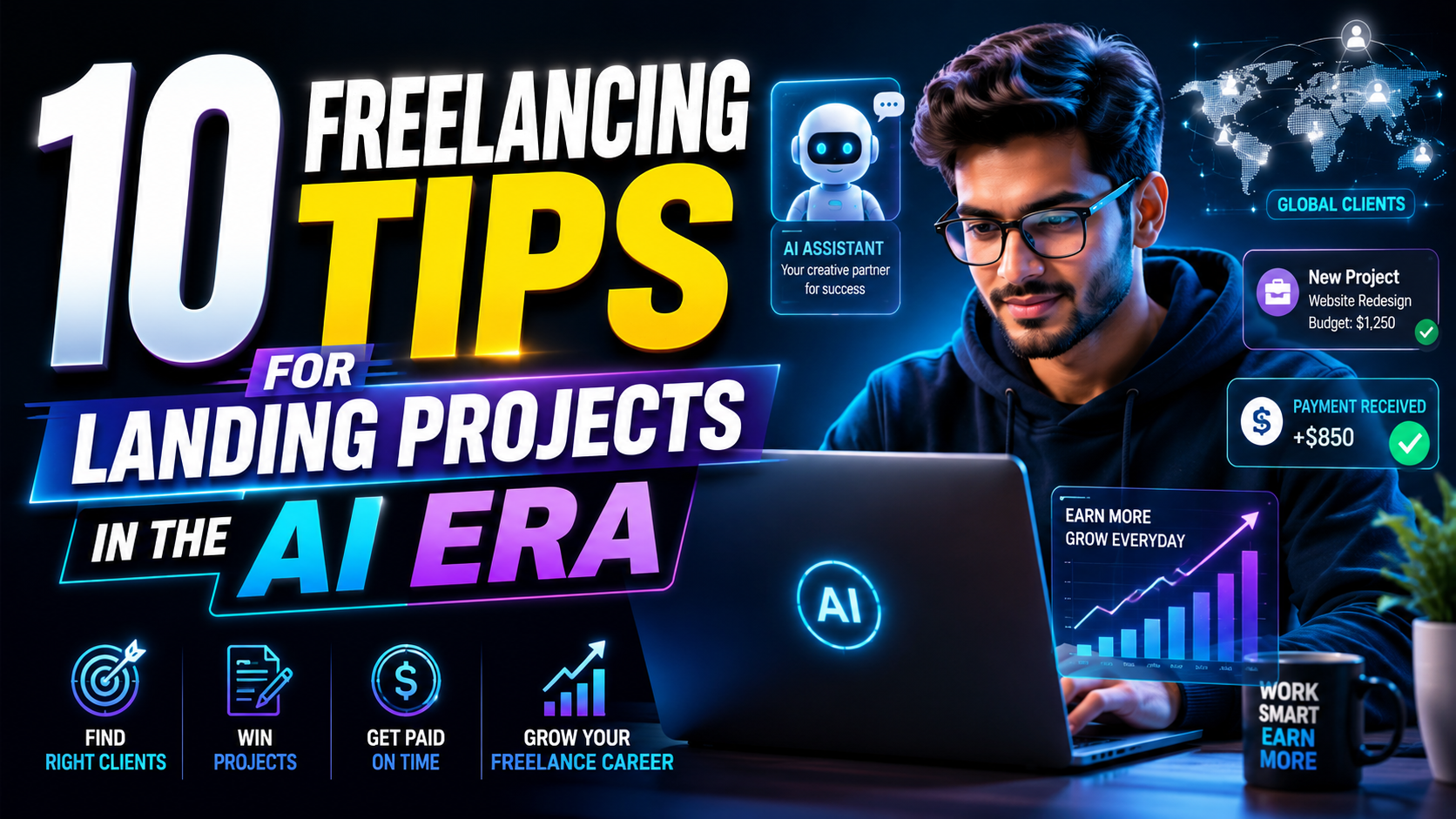
The Market Split No One Warned You About
In February 2026, a mid-career graphic designer in Austin posted to a freelance forum that her monthly income had collapsed from $8,400 to under $2,000 in 18 months. Three weeks later, a prompt engineer in the same city posted that she’d just closed her fourth $15,000 AI integration contract of the year. Same city. Same gig economy. Entirely different trajectories. That gap — between the freelancer being automated and the freelancer doing the automating — is the defining story of independent work right now. How you land on one side of that line isn’t a matter of luck or timing. It’s strategy, positioning, and a willingness to treat this disruption as a restructuring rather than a catastrophe.
The Landscape Has Changed Faster Than Most Freelancers Have
The numbers make the bifurcation unmistakable. A landmark study by researchers at Imperial College London, Harvard Business School, and the German Institute for Economic Research found that within eight months of ChatGPT’s launch, demand for freelance writing jobs fell roughly 30% — the steepest single-category decline they tracked. Software development dropped about 21%. Graphic design fell 17%. The Vollna Upwork Market Report confirmed that trend was accelerating into 2025. Mediabistro
Yet the same market is generating historically high rates at the specialist end. AI-related freelance skills on Upwork grew 109% year-over-year in 2025, with the platform reporting that demand for top AI skills more than doubled across completed job earnings. AI-specialised freelancers command 25–60% higher rates than general practitioners in the same field. HeroHuntJobbers
The US independent workforce already stands at approximately 72.9 million freelancers, with projections indicating that number could reach 86.5 million by 2027 — roughly half the national labor force. Volume is growing. But raw volume disguises a quality split that is becoming harder to straddle. Generic skills are being commoditised fast. Specialised, AI-augmented professionals are experiencing the opposite: a seller’s market, elevated rates, and a client base that can’t hire full-time talent fast enough to meet demand. Autofaceless
That context matters, because the ten strategies that follow aren’t motivational advice. They’re structural responses to a structural shift.
1 — The Core Moves: What You Must Do First
1. Pick a lane narrow enough to own
The first thing most freelancers get wrong in the AI era is staying general. Generalists now compete directly with tools that can perform broad, mid-quality tasks at near-zero marginal cost. The market is rewarding the opposite move — surgical specialisation in an area where the human layer is genuinely irreplaceable.
Clients prefer niche expertise in 68% of cases, and specialists earn 40% higher rates as a result. The question worth sitting with isn’t “what can I do?” It’s “what can I do that becomes harder, not easier, to replicate as AI improves?” The answer usually lies at the intersection of deep domain knowledge, interpersonal judgment, and execution fluency — qualities that take years to develop and don’t compress into a training dataset. Bestjobsearchapps
A UX researcher who specialises in healthcare patient workflows, an accountant who audits AI-generated financial models, a technical writer who documents enterprise ML systems — these aren’t fringe niches. They’re premium ones.
2. Build your portfolio around outcomes, not outputs
Clients in 2026 have become more risk-averse and more data-literate simultaneously. They’re not buying deliverables; they’re buying certainty of result. A portfolio that says “I wrote 50 blog posts” is being passed over for one that says “I built a content infrastructure that reduced a client’s lead acquisition cost by 34%.” Specificity is the currency. “Increased email conversion rates by 47%” lands harder than any description of your creative process.
According to Upwork research, 74% of executives now consider degrees irrelevant when hiring freelancers, focusing instead on proven expertise. In fact, 78% of CEOs assert that their top freelancers contribute more value than degree-holding employees. That signals a hiring culture built on demonstrable results, not credentials. Your portfolio should read like an evidence file. Upwork Inc.
3. Treat AI tools as a multiplier, not a shortcut
Upwork’s research found that 54% of freelancers report advanced AI proficiency compared to just 38% of full-time employees — a gap that clients are increasingly factoring into their decisions. Freelancers who deploy AI tools to deliver faster, more refined work aren’t undercutting themselves; they’re compressing timelines and expanding the scope of what they can credibly promise. The danger lies in using AI as a shortcut to mediocrity — offloading judgment rather than amplifying it. TechTarget
The freelancers winning right now are running AI as a co-pilot while keeping human oversight of quality, strategy, and client relationships. That combination produces deliverables that AI alone cannot match and that unaugmented humans cannot produce at the same speed.
4. Certify what you know — visibly
Prompt engineering certifications from DeepLearning.AI, machine learning specialisations on Coursera, AWS AI practitioner credentials — these are increasingly appearing as threshold requirements in high-value project postings. Prompt engineering has grown 240% since ChatGPT’s launch, AI content editing 180%, and AI tool training 165%, according to Upwork’s research. Credentials in these areas function less as proof of capability and more as filtering mechanisms: they’re a signal that you’ve committed seriously enough to a specialisation to formalise it. Jobbers
Visible certification also shortens the discovery-to-trust arc with new clients. A potential client who can verify your skills before the first call arrives with a materially different posture than one who’s reading your self-description for the first time.
2 — The Analytical Layer: Positioning and Visibility
What AI skills do freelancers need to land clients in 2026?
The answer isn’t a single skill set — it’s a layered combination. Freelancers who command the highest rates are those who can do something a business genuinely needs, then use AI to execute it faster and at higher quality. Specifically: prompt engineering within a defined domain, AI workflow automation using tools like Zapier, Make, and n8n, and the ability to fine-tune or critically evaluate AI outputs in context. Those three capabilities, paired with verifiable domain expertise, consistently produce rate premiums above $100 per hour.
5. Build in public — and be specific about what you’re doing
Thought leadership is among the most underused client-acquisition channels available to independent professionals. In 2026, 56% of freelancers acquire new work through professional and personal networks — a substantial jump from 30% in 2024. This shift is attributed to clients being more risk-averse and relying on trusted referrals, and to the saturation of freelance platforms. Accio
That number didn’t move by accident. It reflects a market in which clients have grown suspicious of cold platform pitches and are defaulting to referrals from people they already trust. The freelancer who publishes a detailed LinkedIn post walking through an AI workflow they built for a real client, or writes a case study explaining why a particular automation saved a client 12 hours a week, is compressing their sales cycle dramatically. Generic visibility doesn’t achieve this. Specific, documented competence does.
6. Position yourself as an AI translator, not just an AI user
Most businesses know they need to adopt AI. Very few know where to start, what tools integrate with their existing stack, or how to measure the return on investment. McKinsey research found that only 1% of companies have successfully scaled AI across their enterprises, leaving an enormous operational gap between executive ambition and ground-level implementation. Freelancers who can bridge that distance — explaining AI capabilities in business terms, scoping realistic projects, delivering measurable results — are filling a role that currently has more demand than supply. TechTarget
This position isn’t purely technical. It requires the kind of communicative and consultative fluency that no AI tool currently replicates. Senior AI consultants operating in this space are billing $150–$300 per hour for enterprise engagements that can run from $25,000 to $500,000 in total contract value.
7. Diversify across platforms while developing relationships that don’t need them
Platform concentration is a risk that experienced freelancers understand but newer ones underestimate. Fiverr recorded a 4% marketplace decline and a 10% drop in active buyers in 2025. Upwork’s active buyer numbers have shown volatility. Commission-free platforms — Contra, Braintrust, Jobbers — are gaining traction among experienced practitioners who want to retain a greater share of their earnings. The asymmetric move is to maintain a presence across multiple platforms while simultaneously building direct client relationships that aren’t mediated by any platform’s algorithm. Autofaceless
Direct relationships are slower to establish and more durable once formed. They’re also where the best work tends to live.
3 — Implications and Second-Order Effects
8. Price to your actual market position — not your anxiety
The structural economics here deserve honest attention. A February 2026 study from Ramp found that more than half of businesses that spent on freelance platforms in 2022 had stopped entirely by 2025. Freelance marketplace spending as a share of total company spend dropped from 0.66% to 0.14%. AI model spending went from zero to 2.85%. Mediabistro
For generalists, that’s alarming. For specialists, it clears the market of competition. There are now effectively two freelance economies running in parallel. One is a commodity market competing on price and speed, inhabited by volume-seeking generalists and increasingly by AI-generated deliverables. The other is a premium market competing on expertise, client trust, and measurable outcomes. Many capable freelancers are operating in the commodity market not because their skills belong there, but because their pricing and positioning haven’t caught up with the value they deliver.
Entry-level prompt engineers bill $50–$80 per hour; experienced ML developers command $100–$200; senior AI consultants clear $150–$300. Those ranges don’t apply universally, but they signal what the top of the market currently pays — and how far below it most qualified freelancers are operating. Jobbers
9. Convert one satisfied client into three
Over 99% of major employers plan to continue or increase their use of freelancers throughout 2025 and 2026. That’s not a statistic to file and forget — it’s a pipeline signal. The clients who already trust you are the fastest path to new, better-paying work, through expanded project scope, contract renewals, and direct referrals to peers in their networks. The freelancers compounding fastest right now aren’t the ones sending the highest volume of cold proposals; they’re the ones delivering so precisely that their clients become the most effective marketing channel they have. DemandSage
One concrete tactic: at project close, send a concise impact summary — three or four data points quantifying what you delivered. It gives the client the language to describe you to a colleague, it reinforces your value before the next budget conversation, and it signals the kind of professional rigour that separates a repeat contractor from a one-off vendor.
4 — The Counterargument Worth Taking Seriously
10. Don’t mistake positioning for pretending
There’s a dissenting view that deserves a fair hearing. Ethan Mollick, professor at the Wharton School of the University of Pennsylvania and a careful analyst of AI’s labour market effects, has argued that the apparent safety of many “AI-adjacent” roles may be shorter-lived than current enthusiasm suggests. The roles that seem like natural refuges today — AI trainer, prompt consultant, automation specialist — are themselves subject to capability improvement as models become more agentic. What looks like a moat at current AI capability levels may not hold at the next.
That framing matters because the advice to “specialise in AI” can tip from strategy into performance if it isn’t grounded in genuine skill development. A freelancer who markets themselves as an “AI integration specialist” after completing a handful of online courses is not the same as one who has deployed a working automation for a real client and can document the result. Upwork reported that AI-related freelance work crossed $300 million in annualized value by late 2025, but that total is concentrated among a relatively small pool of established practitioners. New entrants are competing for visibility against incumbents with verified track records, review histories, and client networks that platform algorithms actively favour. Mediabistro
There’s also a quieter concern: the freelancers most likely to thrive long-term aren’t necessarily those who’ve pivoted hardest toward AI, but those who’ve found the specific intersection where their existing expertise and AI fluency make them genuinely difficult to replace. The sustainable answer, then, is to specialise in something you’d want to know deeply even if it didn’t pay exceptionally well — because that depth is what survives the next wave of capability expansion, and the one after that.
The Gap Is Fixable
The freelance market in 2026 isn’t contracting. It’s bifurcating. On one side: a narrowing commodity tier where price competition is intensifying and AI tools are credible substitutes for many standard deliverables. On the other: an expanding, better-compensated tier of specialists who combine genuine domain knowledge, AI fluency, and client relationships that don’t reduce to a platform rating.
Landing consistently in that second tier requires a clear-eyed assessment of where your actual value lies — and the discipline to say no to work that pulls you in the wrong direction. The freelancers positioned to compound aren’t necessarily the ones who’ve adopted the most tools; they’re the ones who’ve used AI to execute their core work more precisely, made that execution visible, and built the kind of trust that converts a single contract into a multi-year working relationship.
The gap between the Austin designer and the Austin prompt engineer isn’t talent. It’s positioning. That, at least, is fixable.
Discover more from Remote Work Tips
Subscribe to get the latest posts sent to your email.
careers
The Sovereign Developer: The 5 Most Lucrative Coding Jobs in 2026 (And Why They Pay So Well)


For the past three years, the prevailing tech narrative has been dominated by a singular, slightly hysterical prediction: AI is going to automate software engineering. We were told that generative models would render the human coder obsolete, turning computer science degrees into expensive paperweights.
Welcome to 2026. The reality, as always, is far more nuanced—and significantly more lucrative for those who understood the shift.
It is true that the era of the “syntax translator”—the junior developer who takes highly specified Jira tickets and converts them into standard boilerplate—is fading. In fact, the Bureau of Labor Statistics explicitly projects a 6% decline in traditional “computer programmer” roles by 2034, noting that AI is successfully automating repetitive tasks.
But here is the twist: while programmers are declining, demand for software developers, architects, and quality engineers is surging by 15%, representing roughly 129,200 new openings per year. When AI writes the boilerplate, the human premium shifts away from writing code and toward orchestrating systems, designing architecture, and securing infrastructure.
The highest paying coding jobs in 2026 don’t belong to people who just write code; they belong to the “Sovereign Developers.” These are the engineers who understand how to deploy large language models in production, secure decentralized networks, and build internal platforms that multiply the productivity of entire organizations.
If you want to understand where the real money is in tech today, you have to look at the intersection of capital, complexity, and scale. Let’s dive into the data.
The Methodology: Tracking 2026 Tech Compensation
To identify the most lucrative coding jobs this year, we cannot rely on outdated, pre-AI salary surveys. The market has reorganized itself too quickly.
For this analysis, we synthesized real-time 2026 signed-offer data, crossing quantitative databases with qualitative hiring trends. Our primary sources include:
- Levels.fyi and Glassdoor for self-reported, equity-inclusive total compensation (TC) in Tier 1 and Tier 2 tech hubs.
- KORE1’s 2026 AI Salary Guide for production-grade machine learning compensation.
- Kube Careers Q1 2026 / State of Platform Engineering for the shifting economics of DevOps.
- Robert Half and InterviewPal for baseline corporate architecture ranges.
- BEON.tech’s 2026 Engineering Report for global and nearshore market benchmarking.
A note on compensation: We are focusing on “Total Compensation” (Base Salary + Bonus + Equity/RSUs). While base salaries often hit a ceiling around $250,000, equity is what pushes these roles into the half-million-dollar stratosphere.
Here are the top five most lucrative coding careers in 2026, the economic drivers behind them, and what it takes to break in.
1. AI Infrastructure Engineer (The Model Plumber)
We have officially moved past the “magic trick” phase of Artificial Intelligence. In 2023 and 2024, companies hired researchers to build prototypes. In 2026, companies are hiring AI Infrastructure Engineers to make those prototypes run at scale without bankrupting the company on cloud compute costs.
Why Demand is Exploding
According to Coursera’s 2026 AI Pay Guide, the hype has matured into operational reality. An AI Infrastructure Engineer (or MLOps Engineer) doesn’t necessarily invent new neural network architectures. Instead, they build the pipes. They figure out how to serve a 70-billion parameter open-source model to two million daily active users with sub-100 millisecond latency. They manage GPU clustering, optimize inference engines, and implement RAG (Retrieval-Augmented Generation) pipelines.
Because compute is the most expensive line item on a modern tech company’s P&L, an engineer who can optimize a model’s efficiency by 15% can save a corporation millions of dollars a month. That leverage commands an astronomical premium.
The 2026 Salary Range
- Mid-Level (3-5 years): $170,000 – $260,000 Total Comp
- Senior (6-9 years): $220,000 – $350,000+ Total Comp
- Staff / Principal (10+ years): $350,000 – $600,000+ Total Comp
As KORE1’s recent signed-offer data reveals, inside FAANG (Facebook, Amazon, Apple, Netflix, Google) and premier AI startups like Anthropic and OpenAI, Staff-level AI engineers are routinely seeing total compensation north of $600,000. Even in non-tech hubs like Denver or remote U.S. roles, senior base salaries easily clear $200,000.
The Toolbelt
- Languages: Python, C++, Rust (for performance-critical bottlenecks).
- Frameworks/Tools: PyTorch, vLLM, TensorRT, Triton, LangChain.
- Infrastructure: Kubernetes, CUDA programming, Vector Databases (Pinecone, Weaviate).
2. Platform Engineer (The Evolution of DevOps)
If you are still calling yourself a DevOps Engineer, you might be leaving 20% of your potential salary on the table. The breakout role of the last two years has undeniably been the Platform Engineer.
Why Demand is Exploding
For years, “DevOps” was less of a role and more of a chaotic culture where software engineers were suddenly forced to manage their own cloud infrastructure, leading to massive burnout. Enter Platform Engineering.
Instead of fixing individual deployment pipelines, Platform Engineers build an “Internal Developer Platform” (IDP). They treat their fellow developers as their customers, building self-service portals where a software engineer can spin up a secure, compliant cloud environment with a single click.
Gartner accurately predicted that by 2026, 80% of large engineering organizations would have dedicated platform teams. Because a great platform engineer accelerates the output of every other developer in the company, their multiplier effect is massive.
The 2026 Salary Range
- Average Base Salary: $172,038
- Senior Total Comp: $220,000 – $290,000
- The “Platform Premium”: According to Q1 2026 data from Kube Careers, Platform Engineers earn an average of 20% to 27% more than traditional DevOps engineers ($172K vs. $143K), simply because the role requires a broader, product-oriented mindset.
The Toolbelt
- Languages: Go, Python, TypeScript.
- Frameworks/Tools: Backstage (Spotify’s IDP framework), Crossplane, ArgoCD.
- Infrastructure: Kubernetes (absolute mastery required), Terraform, advanced CI/CD.
3. Data Architect (The Moat Builder)
In the age of ubiquitous AI, the algorithms are largely commoditized. Everyone has access to the same foundational models from OpenAI, Google, or Meta. Therefore, a company’s only remaining competitive moat is its proprietary, internal data. If your data is messy, your AI is useless.
Why Demand is Exploding
The Data Architect is the visionary who structures how an organization collects, governs, and utilizes petabytes of information. They are moving away from clunky, centralized data warehouses and toward modern “Data Mesh” architectures—treating data as a decentralized product.
As noted by InterviewPal’s 2026 Benchmarks, competencies in real-time data streaming and multi-cloud architectures add 15% to 25% salary premiums to an offer. You aren’t just writing SQL; you are designing the nervous system of the enterprise.
The 2026 Salary Range
- Median Total Comp: $203,250
- Top 10% (Senior/Enterprise): $400,000+ Total Comp
- Geographic Arbitrage: Remote Data Architects living in tier-2 cities are frequently securing San Francisco-level base salaries ($180,000 – $280,000) because the talent pool capable of bridging data engineering and machine learning workflows is incredibly shallow.
The Toolbelt
- Languages: SQL (advanced), Python, Scala.
- Frameworks/Tools: Apache Kafka, Flink, Spark, dbt (Data Build Tool).
- Infrastructure: Snowflake, Databricks, AWS Redshift/GCP BigQuery.
4. Cybersecurity Architect / Security Engineer (The Shield)
As code generation tools allow developers to ship software faster than ever, the surface area for cyber attacks has expanded exponentially. Furthermore, AI agents are now being weaponized by threat actors to find zero-day vulnerabilities at machine speed.
Why Demand is Exploding
The Cybersecurity Architect is no longer just the “department of no.” They are fundamental to business continuity. These professionals design “Zero Trust” networks and secure the sprawling, complex cloud environments deployed by the engineers mentioned above.
A 2026 Unihackers Salary Guide highlights that there are still millions of unfilled cybersecurity positions globally. The shift toward securing LLM supply chains (ensuring AI models aren’t poisoned with malicious training data) has created a hyper-niche, hyper-lucrative subfield. When the alternative is a $50 million ransomware payout and a destroyed reputation, companies do not bargain hunt for security architects.
The 2026 Salary Range
- Security Engineer (Mid): $150,000 – $247,000 Base
- Cloud Security Architect: $170,000 – $220,000 Base
- CISO (Chief Information Security Officer): $220,000 – $420,000+ Base (Total comp routinely exceeds $500K in enterprise).
The Toolbelt
- Languages: Python, Go, C (for reverse engineering).
- Frameworks/Tools: Cloud Security Posture Management (CSPM), SIEM tools, Identity and Access Management (IAM).
- Methodologies: Zero Trust Architecture, DevSecOps, Penetration Testing, AI Threat Modeling.
5. Cloud/Distributed Systems Architect (The Orchestrator)
While “Cloud Architect” might sound like a legacy title from 2018, the 2026 version of this role is practically unrecognizable. It is no longer about migrating on-premise servers to AWS. It is about managing terrifying levels of distributed complexity.
Why Demand is Exploding
Companies are now running “multi-cloud” strategies to avoid vendor lock-in, while simultaneously pushing compute to the “edge” (closer to the user) to support real-time AI features. The Cloud Architect designs systems that can survive entire regional data center outages without the user ever noticing.
According to Robert Half’s 2026 Tech Salary Data, cloud architecture remains foundational. They must balance high availability with ruthless cost optimization. A great Distributed Systems Architect pays for their own salary in their first month just by optimizing cloud egress fees and compute instances.
The 2026 Salary Range
- Mid-Level Base: $135,000 – $170,000
- High/Senior Base: $162,750 – $200,000+
- Total Comp: Frequently crosses $250,000 to $300,000 when factoring in equity at major tech firms and tier-1 consultancies.
The Toolbelt
- Languages: Java, Go, Rust.
- Frameworks/Tools: HashiCorp Stack (Terraform, Consul, Vault), gRPC.
- Infrastructure: Deep, native expertise in AWS, GCP, or Azure; Distributed consensus algorithms (Raft/Paxos).
2026 Coding Jobs Landscape: A Comparative View
| Role | Median Total Comp (US) | Primary Economic Driver | Barrier to Entry | Career Velocity |
| AI Infrastructure | $250,000+ | AI scale & compute optimization | Very High | Explosive |
| Platform Engineer | $210,000+ | Org-wide developer productivity | High | High |
| Data Architect | $203,000+ | Proprietary data as a business moat | High | Steady / High |
| Cybersecurity Arch. | $210,000+ | Cloud expansion & AI threat vectors | High (Requires high trust) | High |
| Cloud Architect | $190,000+ | Multi-cloud complexity & cost control | Medium / High | Steady |
(Note: Data aggregated from Levels.fyi, Kube Careers, and KORE1 Q1 2026 reports. Figures represent estimated medians for senior-level talent including equity).
How to Break In: Advice for Ambitious Tech Professionals
If you are looking at these numbers and wondering how to pivot your career, the advice for 2026 is fundamentally different than it was a decade ago. You cannot just “learn to code” in a vacuum anymore. You must learn to architect.
Here is how you upskill into these premium tiers:
1. Shift from “Syntax” to “Systems Thinking”
Stop defining yourself by the programming language you use. Being a “React Developer” or a “Java Developer” is a vulnerable position in an era of AI code generation. Instead, become an expert in the systems those languages run on. Understand networking, memory management, distributed databases, and cloud economics. AI is great at writing a discrete function; it is currently terrible at designing a resilient, SOC2-compliant microservices architecture.
2. Learn the Language of the Business
The highest-paid engineers don’t talk about code; they talk about leverage. A Platform Engineer commands $200,000 because they can say: “My internal portal reduced developer onboarding time from 3 weeks to 3 hours, saving the company $1.2M annually.” Learn to translate your technical implementations into P&L (Profit & Loss) impact.
3. Embrace the Open Source AI Ecosystem
You do not need a Ph.D. in mathematics to work in AI today. You need to understand implementation. Spend your weekends fine-tuning open-source models (like LLaMA 3 or Mistral) on your own data. Learn how to use vector databases. The gap between “traditional software engineer” and “AI engineer” is bridged by understanding the modern MLOps stack.
4. Master Cloud Economics (FinOps)
In the era of zero-interest rate phenomena (ZIRP), companies didn’t care about cloud bills. In 2026, efficiency is everything. If you can walk into an interview and demonstrate how your architectural decisions reduced AWS spend by 30% while improving performance, you write your own ticket.
The Broad View: Code as Capital
The panic surrounding the death of the software engineer was misplaced. What died was the commoditized coder.
As we look at the landscape of 2026, it is clear that programming is no longer viewed as a blue-collar digital trade. It has evolved into high-stakes capital allocation. When you deploy code today, you are deploying the autonomous agents, data pipelines, and security protocols that constitute the actual metabolic system of the modern corporation.
The roles that command a quarter-million dollars or more are those that require intense human judgment, strategic foresight, and an understanding of complex, interlocking systems. The AI will write the lines. But it is the Sovereign Developer who will build the world.
Frequently Asked Questions (FAQ)
Q: Will AI eventually automate these high-paying architecture jobs too?
A: Eventually is a long time, but architecture requires understanding ambiguous business requirements, navigating corporate politics, and balancing competing trade-offs (e.g., cost vs. latency vs. security). Current AI excels at deterministic tasks with clear boundaries, not ambiguous, high-stakes system design.
Q: Do I need a degree to get these jobs in 2026?
A: According to the BLS, a bachelor’s degree remains the standard entry point. However, in disciplines like Platform Engineering and Cloud Architecture, undeniable proof of work (open-source contributions, massive system design experience, top-tier certifications like AWS Solutions Architect Professional or Kubernetes CKA) routinely supersedes formal education requirements.
Q: What is the highest paying coding job without a management title?
A: Staff and Principal AI/ML Infrastructure Engineers. These are “Individual Contributor” (IC) roles that do not manage people, yet they frequently out-earn mid-level engineering managers and directors, easily pulling $400K+ in total compensation at top-tier tech firms.
Q: I’m a mid-level Full-Stack Developer. What is my fastest path to a $200K+ role?
A: The most logical lateral move is into Platform Engineering or Cloud Architecture. Your frontend/backend experience gives you empathy for the developers you will be building tools for. Upskill heavily in Kubernetes, Go, and Infrastructure as Code (Terraform), and reposition your resume around “developer experience” and “system reliability.”
Discover more from Remote Work Tips
Subscribe to get the latest posts sent to your email.


Top 6 Payment Solutions for Freelancers Faster Than Banks
Midway through a project in Milan, a freelance UX designer named Elena watched her rent payment bounce. The client’s bank...


10 Freelancing Tips for Landing Projects in the AI Era
The Market Split No One Warned You About In February 2026, a mid-career graphic designer in Austin posted to a...


The Sovereign Developer: The 5 Most Lucrative Coding Jobs in 2026 (And Why They Pay So Well)
For the past three years, the prevailing tech narrative has been dominated by a singular, slightly hysterical prediction: AI is...


Top 10 Most Demanded Freelance Skills in 2026
The Trillion-Dollar Talent Shift Nobody Is Talking About Honestly There is a number that should stop every career-minded professional in...


Fiverr Denies ‘Major Security Lapse’ Despite Private User Data Appearing in Google Search
Imagine logging into Google on a Tuesday morning to check your own name — a routine vanity search, the kind...


4 Must-Have Skills Every Nomadic Founder Needs to Build a Successful Online Business
Want to work from anywhere? I know this because I’ve been on both sides of that line. From Trucking Routes...


Unlock 50% More Billable Hours: Top 5 AI Tools Every Freelancer Needs in 2026
Here is a number worth sitting with: AI-enabled freelancers now save an average of eight hours per week and earn...


Challenges to Freelancers in the Age of 5G and AI in 2026
The Morning the Rates Dropped At 6:47 on a Tuesday morning in Bengaluru, Arjun Mehta refreshed his Upwork dashboard and...
-

 blogging4 years ago
How to Use Social Media to Promote Your Blog
-

 freelance4 years ago
6 Future-Focused Skills Freelance Creatives Can’t Afford to Ignore
-

 social media4 years ago
How to Learn Social Media Without Getting Scammed
-

 blogging5 years ago
20 Best Freelance Marketplaces for Freelancers in 2022 to Make Money
-

 freelance4 years ago
7 Highest Paying Freelance Jobs For Earning A Steady Income
-

 Digital Banking4 years ago
Pakistan Consumer Confidence Index increased by 8.8% in Q4 2021
-

 blogging4 years ago
30 “Proven” Ways to Make Money Online Blogging with WordPress
-

 Startups4 years ago
Private equity is buying up America’s newspapers