
Digital Marketing
Content Marketing Showdown: Google vs. Facebook


Have any companies shaped the digital era more than Google and Facebook? For better or worse, it’s unlikely you’re reading this article without interacting with their products. Since its foundation in 1998, Menlo Park-headquartered Google has won the search engine war so consummately that it’s now a verb. Today it has so many wings that when this writer googled “google wings,” the first result was a drone delivery company called Wing, owned by Google parent Alphabet.
Google Chrome, Gmail, YouTube, and Google Pixel are just four of dozens of ventures into which the giant has strayed—few of them unsuccessfully. Of course, one could argue that Google hasn’t always lived up to its core “don’t be evil” message. But it has rarely taken a moonshot and missed (“moonshot” is a term adopted by Google for its most ambitious projects, duh).
Facebook may be the relative baby here, having been founded in 2004. Few would argue it has shaped society any less than its neighbor, however. The platform, whose parent firm was last year renamed Meta, now has almost three billion users in every country on Earth. Rather than pursue Google’s in-out expansion, Facebook has bolstered its own innovation by buying other social media platforms, the biggest of which are WhatsApp and Instagram.
Facebook has come under heavy fire for political manipulation, hate speech, and other antitrust issues. Yet its founder Mark Zuckerberg has recently set his eyes on an altogether different goal: Web3. Facebook’s pursuit of wearables and the “metaverse” has confounded as much as excited. Let’s take a look at how both companies communicate their latest utopian vision.
Innovation
Google is a company pinned on innovation, whether that involves AR glasses, self-driving cars, or spaceships. Unsurprisingly, it chooses to communicate this via its own company YouTube, which racks up billions of millions of views. Its Year in Search—an emotion-laden roundup of the year’s news—is an Internet fixture.
Projects like Maps, Books, and Earth feel like digital updates to the Library of Alexandria and the cartography of Marco Polo. However, perhaps the company’s most significant marketing innovation is using sites like Media Labs as giant white papers. They offer tutorials, stats, and features to digital marketers for free. Thus Google can act as a paternal online figure and direct users to pay-to-play products.
Since its 2004 foundation, Facebook has sought less to innovate outright than tweak and bolt things onto its basic social media offering. As a result, even its branding has changed very little. Acquisitions of platforms like WhatsApp and Instagram are less innovative than they are attempts to monopolize the social media industry by gobbling up competitors. Its marketing reflects this. Last September’s YouTube campaign Not Wasting My Twenties, created by Portland agency Wieden+Kennedy, bagged just 42,000 views. A similarly-timed Google Maps collaboration with the Navajo Nation has almost 900,000.
WINNER: Google
Entertainment
Google’s YouTube content is an endless barrage of entertaining content. Its evocative 2019 campaign 100 Billion Words, which aired at The Big Game, managed to imbue a translation program with genuine emotion. It does quirky well, too, with ads like 2010’s Speed Test that pitted Chrome against a potato strapped into a wacky Rube Goldberg Machine.
Mark Zuckerberg usually places himself, Steve Jobs-style, in the center of Facebook’s campaigns, which can often feel a little stilted. Yet October’s ambitious pivot to the metaverse has prompted the company to get more creative. Meta aired a bizarre ad at this year’s Super Bowl: an animatronic dog was thrown in a trash compactor before being saved by a Quest 2 user. Too little for this contest, but a step in a more innovative—if weird—direction.
WINNER: Google
Social Savvy
As the planet’s leading social media brand, it would be mad for Facebook not to be socially savvy. Looking at the posts on its official Instagram and WhatsApp channels, it’s clear the company knows exactly who its users are.
In 2016, Facebook Live courted celebrity hook-ups with over 100 deals. Since then, it has focused on user-led campaigns, plucking influencers and others from relative obscurity.
WhatsApp’s recent hook-up with Nigerian-Greek NBA star Giannis Antetokounmpo, and Lagosian fashion house Post Imperial, exemplifies its targeting of users in Africa and other high-population, low-income markets. Likewise, Instagram’s IG account is a whistlestop world tour of influencers, from Korea to Kuwait.
Google’s own Google+ platform may have shuttered in 2019, but its social media presence elsewhere hasn’t slowed. Google Arts and Culture features a raft of games, quizzes, articles, and celebrity campaigns, including one with actors Gal Gadot, Dwayne Johnson, and Ryan Reynolds, aired on Instagram and other platforms.
WINNER: Facebook
Consistency
Despite its recent Web3 plans, Facebook might be the king of consistency in Silicon Valley. Even its iconic cobalt-and-white logo has barely changed since the platform was a hastily-hashed university spin-off. There is scarcely a human being on Earth who doesn’t recognize Facebook’s brand. Given the fact that its user base dipped last year for the first time ever, that may not be all good.
Google’s red, yellow, green, and blue logo has remained iconic despite countless tweaks, innovations, spin-offs, and widgets. Its motto “don’t be evil” might seem a pretty low moral bar, and the firm demoted it to the back of its code of conduct. But it belies a profound message about the company’s marketing as a benign force, operating in the background with a mild marketing voice. Think about the Google Doodle or the gentle editorial of Think with Google and other open-source portals aimed at professionals.
All of which is great. But for consistency that hasn’t sacrificed a shred of brand awareness, Facebook just about shades this round.
WINNER: Facebook
Impact
Facebook’s impact as a company is undeniable (and not always positive: some say that coups, corruption, and violence from Myanmar to Mexico have been steered or enhanced by the platform’s use). But as a marketing machine, the company leans too hard on the omniscient image of its founder, and its video and celebrity campaigns can feel a little underwhelming. Gambling on the metaverse should see the firm adopt a more commensurately daring marketing attitude. And as platforms like TikTok threaten its core business, expect more off-piste use of influencers and brand ambassadors from developing nations.
Google has proven that it is the more innovative and consummate marketing performer. From Google Doodles to moonshots and the sponsorship of science competitions, the company is always looking ahead and building a futurist brand image. Add to that its hundreds of successful and creative video campaigns, and there can only be one winner of this contest.
WINNER: Google
Winner: Google, 3-2
Google and Facebook have changed our world forever, but in wildly contrasting ways. However, when it comes to marketing, we prefer Google’s cool confidence underpinned by genuine communication innovation over Facebook’s shouty-but-oftentimes-confused messaging. It can often seem like Facebook is marketing to social media metrics, whereas Google is speaking to a wider sense of wonderment with its leading-edge tech.
Via Contently
Discover more from Remote Work Tips
Subscribe to get the latest posts sent to your email.



A sustainable freelance career starts with a demonstrable client problem, a transparent portfolio and a written project scope—not just a fashionable skill label. Research cutoff: October 12, 2026; confirm developing facts before publication.
What is happening and why readers are searching
Freelancing in 2026 rewards a credible problem-solving portfolio more than a generic promise to “work from anywhere.” Upwork’s February 2026 skills report found sustained demand in full-stack development, virtual assistance, data analytics and graphic design, while some AI-specific services expanded quickly. Its evidence comes from platform activity, so it should not be presented as a census of the entire labor market. Sources: Upwork research and FTC job scam guidance.
The important context competitors can overlook
The most durable freelance offers combine a technical or creative capability with a measurable business outcome. A web developer may improve checkout speed; an analyst may reconcile marketing data; a designer may build conversion-tested assets. Clients often purchase reduced uncertainty, not hours. That is why proof of previous work, clear project scopes and responsive communication can matter more than buzzwords in a profile. For primary-source checks and current reporting, see Upwork research and IRS Gig Economy Tax Center. The key distinction is evidence-led market demand plus realistic client-acquisition plan.
A practical way to use this information
Pick one niche, produce two original portfolio examples, publish a transparent service package and contact prospective clients with a brief problem-specific proposal. Track inquiries, meetings, closes and repeat revenue. Calculate unpaid administration time before quoting a rate. Beginners should be skeptical of job ads demanding deposits or advance purchases of equipment.
What to verify before making a decision
The right next step is to identify the source, timestamp and applicable market or jurisdiction. Check whether a number is a historical observation, official announcement, target, forecast or scenario. If you intend to act financially, legally or commercially, use the relevant provider’s current terms and obtain professional advice where appropriate. The sources cited here establish context; they are not a substitute for live prices, individual eligibility checks or binding agreements.
Reader questions
Which freelance skills were in demand in 2026?
Upwork reported demand for established areas such as full-stack development, virtual assistance and analytics.
Do I need an expensive certification before applying?
Often a relevant work sample and strong project communication matter more, although some regulated tasks require qualifications.
Start with a client problem rather than a fashionable skill label
A freelance career begins with a problem someone is willing to pay to solve. “I use AI” is a weak service description; “I organize a company’s weekly support reports into an accurate dashboard” is specific. The latter identifies a buyer, an output and a result that can be reviewed. In-demand skills lists are helpful for identifying markets, but platform surveys do not guarantee that every new freelancer will secure clients in a listed category. Experience, language, portfolio quality, reliability and competition influence the outcome.
Choose an initial service where you can produce a tangible sample: a redesigned product page, a reconciled spreadsheet, a short video with captions, a translation with terminology notes, or a software test report. For regulated topics such as legal advice, medicine or investment recommendations, credentials and professional obligations matter. A beginner should not market unqualified specialist advice simply because an online marketplace contains buyers asking for it.
Build a three-piece portfolio that proves capability
The first sample should demonstrate the basic service. The second should show a difficult or realistic constraint, such as correcting an inconsistent dataset or adapting a design for mobile readability. The third should tell a short case-study story: the initial problem, the actions taken, the tools used and the result. If a sample was created without a paying client, label it as a demonstration. Never invent customer testimonials, sales improvements or company permission. Credibility rises when a prospective client can inspect actual work and understand its limitations.
For writers and marketers, a strong sample can include an outline, source verification, original data interpretation and a final article. For developers, a small documented application with a working demo may be more convincing than a long list of programming languages. For virtual assistants, an anonymized process checklist or sample project board can communicate professionalism without revealing anyone’s private information. Focus on quality and clear explanation, not sheer quantity.
Pricing: hourly, fixed-project and retainer tradeoffs
Hourly pricing is convenient when the scope is uncertain, but clients need confidence that time will be recorded fairly. Fixed pricing can reward an efficient freelancer but becomes risky when revision requirements are vague. A monthly retainer creates predictable income when responsibilities and limits are clearly written. For example, a $400 fixed-price assignment that takes eight hours provides $50 per working hour before taxes, business expenses and time spent finding the job. If unexpected revisions double the work, the effective rate falls to $25. Freelancers should calculate their true workload, not just the proposed invoice amount.
Ask for a written scope including deliverables, deadlines, feedback rounds, necessary client inputs, payment terms and what counts as extra work. When a project requires third-party software or licensed images, specify who pays. An agreement should also address confidentiality, ownership and permitted use of the finished work. Complex contracts may warrant legal advice, but even a short written agreement prevents many basic misunderstandings.
Where the first clients can come from
Marketplaces can help beginners find buyers, but applications compete with experienced sellers. Other paths include referrals, professional communities, relevant local businesses and direct outreach based on a clearly identified need. A useful introductory message refers to the client’s situation and includes one relevant sample; mass messages claiming guaranteed results are unlikely to build trust. Track each outreach attempt, reply, call and proposal so that you can learn which offers attract serious interest.
Do not spend weeks perfecting a website if no one has yet validated demand for the service. A simple portfolio, defined offer and a few respectful conversations can provide more information than an elaborate brand package. Equally, do not underprice indefinitely to win reviews; low fees can make it impossible to allocate time for quality and client communication.
Turn delivery into repeat work
A professional freelancer confirms milestones, communicates delays early and documents handover. Include a concise explanation of how the client can use the deliverable and what support, if any, is included afterward. Ask permission before displaying confidential work in a public portfolio. A satisfied client may return for updates, adjacent projects or introductions, making retention an important part of earning a sustainable income.
Track utilization, unpaid administrative hours, late payments and client concentration. If one customer accounts for nearly all revenue, a missed renewal can put the business at risk. Building reserves and maintaining a pipeline are as important as mastering the latest software tool. A freelance career is an operating business, not simply a collection of online gigs.
Frequently asked questions for first-time freelancers
Should a beginner specialize immediately?
Begin with a reasonably narrow service to make your offer clear, while remaining open to adjacent needs. “I improve product-listing descriptions for small online stores” is easier for a buyer to assess than “I do everything digital.” As work accumulates, the freelancer can expand into analytics, design or customer support if the skill and demand justify it.
How do I get experience without inventing clients?
Build demonstration projects using fictional or publicly available data where permitted, contribute to genuine community efforts, or volunteer for a limited, transparently defined assignment. Label samples honestly. Employers and clients often value a clean explanation of a real approach more than a fabricated claim about a famous brand.
Should I accept work without a contract?
At minimum, secure a written agreement on deliverables, deadlines, payment, revisions and usage rights. The detail needed depends on project scale and jurisdiction. An unclear arrangement increases the possibility of scope creep, disputes or late payments. Keep client communications professional and preserve approvals.
Discover more from Remote Work Tips
Subscribe to get the latest posts sent to your email.
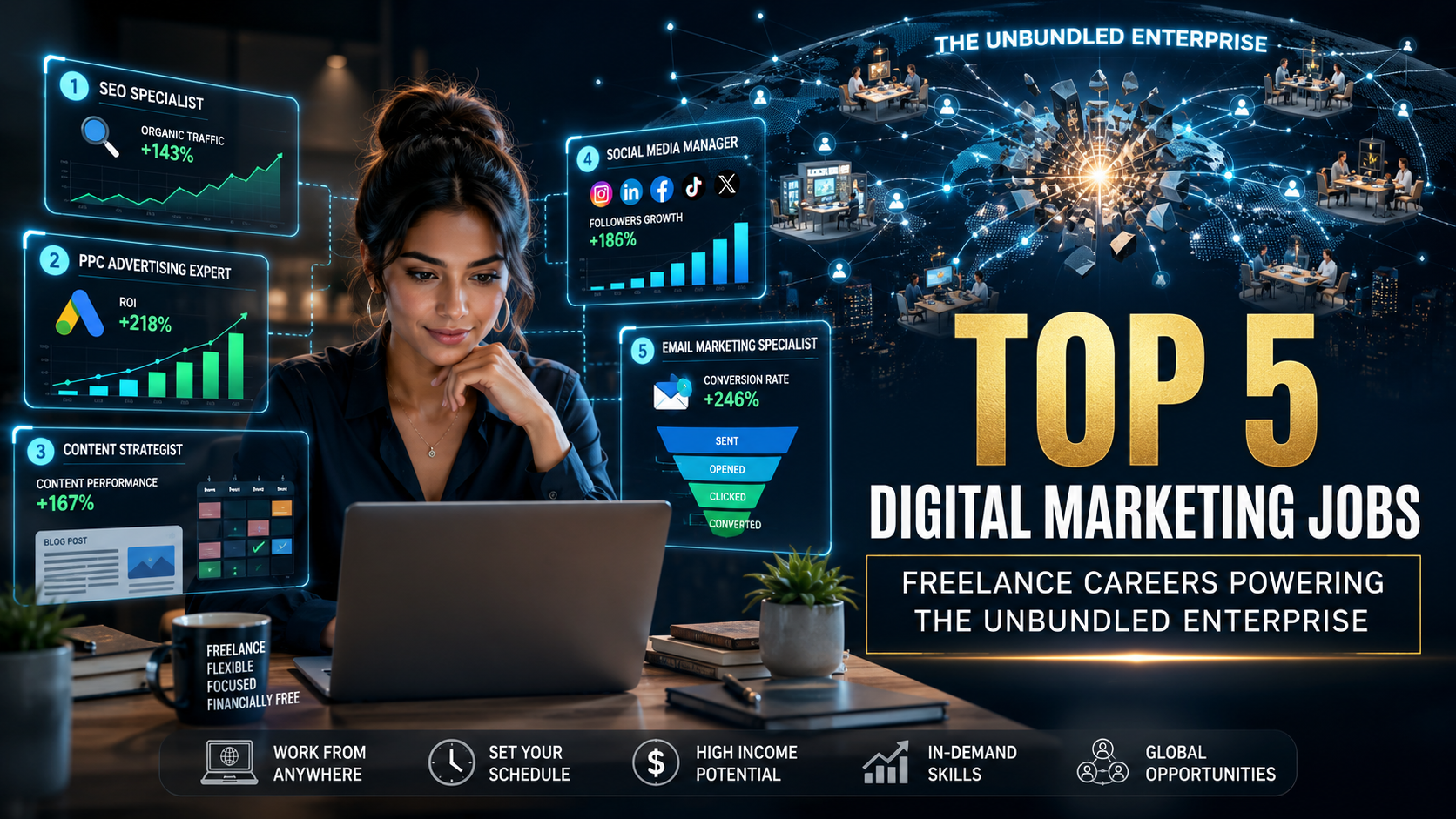
In October 2025, a quiet structural shift swept through mid-tier Madison Avenue advertising agencies. Faced with stubborn capital costs and institutional directives to optimize balance sheets, Fortune 500 brands quietly terminated long-term agency retainers worth millions. These legacy arrangements did not disappear; they fragmented. The modern corporate enterprise no longer seeks a multi-million-dollar agency suite to manage its digital presence; instead, it hunts for targeted, unbundled expertise. This structural realignment has transformed corporate marketing from an overhead liability into an on-demand network of elite, independent practitioners who operate far outside the traditional corporate framework.
The macroeconomic forces driving this migration are structural rather than cyclical. According to data compiled in the Gartner Marketing Spend Report, overall enterprise corporate marketing allocations contracted to 7.7% of total revenue, down significantly from pre-pandemic highs of over 10%. Concurrently, operational complexities have multiplied. The rapid emergence of generative search engines, predictive data frameworks, and complex privacy compliance measures has left generic in-house marketing teams flat-footed. Hiring full-time executive talent requires significant overhead, equity allocations, and lengthy onboarding cycles that modern enterprises simply cannot afford. A recent market analysis by Upwork Institutional Research indicated that 64% of corporate hiring managers plan to plug these critical capability gaps by hiring specialized, elite independent contractors over the next 18 months. Consequently, corporate capital is shifting rapidly away from generalized full-time roles toward specialized independent professionals.
1 — The Core Development
To build a sustainable income as an independent contractor, professionals must look beyond execution and focus entirely on high-impact specialization. The highest-paying digital marketing jobs for freelancers are no longer found in baseline copywriting or basic social media scheduling; those commoditized tasks have been largely absorbed by automated software pipelines. Instead, today’s marketplace rewards independent professionals who can architect systems, recover decaying organic search visibility, and directly influence pipeline revenue.
The first critical role commanding premium fees is the Fractional Chief Marketing Officer (Fractional CMO). Mid-sized enterprises earning between $10 million and $100 million annually frequently find themselves in a strategic dead zone: they need executive-level marketing leadership but lack the $300,000 annual budget required to secure a top-tier full-time CMO. The independent growth strategist steps into this vacuum, selling fractional leadership across three or four concurrent clients. On January 12, 2026, data from premium consulting registries showed that experienced fractional leaders routinely command retainers ranging from $5,000 to $12,000 per month per client, focusing exclusively on unit economics, channel diversification, and team restructuring.
The second elite domain is the Technical SEO Architect. As search engines move away from simple keyword matching toward semantic entity recognition, legacy search engine optimization practices have crumbled. Companies are watching their organic search footprints erode due to complex algorithmic core rollouts. An enterprise Technical SEO Architect operates more like a software engineer than a traditional marketer. They audit JavaScript rendering pipelines, configure structured data graphs, and optimize server-side delivery to ensure absolute search engine visibility. According to an industry study by HubSpot Enterprise Trends, organizations that invest in advanced entity-based data modeling experience a 42% faster recovery from search algorithm penalties than those relying on legacy keyword optimization. For a skilled professional operating in this niche, a single comprehensive architectural audit can easily command $15,000, with ongoing monitoring retainers clearing $6,000 monthly.
2 — Analytical Layer
Moving further down the operational funnel reveals more high paying freelance marketing roles that insulate independent contractors from market volatility. These positions succeed because they are directly tied to financial conversion and technological integration. The modern corporate buyer is deeply risk-averse; they refuse to pay for creative vanity projects, but they will eagerly write five-figure checks to an independent practitioner who treats marketing as an optimization problem.
The third position is the Conversion Rate Optimization (CRO) & User Behavior Analyst. Driving traffic to a digital property is meaningless if the traffic fails to convert into revenue. A CRO specialist combines data science, behavioral psychology, and rigorous A/B testing frameworks to extract maximum value from existing user footprints. They analyze session recordings, isolate checkout friction points, and re-engineer user paths. This role is highly insulated from budget cuts because its return on investment is immediately visible on a company’s balance sheet; if a specialist lifts a platform’s conversion rate from 1.8% to 2.4%, they instantly create millions of dollars in net new revenue without increasing the client’s advertising spend.
What are the highest-paying digital marketing jobs for freelancers?
The highest-paying digital marketing jobs for freelancers are fractional CMO leadership, technical SEO architecture, conversion rate optimization (CRO), marketing automation engineering, and performance marketing direction. These elite, remote marketing contracts command premium rates because they directly influence corporate revenue pipelines, optimize complex data infrastructure, and require advanced technical execution.
The fourth position is the Marketing Automation & Data Attribution Engineer. In an era dominated by privacy regulations like GDPR and the deprecation of third-party tracking cookies, corporate data collection has become severely fractured. Modern enterprises employ fragmented technology stacks, using separate tools for customer relationship management, email marketing, web analytics, and customer data management. The automation engineer acts as a systems architect, using tools like Zapier, Make, and custom APIs to synthesize these disconnected data feeds. They build multi-touch attribution models that trace a customer’s journey across dozens of digital touchpoints, proving exactly which marketing dollar drove the final purchase. A single system integration contract for an enterprise client can yield upwards of $25,000, creating an exceptionally stable baseline for independent data engineers.
3 — Implications & Second-Order Effects
The fifth high-paying independent role is the Paid Acquisition & Performance Marketing Director. Managing multi-million-dollar ad spends across platforms like Google, Meta, and programmatic ad exchanges requires deep analytical capability. Modern performance marketing is no longer about selecting interests or demographic toggles; it requires managing complex machine-learning bidding algorithms, structuring first-party data loops, and executing rapid creative testing pipelines.
The downstream consequences of this shift toward independent specialists are reshaping the broader business ecosystem. As elite talent decouples from traditional agency structures, corporations are building agile, modular marketing networks. Instead of paying an agency a flat 15% management fee on ad spend, enterprises retain an independent performance marketing director to oversee strategy, an independent CRO specialist to optimize the landing pages, and a technical SEO architect to protect organic visibility.
This decentralization alters corporate cost structures. Fixed marketing overhead is converted into variable project costs, increasing corporate financial resilience during economic shutdowns. A comprehensive study by the McKinsey Global Institute noted that companies utilizing agile talent models achieved a 22% reduction in operational execution costs alongside a 15% acceleration in speed-to-market for major campaigns. Still, this model creates an intensely bifurcated labor market. Generalist freelancers who refuse to specialize face severe downward pricing pressure, while the top five percent of technical and strategic independent contractors enjoy record-high billing rates.
4 — Competing Perspectives or Counterargument
The picture is more complicated than a simple migration toward freelance prosperity. Critics argue that the unbundled freelance model introduces severe hidden costs and operational vulnerabilities for both corporations and independent practitioners. Legacy agencies, despite their bloat, provide institutional continuity, centralized accountability, and deep resource redundancy. If an agency employee leaves, a replacement is inserted instantly without disrupting the client’s operational momentum.
When an enterprise relies on an independent contractor, it introduces key-person risk. If a freelance automation engineer suddenly becomes unavailable, the client’s data infrastructure can quickly become unmanageable. Furthermore, many independent professionals underestimate the operational friction of running a solo business. Data published by the Bureau of Labor Statistics indicates that independent professionals spend an average of 28% of their working hours on non-billable tasks, including lead generation, collections, and administrative overhead. This means that an attractive hourly contract rate of $150 can quickly degrade when accounting for unbilled operational hours and lack of employer-subsidized benefits. For many practitioners, the lack of a predictable income floor outweighs the theoretical autonomy of the independent market.
5 — The Technical Execution of High-Value Roles
To understand how these elite positions operate in practice, we must examine the specific technological frameworks they manage. The division between execution and architecture is best illustrated by breaking down the daily work products of these top five roles.
Role Primary Technology Stack Core Metric of Success Average Project Value Fractional CMO HubSpot, Salesforce, Tableau Customer Acquisition Cost (CAC) Efficiency $8,000 / month Technical SEO Architect Screaming Frog, Log File Analyzers, Next.js Organic Crawl Efficiency & Core Web Vitals $12,000 / project CRO Specialist Optimizely, Hotjar, Google Analytics 4 Average Order Value (AOV) & Conversion Lift $10,000 / project Automation Engineer Zapier, Make, Segment, SQL Attribution Data Accuracy $15,000 / architecture Performance Director Meta Ads Manager, Google Ads, Liveramp Return on Ad Spend (ROAS) $7,500 / month
The Mechanics of Fractional Leadership
The fractional CMO does not write social posts. They sit with the Chief Financial Officer to map out the marketing efficiency ratio. When an enterprise is burning capital on inefficient paid acquisition, the fractional leader steps in to reallocate budget toward organic channels or customer retention systems. They build the strategic roadmap that full-time junior staff members execute.
The Realities of Architectural SEO
A professional operating as a technical SEO architect looks at a website the way a structural engineer looks at a skyscraper. They isolate why search engine crawlers are wasting crawl budget on duplicate parameters. They build structured schema markup that directly feeds search engine knowledge graphs, ensuring the client’s brand is recognized as a verified entity rather than just a loose collection of keywords.
6 — Securing Premium Enterprise Contracts
Securing these premium remote marketing contracts requires a sophisticated business development methodology that completely avoids public freelance bidding marketplaces. High-earning independent practitioners build authoritative profiles through targeted publishing, technical case studies, and strategic networking with venture capital and private equity firms.
Private equity firms represent an exceptional source of high-paying freelance marketing roles. When a private equity firm acquires a portfolio of mid-market business-to-business software providers, they immediately seek to optimize marketing operations to accelerate enterprise value. They rarely want to hire permanent executive teams during the initial optimization phase. Instead, they deploy trusted independent technical architects and fractional growth specialists to audit the newly acquired companies, overhaul their data ecosystems, and install repeatable customer acquisition frameworks. A single relationship with a private equity operating partner can yield a predictable pipeline of enterprise-grade consulting contracts lasting for years.
What follows, however, is a steep learning curve for the independent professional. Managing an enterprise project requires a mastery of corporate politics, clear reporting mechanisms, and absolute clarity regarding data privacy. An independent contractor handling data integration must understand how server-side tracking complies with local privacy mandates. Those who master this intersection of technology and corporate compliance are insulated from the economic shifts that threaten generalist workers.
7 — The Transformation of the Creative Class
The structural displacement of generalist content creators has fundamentally changed the career trajectory for a modern freelance content strategist. Historically, an independent writer could build a comfortable business by churning out search-optimized articles. Today, automated language models produce baseline content for pennies. The independent professional must pivot from content production to semantic content architecture.
This means a content strategist can no longer just write; they must design thematic content hubs that demonstrate deep topical authority to automated search evaluators. They analyze search intent profiles, build comprehensive content calendars based on proprietary industry data, and construct internal link architectures that distribute search authority across commercial landing pages. They transform text from a simple creative output into an organic customer acquisition channel.
The picture is clear: the independent market no longer has room for the unspecialized intermediate. The market has broken into two distinct realities. At the bottom lies a race to the bottom, where commoditized workers compete against automated software platforms for dwindling fees. At the top sits an elite tier of independent consultants who command corporate fees because they solve structural problems that directly impact profitability.
The evolution of corporate marketing has permanently dismantled the traditional binary choice between agency employment and unspecialized gig work. The modern digital economy favors agile, highly specialized independent consultants who can step into an enterprise, solve a critical operational bottleneck, and depart without adding structural drag to the corporate balance sheet.
Success in this environment demands a continuous commitment to technical mastery, clear economic attribution, and a cold refusal to engage in commoditized work. The independent professionals who command the market are those who operate at the volatile intersection of code, capital, and consumer behavior. Ultimately, the future of marketing belongs to those who own their specialized infrastructure and can turn corporate chaos into quantifiable revenue.
Discover more from Remote Work Tips
Subscribe to get the latest posts sent to your email.
careers
The Sovereign Developer: The 5 Most Lucrative Coding Jobs in 2026 (And Why They Pay So Well)


For the past three years, the prevailing tech narrative has been dominated by a singular, slightly hysterical prediction: AI is going to automate software engineering. We were told that generative models would render the human coder obsolete, turning computer science degrees into expensive paperweights.
Welcome to 2026. The reality, as always, is far more nuanced—and significantly more lucrative for those who understood the shift.
It is true that the era of the “syntax translator”—the junior developer who takes highly specified Jira tickets and converts them into standard boilerplate—is fading. In fact, the Bureau of Labor Statistics explicitly projects a 6% decline in traditional “computer programmer” roles by 2034, noting that AI is successfully automating repetitive tasks.
But here is the twist: while programmers are declining, demand for software developers, architects, and quality engineers is surging by 15%, representing roughly 129,200 new openings per year. When AI writes the boilerplate, the human premium shifts away from writing code and toward orchestrating systems, designing architecture, and securing infrastructure.
The highest paying coding jobs in 2026 don’t belong to people who just write code; they belong to the “Sovereign Developers.” These are the engineers who understand how to deploy large language models in production, secure decentralized networks, and build internal platforms that multiply the productivity of entire organizations.
If you want to understand where the real money is in tech today, you have to look at the intersection of capital, complexity, and scale. Let’s dive into the data.
The Methodology: Tracking 2026 Tech Compensation
To identify the most lucrative coding jobs this year, we cannot rely on outdated, pre-AI salary surveys. The market has reorganized itself too quickly.
For this analysis, we synthesized real-time 2026 signed-offer data, crossing quantitative databases with qualitative hiring trends. Our primary sources include:
- Levels.fyi and Glassdoor for self-reported, equity-inclusive total compensation (TC) in Tier 1 and Tier 2 tech hubs.
- KORE1’s 2026 AI Salary Guide for production-grade machine learning compensation.
- Kube Careers Q1 2026 / State of Platform Engineering for the shifting economics of DevOps.
- Robert Half and InterviewPal for baseline corporate architecture ranges.
- BEON.tech’s 2026 Engineering Report for global and nearshore market benchmarking.
A note on compensation: We are focusing on “Total Compensation” (Base Salary + Bonus + Equity/RSUs). While base salaries often hit a ceiling around $250,000, equity is what pushes these roles into the half-million-dollar stratosphere.
Here are the top five most lucrative coding careers in 2026, the economic drivers behind them, and what it takes to break in.
1. AI Infrastructure Engineer (The Model Plumber)
We have officially moved past the “magic trick” phase of Artificial Intelligence. In 2023 and 2024, companies hired researchers to build prototypes. In 2026, companies are hiring AI Infrastructure Engineers to make those prototypes run at scale without bankrupting the company on cloud compute costs.
Why Demand is Exploding
According to Coursera’s 2026 AI Pay Guide, the hype has matured into operational reality. An AI Infrastructure Engineer (or MLOps Engineer) doesn’t necessarily invent new neural network architectures. Instead, they build the pipes. They figure out how to serve a 70-billion parameter open-source model to two million daily active users with sub-100 millisecond latency. They manage GPU clustering, optimize inference engines, and implement RAG (Retrieval-Augmented Generation) pipelines.
Because compute is the most expensive line item on a modern tech company’s P&L, an engineer who can optimize a model’s efficiency by 15% can save a corporation millions of dollars a month. That leverage commands an astronomical premium.
The 2026 Salary Range
- Mid-Level (3-5 years): $170,000 – $260,000 Total Comp
- Senior (6-9 years): $220,000 – $350,000+ Total Comp
- Staff / Principal (10+ years): $350,000 – $600,000+ Total Comp
As KORE1’s recent signed-offer data reveals, inside FAANG (Facebook, Amazon, Apple, Netflix, Google) and premier AI startups like Anthropic and OpenAI, Staff-level AI engineers are routinely seeing total compensation north of $600,000. Even in non-tech hubs like Denver or remote U.S. roles, senior base salaries easily clear $200,000.
The Toolbelt
- Languages: Python, C++, Rust (for performance-critical bottlenecks).
- Frameworks/Tools: PyTorch, vLLM, TensorRT, Triton, LangChain.
- Infrastructure: Kubernetes, CUDA programming, Vector Databases (Pinecone, Weaviate).
2. Platform Engineer (The Evolution of DevOps)
If you are still calling yourself a DevOps Engineer, you might be leaving 20% of your potential salary on the table. The breakout role of the last two years has undeniably been the Platform Engineer.
Why Demand is Exploding
For years, “DevOps” was less of a role and more of a chaotic culture where software engineers were suddenly forced to manage their own cloud infrastructure, leading to massive burnout. Enter Platform Engineering.
Instead of fixing individual deployment pipelines, Platform Engineers build an “Internal Developer Platform” (IDP). They treat their fellow developers as their customers, building self-service portals where a software engineer can spin up a secure, compliant cloud environment with a single click.
Gartner accurately predicted that by 2026, 80% of large engineering organizations would have dedicated platform teams. Because a great platform engineer accelerates the output of every other developer in the company, their multiplier effect is massive.
The 2026 Salary Range
- Average Base Salary: $172,038
- Senior Total Comp: $220,000 – $290,000
- The “Platform Premium”: According to Q1 2026 data from Kube Careers, Platform Engineers earn an average of 20% to 27% more than traditional DevOps engineers ($172K vs. $143K), simply because the role requires a broader, product-oriented mindset.
The Toolbelt
- Languages: Go, Python, TypeScript.
- Frameworks/Tools: Backstage (Spotify’s IDP framework), Crossplane, ArgoCD.
- Infrastructure: Kubernetes (absolute mastery required), Terraform, advanced CI/CD.
3. Data Architect (The Moat Builder)
In the age of ubiquitous AI, the algorithms are largely commoditized. Everyone has access to the same foundational models from OpenAI, Google, or Meta. Therefore, a company’s only remaining competitive moat is its proprietary, internal data. If your data is messy, your AI is useless.
Why Demand is Exploding
The Data Architect is the visionary who structures how an organization collects, governs, and utilizes petabytes of information. They are moving away from clunky, centralized data warehouses and toward modern “Data Mesh” architectures—treating data as a decentralized product.
As noted by InterviewPal’s 2026 Benchmarks, competencies in real-time data streaming and multi-cloud architectures add 15% to 25% salary premiums to an offer. You aren’t just writing SQL; you are designing the nervous system of the enterprise.
The 2026 Salary Range
- Median Total Comp: $203,250
- Top 10% (Senior/Enterprise): $400,000+ Total Comp
- Geographic Arbitrage: Remote Data Architects living in tier-2 cities are frequently securing San Francisco-level base salaries ($180,000 – $280,000) because the talent pool capable of bridging data engineering and machine learning workflows is incredibly shallow.
The Toolbelt
- Languages: SQL (advanced), Python, Scala.
- Frameworks/Tools: Apache Kafka, Flink, Spark, dbt (Data Build Tool).
- Infrastructure: Snowflake, Databricks, AWS Redshift/GCP BigQuery.
4. Cybersecurity Architect / Security Engineer (The Shield)
As code generation tools allow developers to ship software faster than ever, the surface area for cyber attacks has expanded exponentially. Furthermore, AI agents are now being weaponized by threat actors to find zero-day vulnerabilities at machine speed.
Why Demand is Exploding
The Cybersecurity Architect is no longer just the “department of no.” They are fundamental to business continuity. These professionals design “Zero Trust” networks and secure the sprawling, complex cloud environments deployed by the engineers mentioned above.
A 2026 Unihackers Salary Guide highlights that there are still millions of unfilled cybersecurity positions globally. The shift toward securing LLM supply chains (ensuring AI models aren’t poisoned with malicious training data) has created a hyper-niche, hyper-lucrative subfield. When the alternative is a $50 million ransomware payout and a destroyed reputation, companies do not bargain hunt for security architects.
The 2026 Salary Range
- Security Engineer (Mid): $150,000 – $247,000 Base
- Cloud Security Architect: $170,000 – $220,000 Base
- CISO (Chief Information Security Officer): $220,000 – $420,000+ Base (Total comp routinely exceeds $500K in enterprise).
The Toolbelt
- Languages: Python, Go, C (for reverse engineering).
- Frameworks/Tools: Cloud Security Posture Management (CSPM), SIEM tools, Identity and Access Management (IAM).
- Methodologies: Zero Trust Architecture, DevSecOps, Penetration Testing, AI Threat Modeling.
5. Cloud/Distributed Systems Architect (The Orchestrator)
While “Cloud Architect” might sound like a legacy title from 2018, the 2026 version of this role is practically unrecognizable. It is no longer about migrating on-premise servers to AWS. It is about managing terrifying levels of distributed complexity.
Why Demand is Exploding
Companies are now running “multi-cloud” strategies to avoid vendor lock-in, while simultaneously pushing compute to the “edge” (closer to the user) to support real-time AI features. The Cloud Architect designs systems that can survive entire regional data center outages without the user ever noticing.
According to Robert Half’s 2026 Tech Salary Data, cloud architecture remains foundational. They must balance high availability with ruthless cost optimization. A great Distributed Systems Architect pays for their own salary in their first month just by optimizing cloud egress fees and compute instances.
The 2026 Salary Range
- Mid-Level Base: $135,000 – $170,000
- High/Senior Base: $162,750 – $200,000+
- Total Comp: Frequently crosses $250,000 to $300,000 when factoring in equity at major tech firms and tier-1 consultancies.
The Toolbelt
- Languages: Java, Go, Rust.
- Frameworks/Tools: HashiCorp Stack (Terraform, Consul, Vault), gRPC.
- Infrastructure: Deep, native expertise in AWS, GCP, or Azure; Distributed consensus algorithms (Raft/Paxos).
2026 Coding Jobs Landscape: A Comparative View
| Role | Median Total Comp (US) | Primary Economic Driver | Barrier to Entry | Career Velocity |
| AI Infrastructure | $250,000+ | AI scale & compute optimization | Very High | Explosive |
| Platform Engineer | $210,000+ | Org-wide developer productivity | High | High |
| Data Architect | $203,000+ | Proprietary data as a business moat | High | Steady / High |
| Cybersecurity Arch. | $210,000+ | Cloud expansion & AI threat vectors | High (Requires high trust) | High |
| Cloud Architect | $190,000+ | Multi-cloud complexity & cost control | Medium / High | Steady |
(Note: Data aggregated from Levels.fyi, Kube Careers, and KORE1 Q1 2026 reports. Figures represent estimated medians for senior-level talent including equity).
How to Break In: Advice for Ambitious Tech Professionals
If you are looking at these numbers and wondering how to pivot your career, the advice for 2026 is fundamentally different than it was a decade ago. You cannot just “learn to code” in a vacuum anymore. You must learn to architect.
Here is how you upskill into these premium tiers:
1. Shift from “Syntax” to “Systems Thinking”
Stop defining yourself by the programming language you use. Being a “React Developer” or a “Java Developer” is a vulnerable position in an era of AI code generation. Instead, become an expert in the systems those languages run on. Understand networking, memory management, distributed databases, and cloud economics. AI is great at writing a discrete function; it is currently terrible at designing a resilient, SOC2-compliant microservices architecture.
2. Learn the Language of the Business
The highest-paid engineers don’t talk about code; they talk about leverage. A Platform Engineer commands $200,000 because they can say: “My internal portal reduced developer onboarding time from 3 weeks to 3 hours, saving the company $1.2M annually.” Learn to translate your technical implementations into P&L (Profit & Loss) impact.
3. Embrace the Open Source AI Ecosystem
You do not need a Ph.D. in mathematics to work in AI today. You need to understand implementation. Spend your weekends fine-tuning open-source models (like LLaMA 3 or Mistral) on your own data. Learn how to use vector databases. The gap between “traditional software engineer” and “AI engineer” is bridged by understanding the modern MLOps stack.
4. Master Cloud Economics (FinOps)
In the era of zero-interest rate phenomena (ZIRP), companies didn’t care about cloud bills. In 2026, efficiency is everything. If you can walk into an interview and demonstrate how your architectural decisions reduced AWS spend by 30% while improving performance, you write your own ticket.
The Broad View: Code as Capital
The panic surrounding the death of the software engineer was misplaced. What died was the commoditized coder.
As we look at the landscape of 2026, it is clear that programming is no longer viewed as a blue-collar digital trade. It has evolved into high-stakes capital allocation. When you deploy code today, you are deploying the autonomous agents, data pipelines, and security protocols that constitute the actual metabolic system of the modern corporation.
The roles that command a quarter-million dollars or more are those that require intense human judgment, strategic foresight, and an understanding of complex, interlocking systems. The AI will write the lines. But it is the Sovereign Developer who will build the world.
Frequently Asked Questions (FAQ)
Q: Will AI eventually automate these high-paying architecture jobs too?
A: Eventually is a long time, but architecture requires understanding ambiguous business requirements, navigating corporate politics, and balancing competing trade-offs (e.g., cost vs. latency vs. security). Current AI excels at deterministic tasks with clear boundaries, not ambiguous, high-stakes system design.
Q: Do I need a degree to get these jobs in 2026?
A: According to the BLS, a bachelor’s degree remains the standard entry point. However, in disciplines like Platform Engineering and Cloud Architecture, undeniable proof of work (open-source contributions, massive system design experience, top-tier certifications like AWS Solutions Architect Professional or Kubernetes CKA) routinely supersedes formal education requirements.
Q: What is the highest paying coding job without a management title?
A: Staff and Principal AI/ML Infrastructure Engineers. These are “Individual Contributor” (IC) roles that do not manage people, yet they frequently out-earn mid-level engineering managers and directors, easily pulling $400K+ in total compensation at top-tier tech firms.
Q: I’m a mid-level Full-Stack Developer. What is my fastest path to a $200K+ role?
A: The most logical lateral move is into Platform Engineering or Cloud Architecture. Your frontend/backend experience gives you empathy for the developers you will be building tools for. Upskill heavily in Kubernetes, Go, and Infrastructure as Code (Terraform), and reposition your resume around “developer experience” and “system reliability.”
Discover more from Remote Work Tips
Subscribe to get the latest posts sent to your email.


Freelance Taxes and 1099 Forms in 2026: A Practical U.S. Recordkeeping Guide
Freelancers sometimes assume that income is not taxable unless a platform sends a 1099. The Internal Revenue Service explicitly says...


Modern Freelance Tools in 2026: How to Build an AI-Assisted Workflow That Clients Trust
An effective freelance tool stack should reduce mistakes and administration, not merely add more subscriptions. Modern workflows might combine an...


Freelance Careers in 2026: In-Demand Skills, Portfolio Proof and Getting First Clients
A sustainable freelance career starts with a demonstrable client problem, a transparent portfolio and a written project scope—not just a...


Freelancing in 2026: The Tools, Projects and Positioning That Win High-Ticket Clients
Freelancing has split into two markets. Commodity work is getting cheaper, while expert work is getting more valuable. The tools...


How to Calculate Your Freelance Day Rate (& Raise It Without Losing Clients)
Setting your freelance day rate is one of the most critical commercial decisions you will make. Set it too low,...


Optimizing for AI Overviews: The Freelancer’s Guide to Schema Markup & Generative Engine Optimization (GEO)
Traditional search engine optimization is undergoing a seismic shift. As Google AI Overviews, Perplexity, and SearchGPT handle millions of daily...


Top 6 Payment Solutions for Freelancers Faster Than Banks
Midway through a project in Milan, a freelance UX designer named Elena watched her rent payment bounce. The client’s bank...


10 Freelancing Tips for Landing Projects in the AI Era
The Market Split No One Warned You About In February 2026, a mid-career graphic designer in Austin posted to a...
-

 blogging5 years ago
How to Use Social Media to Promote Your Blog
-

 freelance5 years ago
6 Future-Focused Skills Freelance Creatives Can’t Afford to Ignore
-

 social media5 years ago
How to Learn Social Media Without Getting Scammed
-

 freelance10 months ago
The Economics of Remote Work: How Hybrid Models Are Reshaping Global Productivity
-

 blogging5 years ago
20 Best Freelance Marketplaces for Freelancers in 2022 to Make Money
-

 freelance5 years ago
7 Highest Paying Freelance Jobs For Earning A Steady Income
-

 Digital Banking5 years ago
Pakistan Consumer Confidence Index increased by 8.8% in Q4 2021
-

 freelance11 months ago
Best Alternatives to Fiverr and Upwork: 5 Best Freelance Marketplaces