
Cyber Security
Should Freelancers Sweat Cybersecurity?


As you’re sipping an oat milk cortado in a coffee shop or laying on the couch next to a snoring dog, it’s easy for freelancers to become a bit removed from the everyday woes of most working people. Office politics? No thank you. Traffic? Poor things. Personal hygiene? Swore that off a long time ago.
But one menace is unavoidable whether you collect 1099s or W-2s: cybercrime.
Sorry to be a killjoy. But according to Gallop, 23 percent of U.S. households were victimized by cybercrime in 2018—more than any other reported crime. As a freelancer, you’re likely more exposed than most thanks to your constant connectivity, frequent new email contacts, and transient work patterns.
“Freelancers should absolutely worry about cybersecurity,” said Jessica Naziri, founder of technology and lifestyle site TechSesh.co. “Freelancers can inadvertently expose sensitive company data through unsecured Wi-Fi networks or poor password hygiene.”
Consider your own exposure too. What financial or personal info might hackers be able to access through that laptop you’ve toted to the coffee shop?
Cybersecurity may be a serious matter for freelancers to address, but it’s not rocket science—or, more aptly, it’s not writing a 40-page whitepaper on rocket science. Here’s what you should do to shore up your digital security.
Don’t use unprotected public Wi-Fi
Trust your barista with getting your foam just right, but not with your data.
“It cannot be stressed enough that connecting to public Wi-Fi can be very dangerous if you aren’t taking any precautions,” warned Mark Soto, owner of Milwaukee-based cybersecurity company Cybericus. “One precaution is to simply not use any public Wi-Fi, and use your phone as a hotspot when you’re not at home.”
Soto also suggested investing in a virtual private network or VPN. This software helps secure your network connection and shield internet activity in public. Unguarded, hackers can sneak onto your computer, grab whatever financial info, login credentials, and personal identification data they can get their hands on, and you might never know.
“It’s one of the best investments you can make, and it isn’t too expensive either,” Soto said. VPNs run from around $3 to $15 a month.
Secure your home network
Sometimes the danger comes from inside the house.
“Hackers take advantage of the fact that home networks usually don’t have the same level of security as corporate networks,” said Naziri. “If your Wi-Fi is open, hackers can connect, spy on traffic that passes through them, and access confidential information from devices on the network.”
To avoid that disaster, the National Cybersecurity Alliance’s StaySafeOnline initiative offers a few tips, including:
- Change the default name on your router to something that doesn’t make clear which home it belongs to.
- Change the preset password on your router.
- Select a security level for your router above WEP. StaySafeOnline recommends WPA2, if available, or WPA. You’ll find these options in the settings menu of your router software.
- If your router allows it, create a separate password for guests—or have a whole different network for visitors.
Back it all up
Freelancers often learn the value of backing up their data from an elbow-meets-coffee-meets-keyboard scenario, but it’s worth reinforcing from a cybersecurity angle too. Ransomware is an increasingly common type of cybercrime where a hacker locks you out of your files until you pay to get them back.
“If you were to, for some reason, lose all your files on your computer tomorrow, how would that affect you?” Soto asked. “Did you have any saved backups for that logo that’s due tomorrow? Did you save that 2,000-word article you’ve been working on for the past two days anywhere?”
If you did, ransomware loses its bite. If you don’t, you might find yourself among the many people who, against the advice of authorities, just pay $200-$400 to get their files unlocked. Soto recommends using a cloud backup system, which typically costs anywhere from $2 to $15 per month, depending on how much storage you need. External hard drives can be a tad risky since hackers can access them when the drive is connected to your computer.
Install antivirus software
Given how long it’s been since the term “computer virus” has been top-of-mind, it’s easy to assume antivirus software is no longer a big deal. But here’s the thing: What we call antivirus is really anti-malware software. Malware is the umbrella term for all malicious software, so a good antivirus program will scan your computer for all sorts of digital threats.
“Sadly, you do still need antivirus software,” Naziri said. “It doesn’t have to be the one preloaded [on your computer], but definitely get one.”
And just in case you felt safe and smug behind your MacBook, bad news: Experts agree that Macs need antivirus software too. It typically costs around $20 to $30 per year.
Practice good internet hygiene
Listen, do whatever you want with your personal hygiene. No one will be the wiser. But know that your internet hygiene has real consequences: One study found that human error was responsible for about 90 percent of cybercrimes.
In addition to regular backups and running your antivirus software, here are some everyday practices that keep you safer:
- Create strong, unique passwords for every (yes, every) online account. Utilize a password manager to keep track of them all. Password managers safety store all of your login credentials from various websites and auto-populate the login fields on websites when you need them. That way, you can have passwords so strong that you can’t even remember them. Paid varieties run $20-$60 a year. Free versions exist, like Google Chrome’s built-in password manager, but as Soto points out, if someone hacks your Google account, they get they keys to your digital kingdom.
- Don’t open any files you weren’t expecting. It’s a big ask for freelancers who might get a surprise lead via email, but every file should be regarded with suspicion. And definitely don’t open files with .exe extensions, Naziri said. Those are programs.
- Hover over a link before you click in an unsolicited email or suspicious website. Make sure the URL you see appear in the lower-left corner of your browser matches the intended destination.
- Update your software every time you get an alert. Software needs constant updating to stay ahead of hackers.
While it takes a bit of time and effort to protect yourself with smart cybersecurity habits, once you’ve implemented them, you don’t need to spend your time worrying about getting hacked or forking over a few hundred precious dollars to a hacker. Cybercriminals may come knocking, but when they don’t find an easy way in, they’re likely to leave you alone.
Discover more from Remote Work Tips
Subscribe to get the latest posts sent to your email.



careers
The Sovereign Developer: The 5 Most Lucrative Coding Jobs in 2026 (And Why They Pay So Well)


For the past three years, the prevailing tech narrative has been dominated by a singular, slightly hysterical prediction: AI is going to automate software engineering. We were told that generative models would render the human coder obsolete, turning computer science degrees into expensive paperweights.
Welcome to 2026. The reality, as always, is far more nuanced—and significantly more lucrative for those who understood the shift.
It is true that the era of the “syntax translator”—the junior developer who takes highly specified Jira tickets and converts them into standard boilerplate—is fading. In fact, the Bureau of Labor Statistics explicitly projects a 6% decline in traditional “computer programmer” roles by 2034, noting that AI is successfully automating repetitive tasks.
But here is the twist: while programmers are declining, demand for software developers, architects, and quality engineers is surging by 15%, representing roughly 129,200 new openings per year. When AI writes the boilerplate, the human premium shifts away from writing code and toward orchestrating systems, designing architecture, and securing infrastructure.
The highest paying coding jobs in 2026 don’t belong to people who just write code; they belong to the “Sovereign Developers.” These are the engineers who understand how to deploy large language models in production, secure decentralized networks, and build internal platforms that multiply the productivity of entire organizations.
If you want to understand where the real money is in tech today, you have to look at the intersection of capital, complexity, and scale. Let’s dive into the data.
The Methodology: Tracking 2026 Tech Compensation
To identify the most lucrative coding jobs this year, we cannot rely on outdated, pre-AI salary surveys. The market has reorganized itself too quickly.
For this analysis, we synthesized real-time 2026 signed-offer data, crossing quantitative databases with qualitative hiring trends. Our primary sources include:
- Levels.fyi and Glassdoor for self-reported, equity-inclusive total compensation (TC) in Tier 1 and Tier 2 tech hubs.
- KORE1’s 2026 AI Salary Guide for production-grade machine learning compensation.
- Kube Careers Q1 2026 / State of Platform Engineering for the shifting economics of DevOps.
- Robert Half and InterviewPal for baseline corporate architecture ranges.
- BEON.tech’s 2026 Engineering Report for global and nearshore market benchmarking.
A note on compensation: We are focusing on “Total Compensation” (Base Salary + Bonus + Equity/RSUs). While base salaries often hit a ceiling around $250,000, equity is what pushes these roles into the half-million-dollar stratosphere.
Here are the top five most lucrative coding careers in 2026, the economic drivers behind them, and what it takes to break in.
1. AI Infrastructure Engineer (The Model Plumber)
We have officially moved past the “magic trick” phase of Artificial Intelligence. In 2023 and 2024, companies hired researchers to build prototypes. In 2026, companies are hiring AI Infrastructure Engineers to make those prototypes run at scale without bankrupting the company on cloud compute costs.
Why Demand is Exploding
According to Coursera’s 2026 AI Pay Guide, the hype has matured into operational reality. An AI Infrastructure Engineer (or MLOps Engineer) doesn’t necessarily invent new neural network architectures. Instead, they build the pipes. They figure out how to serve a 70-billion parameter open-source model to two million daily active users with sub-100 millisecond latency. They manage GPU clustering, optimize inference engines, and implement RAG (Retrieval-Augmented Generation) pipelines.
Because compute is the most expensive line item on a modern tech company’s P&L, an engineer who can optimize a model’s efficiency by 15% can save a corporation millions of dollars a month. That leverage commands an astronomical premium.
The 2026 Salary Range
- Mid-Level (3-5 years): $170,000 – $260,000 Total Comp
- Senior (6-9 years): $220,000 – $350,000+ Total Comp
- Staff / Principal (10+ years): $350,000 – $600,000+ Total Comp
As KORE1’s recent signed-offer data reveals, inside FAANG (Facebook, Amazon, Apple, Netflix, Google) and premier AI startups like Anthropic and OpenAI, Staff-level AI engineers are routinely seeing total compensation north of $600,000. Even in non-tech hubs like Denver or remote U.S. roles, senior base salaries easily clear $200,000.
The Toolbelt
- Languages: Python, C++, Rust (for performance-critical bottlenecks).
- Frameworks/Tools: PyTorch, vLLM, TensorRT, Triton, LangChain.
- Infrastructure: Kubernetes, CUDA programming, Vector Databases (Pinecone, Weaviate).
2. Platform Engineer (The Evolution of DevOps)
If you are still calling yourself a DevOps Engineer, you might be leaving 20% of your potential salary on the table. The breakout role of the last two years has undeniably been the Platform Engineer.
Why Demand is Exploding
For years, “DevOps” was less of a role and more of a chaotic culture where software engineers were suddenly forced to manage their own cloud infrastructure, leading to massive burnout. Enter Platform Engineering.
Instead of fixing individual deployment pipelines, Platform Engineers build an “Internal Developer Platform” (IDP). They treat their fellow developers as their customers, building self-service portals where a software engineer can spin up a secure, compliant cloud environment with a single click.
Gartner accurately predicted that by 2026, 80% of large engineering organizations would have dedicated platform teams. Because a great platform engineer accelerates the output of every other developer in the company, their multiplier effect is massive.
The 2026 Salary Range
- Average Base Salary: $172,038
- Senior Total Comp: $220,000 – $290,000
- The “Platform Premium”: According to Q1 2026 data from Kube Careers, Platform Engineers earn an average of 20% to 27% more than traditional DevOps engineers ($172K vs. $143K), simply because the role requires a broader, product-oriented mindset.
The Toolbelt
- Languages: Go, Python, TypeScript.
- Frameworks/Tools: Backstage (Spotify’s IDP framework), Crossplane, ArgoCD.
- Infrastructure: Kubernetes (absolute mastery required), Terraform, advanced CI/CD.
3. Data Architect (The Moat Builder)
In the age of ubiquitous AI, the algorithms are largely commoditized. Everyone has access to the same foundational models from OpenAI, Google, or Meta. Therefore, a company’s only remaining competitive moat is its proprietary, internal data. If your data is messy, your AI is useless.
Why Demand is Exploding
The Data Architect is the visionary who structures how an organization collects, governs, and utilizes petabytes of information. They are moving away from clunky, centralized data warehouses and toward modern “Data Mesh” architectures—treating data as a decentralized product.
As noted by InterviewPal’s 2026 Benchmarks, competencies in real-time data streaming and multi-cloud architectures add 15% to 25% salary premiums to an offer. You aren’t just writing SQL; you are designing the nervous system of the enterprise.
The 2026 Salary Range
- Median Total Comp: $203,250
- Top 10% (Senior/Enterprise): $400,000+ Total Comp
- Geographic Arbitrage: Remote Data Architects living in tier-2 cities are frequently securing San Francisco-level base salaries ($180,000 – $280,000) because the talent pool capable of bridging data engineering and machine learning workflows is incredibly shallow.
The Toolbelt
- Languages: SQL (advanced), Python, Scala.
- Frameworks/Tools: Apache Kafka, Flink, Spark, dbt (Data Build Tool).
- Infrastructure: Snowflake, Databricks, AWS Redshift/GCP BigQuery.
4. Cybersecurity Architect / Security Engineer (The Shield)
As code generation tools allow developers to ship software faster than ever, the surface area for cyber attacks has expanded exponentially. Furthermore, AI agents are now being weaponized by threat actors to find zero-day vulnerabilities at machine speed.
Why Demand is Exploding
The Cybersecurity Architect is no longer just the “department of no.” They are fundamental to business continuity. These professionals design “Zero Trust” networks and secure the sprawling, complex cloud environments deployed by the engineers mentioned above.
A 2026 Unihackers Salary Guide highlights that there are still millions of unfilled cybersecurity positions globally. The shift toward securing LLM supply chains (ensuring AI models aren’t poisoned with malicious training data) has created a hyper-niche, hyper-lucrative subfield. When the alternative is a $50 million ransomware payout and a destroyed reputation, companies do not bargain hunt for security architects.
The 2026 Salary Range
- Security Engineer (Mid): $150,000 – $247,000 Base
- Cloud Security Architect: $170,000 – $220,000 Base
- CISO (Chief Information Security Officer): $220,000 – $420,000+ Base (Total comp routinely exceeds $500K in enterprise).
The Toolbelt
- Languages: Python, Go, C (for reverse engineering).
- Frameworks/Tools: Cloud Security Posture Management (CSPM), SIEM tools, Identity and Access Management (IAM).
- Methodologies: Zero Trust Architecture, DevSecOps, Penetration Testing, AI Threat Modeling.
5. Cloud/Distributed Systems Architect (The Orchestrator)
While “Cloud Architect” might sound like a legacy title from 2018, the 2026 version of this role is practically unrecognizable. It is no longer about migrating on-premise servers to AWS. It is about managing terrifying levels of distributed complexity.
Why Demand is Exploding
Companies are now running “multi-cloud” strategies to avoid vendor lock-in, while simultaneously pushing compute to the “edge” (closer to the user) to support real-time AI features. The Cloud Architect designs systems that can survive entire regional data center outages without the user ever noticing.
According to Robert Half’s 2026 Tech Salary Data, cloud architecture remains foundational. They must balance high availability with ruthless cost optimization. A great Distributed Systems Architect pays for their own salary in their first month just by optimizing cloud egress fees and compute instances.
The 2026 Salary Range
- Mid-Level Base: $135,000 – $170,000
- High/Senior Base: $162,750 – $200,000+
- Total Comp: Frequently crosses $250,000 to $300,000 when factoring in equity at major tech firms and tier-1 consultancies.
The Toolbelt
- Languages: Java, Go, Rust.
- Frameworks/Tools: HashiCorp Stack (Terraform, Consul, Vault), gRPC.
- Infrastructure: Deep, native expertise in AWS, GCP, or Azure; Distributed consensus algorithms (Raft/Paxos).
2026 Coding Jobs Landscape: A Comparative View
| Role | Median Total Comp (US) | Primary Economic Driver | Barrier to Entry | Career Velocity |
| AI Infrastructure | $250,000+ | AI scale & compute optimization | Very High | Explosive |
| Platform Engineer | $210,000+ | Org-wide developer productivity | High | High |
| Data Architect | $203,000+ | Proprietary data as a business moat | High | Steady / High |
| Cybersecurity Arch. | $210,000+ | Cloud expansion & AI threat vectors | High (Requires high trust) | High |
| Cloud Architect | $190,000+ | Multi-cloud complexity & cost control | Medium / High | Steady |
(Note: Data aggregated from Levels.fyi, Kube Careers, and KORE1 Q1 2026 reports. Figures represent estimated medians for senior-level talent including equity).
How to Break In: Advice for Ambitious Tech Professionals
If you are looking at these numbers and wondering how to pivot your career, the advice for 2026 is fundamentally different than it was a decade ago. You cannot just “learn to code” in a vacuum anymore. You must learn to architect.
Here is how you upskill into these premium tiers:
1. Shift from “Syntax” to “Systems Thinking”
Stop defining yourself by the programming language you use. Being a “React Developer” or a “Java Developer” is a vulnerable position in an era of AI code generation. Instead, become an expert in the systems those languages run on. Understand networking, memory management, distributed databases, and cloud economics. AI is great at writing a discrete function; it is currently terrible at designing a resilient, SOC2-compliant microservices architecture.
2. Learn the Language of the Business
The highest-paid engineers don’t talk about code; they talk about leverage. A Platform Engineer commands $200,000 because they can say: “My internal portal reduced developer onboarding time from 3 weeks to 3 hours, saving the company $1.2M annually.” Learn to translate your technical implementations into P&L (Profit & Loss) impact.
3. Embrace the Open Source AI Ecosystem
You do not need a Ph.D. in mathematics to work in AI today. You need to understand implementation. Spend your weekends fine-tuning open-source models (like LLaMA 3 or Mistral) on your own data. Learn how to use vector databases. The gap between “traditional software engineer” and “AI engineer” is bridged by understanding the modern MLOps stack.
4. Master Cloud Economics (FinOps)
In the era of zero-interest rate phenomena (ZIRP), companies didn’t care about cloud bills. In 2026, efficiency is everything. If you can walk into an interview and demonstrate how your architectural decisions reduced AWS spend by 30% while improving performance, you write your own ticket.
The Broad View: Code as Capital
The panic surrounding the death of the software engineer was misplaced. What died was the commoditized coder.
As we look at the landscape of 2026, it is clear that programming is no longer viewed as a blue-collar digital trade. It has evolved into high-stakes capital allocation. When you deploy code today, you are deploying the autonomous agents, data pipelines, and security protocols that constitute the actual metabolic system of the modern corporation.
The roles that command a quarter-million dollars or more are those that require intense human judgment, strategic foresight, and an understanding of complex, interlocking systems. The AI will write the lines. But it is the Sovereign Developer who will build the world.
Frequently Asked Questions (FAQ)
Q: Will AI eventually automate these high-paying architecture jobs too?
A: Eventually is a long time, but architecture requires understanding ambiguous business requirements, navigating corporate politics, and balancing competing trade-offs (e.g., cost vs. latency vs. security). Current AI excels at deterministic tasks with clear boundaries, not ambiguous, high-stakes system design.
Q: Do I need a degree to get these jobs in 2026?
A: According to the BLS, a bachelor’s degree remains the standard entry point. However, in disciplines like Platform Engineering and Cloud Architecture, undeniable proof of work (open-source contributions, massive system design experience, top-tier certifications like AWS Solutions Architect Professional or Kubernetes CKA) routinely supersedes formal education requirements.
Q: What is the highest paying coding job without a management title?
A: Staff and Principal AI/ML Infrastructure Engineers. These are “Individual Contributor” (IC) roles that do not manage people, yet they frequently out-earn mid-level engineering managers and directors, easily pulling $400K+ in total compensation at top-tier tech firms.
Q: I’m a mid-level Full-Stack Developer. What is my fastest path to a $200K+ role?
A: The most logical lateral move is into Platform Engineering or Cloud Architecture. Your frontend/backend experience gives you empathy for the developers you will be building tools for. Upskill heavily in Kubernetes, Go, and Infrastructure as Code (Terraform), and reposition your resume around “developer experience” and “system reliability.”
Discover more from Remote Work Tips
Subscribe to get the latest posts sent to your email.
Cyber Security
🏆 The $120k Remote Career Pivot: Your 90-Day Roadmap to a Cybersecurity Analyst Role (No Degree Required)
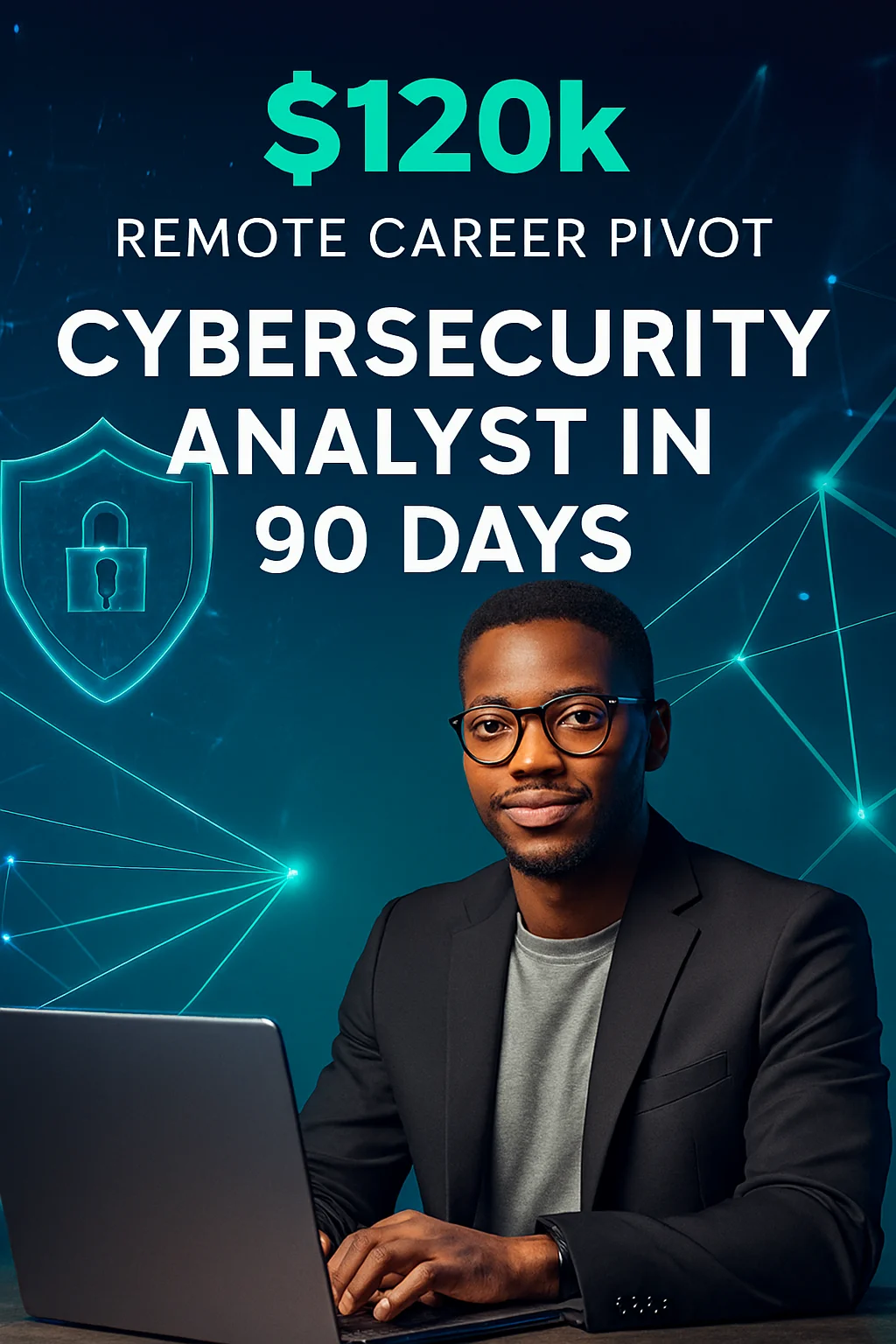
The cybersecurity shortage is your greatest financial asset. This is the step-by-step, skill-based roadmap to securing a six-figure, Remote Cybersecurity Jobs position in 90 days, bypassing the degree gatekeepers and proving that practical knowledge is the new currency.
Part 1: The Lede and The $120k Thesis
The single greatest lie the corporate world sells is the necessity of a four-year degree for a six-figure, white-collar career. In the current digital economy, this prerequisite has collapsed, especially within the relentless, hyper-demanding field of cybersecurity. Corporations don’t have time for academic prerequisites; they have immediate, escalating threats and a globally recognized talent shortage.
According to the U.S. Bureau of Labor Statistics (BLS), employment for Information Security Analysts is projected to grow by an astounding 35% between 2021 and 2031—a rate six times faster than the average occupation. This massive talent deficit, coupled with the proven earning potential of a Cybersecurity Analyst Salary No Degree (with average senior roles exceeding $120,000 annually), has created a unique window of opportunity: a high-speed, high-reward entry into the most stable market of the next decade.
This article is your ultra-specific, 90 Day Career Pivot plan. We are not aiming for an internship; we are aiming for a high-earning, remote, operational role. This transition is purely skill-based, driven by verifiable, industry-mandated certifications and a hands-on technical portfolio. Follow this precise roadmap, and you can transition from your current role to a six-figure remote security professional in three months.
Part 2: Day 1–30: The Foundation (The Theory and Vocabulary)
The first 30 days are about intense immersion. Before you touch a single hacking tool or install a virtual machine, you must master the fundamental language and philosophy of security. This foundation is what allows you to speak credibly in a remote interview and understand the dense material in your certification sprint, preparing you for successful Remote Cybersecurity Training.
Mastering the Core Principles: The Theory of Defense
Your goal is to build a rock-solid theoretical baseline. Focus intensely on these four pillars:
- The CIA Triad (The Mission Statement): This is the sacred text of cybersecurity. You must internalize the concepts of Confidentiality, Integrity, and Availability. Every decision a security analyst makes—from patching a server to updating a firewall rule—traces back to protecting these three principles. When you interview, you must be able to frame security priorities using the CIA Triad.
- Networking Fundamentals (The Map): A system cannot be secured if the network is not understood. Spend time mastering the OSI Model (Layers 1-7) and the core protocols: TCP/IP, DNS, DHCP, and ARP. Security threats often manifest at Layer 3 (Network) and Layer 7 (Application). Understanding protocols like ICMP (ping) and the functions of switches and routers is non-negotiable.
- Cryptography Basics (The Locksmith): Understand the difference between symmetric and asymmetric encryption, hashing (e.g., SHA-256), and the critical role of Public Key Infrastructure (PKI) and digital certificates. This is crucial for understanding secure communications, VPNs, and strong authentication.
- Security Architecture Principles: Beyond tools, you must understand concepts like Defense in Depth (using multiple layers of security) and Least Privilege (giving users only the necessary access). These principles inform every real-world security decision.
Affiliate Opportunity: Low-Cost Foundational Courses
To accelerate this foundational phase, leverage established, low-cost video platforms. Invest a small amount here to save potentially hundreds of hours.
- Resource 1 (Video): The highest-rated, current Network+ and Security+ fundamental video courses on Udemy or Coursera. Look for courses with a high volume of student reviews and recent updates. (Link to affiliate course)
- Resource 2 (Free): Professor Messer’s free video series on networking and foundational security provides an outstanding, no-cost theoretical grounding, specifically designed to prepare students for CompTIA exams. Supplement his materials with his low-cost practice exams.
Part 3: Day 31–60: The Certification Sprint (The Non-Negotiable Credential)
If degrees are the gatekeepers of the past, vendor-neutral certifications are the gate-openers of the present. For an entry-level remote analyst role, there is one non-negotiable credential: CompTIA Security+. It is universally recognized as the baseline for the industry.
CompTIA Security+ Remote Training: Your Bridge to $100k+
The Security+ is respected by organizations worldwide and is one of the few certifications that fulfills the U.S. Department of Defense directive for IT security roles (DoD 8570/8140 IAT Level II). It proves you understand the broad, operational security concepts every organization needs, directly preparing you for Remote Cybersecurity Training.
Metric CompTIA Security+ (SY0-701) Detail Passing Score 750 (on a scale of 100-900) Exam Cost $425 USD (Official CompTIA Voucher Price) Typical Study Time 90–140 hours total (4-6 weeks for aggressive, full-time study) Key Domain Weighting Security Operations (28%), Threats/Vulnerabilities (22%), Security Program Management (20%)
Your 30-Day Aggressive Study Plan for Security+:
- Weeks 1-2: Core Content Sprint: Dedicate 4-5 hours daily to consuming primary video courses and reading study guides. Prioritize the high-weight domains, especially Security Operations. You must understand incident response and monitoring.
- Week 3: Deep Dive & Practice Tests: Start taking full-length, timed practice exams. This is where the real learning happens. Review every single incorrect answer, not just the right ones. Your goal should be to score 85% consistently before sitting for the real exam.
- Week 4: Performance-Based Question (PBQ) Immersion: Focus on the hands-on, scenario-based questions (PBQs) that require configuration or analysis (e.g., placing the correct security control on a network diagram). This bridges the gap to the Practical Toolkit section. Schedule your exam for Day 60.
Affiliate Opportunity: Top 3 Paid Study Resources
To maximize efficiency and guarantee a pass, high-quality paid resources are essential for Remote Cybersecurity Training. (Affiliate Links go here)
- Resource 1 (Practice Exams): Recommend a top-tier practice exam provider that simulates the testing environment, featuring PBQ practice and question explanations.
- Resource 2 (Video/Lab Platform): Recommend an interactive video course that includes integrated virtual labs to practice command line and firewall configuration tasks.
- Resource 3 (Notes/Cramming): The best-rated official or renowned third-party book (e.g., Darril Gibson’s “Get Certified Get Ahead”) for quick-reference study and review.
Part 4: Day 61–75: The Practical Toolkit (Hands-On Experience)
Certification proves you can talk the talk. The Hands-On Portfolio proves you can walk the walk. This 15-day phase is dedicated to building the verifiable evidence that overrides the “No Degree” problem and directly addresses the high demands of Remote Cybersecurity Jobs.
Building Your Zero-Trust Home Lab for WFH
Your lab doesn’t require expensive hardware. It just requires dedication and accessible software. You will need a Virtual Machine (VM) hypervisor like VirtualBox or VMware Workstation Player.
Unconventional Data: Home Lab Resources & Space
The successful remote analyst must manage their technical resources effectively.
Component Minimum Specification Recommended Specification Processor Quad-core (i5 or Ryzen 5 equivalent) Hexa-core (i7 or Ryzen 7 equivalent) RAM 16 GB 32 GB (Highly Recommended for VMs) Disk Space 30 GB dedicated for Kali Linux and a target VM (Windows or Linux) 60 GB+ dedicated for log files and multiple VM snapshots Disk Type SSD (Solid State Drive) is mandatory for speed NVMe SSD
Actionable Lab Projects to Master (The Core Portfolio):
- Vulnerability Scanning (The Auditor):
- Tool: OpenVAS (free) or a trial of Nessus.
- Actionable Step: Install a deliberately vulnerable VM (like Metasploitable). Run a scan, generate a report, and then write a remediation plan that prioritizes vulnerabilities based on the CVSS (Common Vulnerability Scoring System) score. This demonstrates risk management, a key component of the Zero-Trust Framework for WFH.
- Packet Analysis (The Investigator):
- Tool: Wireshark.
- Actionable Step: Capture network traffic between your Kali VM and a target VM. Filter the traffic to identify clear-text protocols (FTP, Telnet) and encrypted protocols (HTTPS, SSH). Write a brief analysis on the risk of using unencrypted protocols. The ability to read a packet header is the analyst’s core technical superpower.
- SIEM Deployment (The Sentient Watcher):
- Tool: Splunk Free or ELK Stack (Elasticsearch, Logstash, Kibana).
- Actionable Step: Configure the target VM to forward logs to your Splunk instance. Create a simple dashboard to track events (e.g., successful vs. failed login attempts) and configure a basic alert based on three failed logins in five minutes. This demonstrates essential operational security monitoring for Endpoint Protection Tools Review.
The Remote Work Security Environment Metric
An analyst’s role is fundamentally different in a remote world. Your WFH setup is the network perimeter, and the Zero-Trust Framework for WFH philosophy—verify everything, trust nothing—must be applied to your own work setup.
- Tool Knowledge: Recruiters expect knowledge of commercial Endpoint Protection Tools Review solutions (e.g., CrowdStrike, SentinelOne). Be ready to discuss the difference between traditional Anti-Virus (AV) and modern Endpoint Detection and Response (EDR) solutions.
- Actionable Security: Implement a hardware security key (like a YubiKey) for MFA on all your professional accounts and ensure your local firewall is configured for maximum restriction. You must live the security you preach.
Part 5: Day 76–90: The Remote Job Strategy (Selling the Pivot)
With the Security+ certified (Day 60) and a hands-on portfolio complete (Day 75), the last two weeks are dedicated to landing the job. This requires a specific strategy for the highly competitive Remote Cybersecurity Jobs market.
Overcoming the “No Experience” Barrier in Remote Hiring
The “No Degree” hurdle is overcome by the cert and the lab. The “No Experience” hurdle is overcome by skillful resume framing and deep preparation that targets the Cybersecurity Analyst Salary No Degree level.
- The Portfolio Hack (The Evidence Converter):
- Create a clean, professional online document (Google Doc, Notion, or personal website) detailing your lab projects. Do not list tools; list business outcomes. Instead of “Ran a Nessus scan,” write “Identified and patched 14 critical vulnerabilities in a simulated Windows server environment, reducing the attack surface by 70%, and wrote a final remediation report.”
- Include a dedicated, documented case study titled: “The WFH Zero-Trust Implementation: A Personal Case Study,” demonstrating how you apply security principles to your own remote environment.
- The Resume Hack (The Re-Frame):
- You didn’t just do help desk or IT support; you were an “Initial Incident Responder,” and you “Managed Endpoint Security Tooling” and “Implemented Multi-Factor Authentication (MFA) Policies.”
- Move the “Certifications” section to the very top, directly under your professional summary. Your Security+ is your most valuable asset. Use High-Paying Remote Skills 2026 keywords like SIEM, Vulnerability Management, and Incident Response liberally throughout the document.
- The Interview Hack (The Confidence Builder):
- Remote interviews are highly technical and heavily behavioral. The interviewer wants to know how you think under pressure. The STAR method (Situation, Task, Action, Result) is mandatory for all behavioral questions.
- Top 5 Behavioral Questions (and the structure for answering them):
- “Describe a time you had to respond to a critical security alert. How did you handle the initial containment?” (Answer: Use the Containment, Eradication, Recovery framework. Focus on isolation and communication.)
- “An executive is refusing to implement MFA. How do you convince them to follow policy?” (Answer: Translate risk to business impact—data loss, regulatory fines, reputational damage. This shows security leadership.)
- “Tell us about a time you had to prioritize three security risks with limited resources.” (Answer: Use a Risk Matrix tied to the CIA Triad. Show your analytical process for deciding which threat has the highest probability and impact.)
- “How do you ensure you are following the principle of Least Privilege on your own remote workstation?” (Answer: Discuss using a separate, non-administrator account for daily tasks and a separate VM for high-risk analysis.)
- “What is your process for investigating a suspected phishing email that bypassed the email gateway?” (Answer: Detail checking headers, analysing embedded links safely (using sandboxes), and isolating the affected user’s machine. Focus on the analytical, step-by-step process.)
Part 6: Beyond Certification: The High-Income Stack (Future-Proofing)
Securing the first Remote Cybersecurity Jobs is the first step. To transition from an Analyst I salary of $95k to the $120k+ compensation target within two years, you must immediately begin future-proofing your skill stack. This is what defines the most valuable High-Paying Remote Skills 2026 professionals.
From Defender to Architect: The Skills That Drive Six Figures
- Cloud Security (The New Network Perimeter):
- Nearly all remote infrastructure runs on the cloud. You cannot be a senior analyst in 2026 without understanding cloud security.
- Action: Begin studying for the AWS Certified Cloud Practitioner (CCP – $100 USD) or the Microsoft Azure Fundamentals (AZ-900 – $99 USD). These low-barrier entry certifications prove you understand shared responsibility models, Identity and Access Management (IAM), and key security controls (e.g., Security Groups) in a cloud environment.
- Scripting & Automation (The Efficiency Driver):
- The highest-paid analysts automate tedious, repeatable tasks. This is where the 90 Day Career Pivot meets efficiency. Learning Python is non-negotiable.
- Action: Focus on Python scripts for log parsing (filtering millions of lines of SIEM data quickly using libraries like
refor regular expressions), interacting with simple APIs, and creating automated vulnerability reports. This is how you elevate your role from a reactive ticket-responder to a proactive security engineer.
- DevSecOps Principles (Security by Design):
- Understanding the DevSecOps pipeline—integrating security testing into the development process—is a major high-income skill. Learn what SAST (Static Application Security Testing) and DAST (Dynamic Application Security Testing) are and how they prevent vulnerabilities before they hit production. This knowledge proves you think at the organizational level.
- Introductory AI/ML for Threat Detection:
- Analysts today work alongside AI. You won’t be building the models, but you must know how to interpret the output of AI-powered SIEM and Endpoint Protection Tools Review. Understanding terms like “behavioral anomaly detection,” “machine learning baselines,” and the concepts of false positives and false negatives is essential to accurately triage sophisticated, next-generation alerts.
Part 7: Conclusion & Final Call to Action
The demand for skilled, certified, and proven cybersecurity professionals has created the greatest meritocratic opportunity in decades. Your college degree matters far less than your focused, documented, and verifiable commitment over the next 90 days.
By following this precise roadmap—mastering the foundational theory, securing the CompTIA Security+ certification, building a verifiable home lab portfolio, and executing a targeted Remote Cybersecurity Jobs search strategy—you are not just changing careers. You are future-proofing your entire income stream, all while earning a Cybersecurity Analyst Salary No Degree from the comfort of your own home.
The $120k Remote Career Pivot is not a dream; it’s a fully documented plan. The only remaining variable is your will to execute.
Ready to start Day 1 and unlock your potential for a six-figure remote salary? Download our free comprehensive checklist detailing every tool, video course, and practice test required to complete your personalised Remote Cybersecurity Training in 90 days.
Discover more from Remote Work Tips
Subscribe to get the latest posts sent to your email.

Freelancing has become an increasingly popular career choice in recent years, particularly in the technology industry. With the rise of remote work and the growing demand for tech talent, freelance coding jobs are expected to grow in popularity over the next few years. In this blog post, we will explore the opportunities for freelancers in the coding industry in 2024.
The Rise of Remote Work
Remote work has become more popular than ever, especially in the tech industry. According to a study by Upwork, 73% of all teams will have remote workers by 2028. With the rise of remote work, companies are more willing to hire freelancers to complete coding projects. Freelancers can work from anywhere, and companies can save money on office space and other overhead costs.
Increased Demand for Tech Talent
As technology continues to grow and evolve, the demand for skilled tech professionals is also increasing. According to the Bureau of Labor Statistics, employment in computer and information technology occupations is projected to grow 11% from 2019 to 2029, much faster than the average for all occupations. This demand for tech talent provides a great opportunity for freelancers to find work in the coding industry.
New Technologies and Platforms
As technology advances, new platforms and technologies are constantly being developed. Freelancers who stay up-to-date with the latest trends and technologies will have a competitive advantage in the marketplace. For example, blockchain technology is expected to become more mainstream in the coming years, providing opportunities for freelancers with expertise in this area.
Diverse Range of Projects
One of the benefits of freelance coding jobs is the diverse range of projects that freelancers can work on. From mobile app development to website design, freelancers can choose projects that match their skills and interests. This variety of work can help freelancers build a diverse portfolio and gain experience in a variety of areas.
Flexible Schedules
One of the biggest advantages of freelance coding jobs is their flexibility. Freelancers can choose their hours and work as much or as little as they want. This flexibility allows freelancers to work around other commitments, such as family or education and can provide a better work-life balance.
Conclusion
Freelance coding jobs are expected to grow in popularity in the coming years. The rise of remote work, increased demand for tech talent, new technologies and platforms, a diverse range of projects, and flexible schedules all provide opportunities for freelancers in the coding industry. Freelancers who stay up-to-date with the latest trends and technologies will have a competitive advantage in the marketplace and can build successful careers in the tech industry.
Discover more from Remote Work Tips
Subscribe to get the latest posts sent to your email.


Top 6 Payment Solutions for Freelancers Faster Than Banks
Midway through a project in Milan, a freelance UX designer named Elena watched her rent payment bounce. The client’s bank...


10 Freelancing Tips for Landing Projects in the AI Era
The Market Split No One Warned You About In February 2026, a mid-career graphic designer in Austin posted to a...


The Sovereign Developer: The 5 Most Lucrative Coding Jobs in 2026 (And Why They Pay So Well)
For the past three years, the prevailing tech narrative has been dominated by a singular, slightly hysterical prediction: AI is...


Top 10 Most Demanded Freelance Skills in 2026
The Trillion-Dollar Talent Shift Nobody Is Talking About Honestly There is a number that should stop every career-minded professional in...


Fiverr Denies ‘Major Security Lapse’ Despite Private User Data Appearing in Google Search
Imagine logging into Google on a Tuesday morning to check your own name — a routine vanity search, the kind...


4 Must-Have Skills Every Nomadic Founder Needs to Build a Successful Online Business
Want to work from anywhere? I know this because I’ve been on both sides of that line. From Trucking Routes...


Unlock 50% More Billable Hours: Top 5 AI Tools Every Freelancer Needs in 2026
Here is a number worth sitting with: AI-enabled freelancers now save an average of eight hours per week and earn...


Challenges to Freelancers in the Age of 5G and AI in 2026
The Morning the Rates Dropped At 6:47 on a Tuesday morning in Bengaluru, Arjun Mehta refreshed his Upwork dashboard and...
-

 blogging5 years ago
How to Use Social Media to Promote Your Blog
-

 freelance5 years ago
6 Future-Focused Skills Freelance Creatives Can’t Afford to Ignore
-

 social media5 years ago
How to Learn Social Media Without Getting Scammed
-

 freelance9 months ago
The Economics of Remote Work: How Hybrid Models Are Reshaping Global Productivity
-

 blogging5 years ago
20 Best Freelance Marketplaces for Freelancers in 2022 to Make Money
-

 freelance5 years ago
7 Highest Paying Freelance Jobs For Earning A Steady Income
-

 Digital Banking5 years ago
Pakistan Consumer Confidence Index increased by 8.8% in Q4 2021
-

 blogging5 years ago
30 “Proven” Ways to Make Money Online Blogging with WordPress