
AI
The People vs. AI: Why America’s Growing Backlash Against Data Centers Signals a Broader Tech Reckoning


From Virginia’s megacampus communities to Mississippi’s courtrooms, a cross-partisan coalition is demanding that America slow down and ask who, exactly, benefits from the AI revolution—and at what cost.
One icy morning in February, nearly 200 people gathered in a Richmond, Virginia church before dawn. They came from rural farms and suburban subdivisions, from the valleys of Botetourt County and the exurbs of Washington, D.C. Republicans stood alongside Democrats. Pastors sat next to environmental engineers. And though they had arrived carrying different anxieties—higher electricity bills, fouled groundwater, the low industrial hum that now keeps rural families awake at night—they shared a single, galvanizing conviction: that the AI industry’s appetite for infrastructure had outpaced its accountability to the people who must live beside it.
“Aren’t you tired of being ignored by both parties, and having your quality of life and your environment absolutely destroyed by corporate greed?” state senator Danica Roem asked the crowd. The standing ovation that followed was the sound of something new crystallizing in American political life. What is causing AI backlash? The short answer: communities feel they are absorbing all of the costs—environmental, economic, democratic—while the profits flow elsewhere.
The activists marched to the state capitol, where state delegate John McAuliff offered what may be the most honest six-word summary of the public’s relationship with the AI boom: “You’re getting a sh-t deal.”

AI Pessimism Is Not a Fringe Position
Pundits frequently portray skepticism of AI as technophobia. The data tell a different story. According to Pew Research Center’s 2025 AI Attitudes Survey, five times as many Americans are concerned as are excited about the increased use of AI in daily life—a ratio that has widened over the past two years, not narrowed, as the technology has become more pervasive. Majorities believe AI will worsen creative thinking, erode meaningful human relationships, and degrade decision-making. More than half say AI poses a serious risk of spreading political misinformation. These are not marginal anxieties; they are mainstream ones.
Internationally, the United States is among the most skeptical rich nations, a finding that surprises many observers who assume American technological exceptionalism translates into enthusiasm. It does not. The country that houses the majority of the world’s AI compute infrastructure is also one of the most apprehensive about its consequences. The table below, drawn from Pew’s cross-national data, illustrates the divide.
Table 1: AI Optimism vs. Pessimism by Country (Pew Research, 2025)
Country % More Excited % More Concerned Net Sentiment United States 18% 38% −20 (Pessimistic) United Kingdom 17% 42% −25 (Pessimistic) Germany 14% 52% −38 (Pessimistic) India 71% 11% +60 (Optimistic) Indonesia 65% 9% +56 (Optimistic) Nigeria 58% 12% +46 (Optimistic) Japan 20% 48% −28 (Pessimistic) Brazil 55% 14% +41 (Optimistic)
Source: Pew Research Center, “AI Attitudes Survey” 2025. Net sentiment = % excited minus % concerned.
The pattern is stark: wealthy democracies with established labor protections and high wages view AI as a threat to existing quality of life; rapidly developing economies, where AI offers tangible prospects of economic leapfrogging, are markedly more enthusiastic. This is not irrational on either side. It reflects a fundamental asymmetry in who stands to gain from the present deployment trajectory.
Ground Zero: Why Virginia Became the Symbol of Bipartisan Resistance to AI Development
Virginia’s Loudoun County—nicknamed “Data Center Alley”—hosts more data center capacity than any comparable geography on Earth, accounting for roughly 70% of the world’s internet traffic at any given moment. The concentration has brought tax revenue and construction jobs. It has also brought something else: a relentless surge in electricity demand that is reshaping the state’s energy grid and the household budgets of people nowhere near a server rack.
As NPR reported, residential customers in Dominion Energy’s service territory—which covers much of northern and central Virginia—have seen bills climb as the utility pursues new generation capacity to feed data centers whose power purchase agreements are structured to benefit large commercial customers first. Rural residents, already stretched by post-pandemic inflation, are being asked to help finance infrastructure they will never use.
The activists in homemade shirts—“Boondoggle: Data Center in Botetourt County”—were not opposing innovation in the abstract. They were opposing a specific regulatory and financial arrangement in which local residents bear external costs while shareholders and cloud tenants capture value. This is a data center backlash in Virginia 2026 that has become a template: similar coalitions are emerging in Indiana, Arizona, Nevada, and rural Texas.
Stalled Projects and the $98 Billion Question
The activism is having measurable economic effects. According to industry trackers, approximately $98 billion in planned U.S. data center projects were stalled or subject to significant regulatory delay in Q2 2025, with activism and permitting challenges cited as primary factors. The table below breaks down the stalls by state.
Table 2: Stalled U.S. Data Center Projects by State (Q2 2025, est.)
State Est. Capital at Risk Primary Objection Status Virginia $34B Energy costs, noise, water Multiple projects paused Indiana $18B Agricultural land use Zoning litigation Arizona $22B Water scarcity State review ordered Nevada $14B Grid capacity, water Environmental impact review Texas $10B Grid stability (ERCOT) Utility negotiations stalled
Source: Industry estimates, state regulatory filings, Q2 2025. Figures rounded.
The delays are not killing AI development—they are redirecting it, to jurisdictions with cheaper power, laxer environmental oversight, and weaker community organization. This is the classic spatial arbitrage of industrial capitalism: the factory moves when the community pushes back. Whether that dispersal is good or bad depends on whether you are in the community that succeeds in pushing or the one that inherits the factory.
The Legal Front: xAI in Mississippi and the Clean Air Act Test
The backlash has found its way into federal courts. Litigation against Elon Musk’s xAI facility in Memphis, Mississippi alleges violations of the Clean Air Act, with plaintiffs arguing that the company’s backup generators—operated as primary power sources during periods of grid stress—emit pollutants at levels requiring permits the company does not possess. The case is being watched nationally as a potential precedent for whether AI companies can claim de facto exemptions from environmental law by classifying their continuous operations as “emergency” use.
If plaintiffs succeed, the implications for the industry would be significant: hundreds of facilities across the country rely on similar generator arrangements. Environmental lawyers note that the xAI case may open the door to Clean Air Act enforcement against data centers at a scale the sector has never faced. “This is not a fringe environmental argument,” one former EPA enforcement official told The Guardian. “These are the same rules every other industrial emitter has to follow.”
Global Pressure: The AI Impact Summit 2026 and Trade Deal Disruptions
The U.S. backlash is not occurring in isolation. At the AI Impact Summit 2026 in New Delhi, delegates attempting to finalize a framework for AI-driven trade agreements—covering data localization, intellectual property, and labor displacement provisions—were disrupted by Youth Congress activists protesting what they called a “digital colonialism” framework that would concentrate AI-derived wealth in American and European technology companies while requiring developing nations to provide low-cost data and labor. The protests did not collapse the summit, but they delayed a planned joint communiqué and forced a revision of language around benefit-sharing mechanisms.
The New Delhi disruptions signal that AI skepticism is globalizing even as AI enthusiasm in some emerging economies remains strong. The distinction, activists argue, is between optimism about AI as a technology and skepticism about the terms on which it is being deployed. These are separable positions, and conflating them—as advocates for the industry often do—obscures the legitimate grievance at the heart of the backlash.
Bernie Sanders and the Case for a Moratorium
Senator Bernie Sanders has proposed what he calls a “moratorium on AI data center development” to “slow down the revolution and protect workers,” arguing that the pace of deployment has deliberately outrun the capacity of democratic institutions to govern it. The proposal, greeted with skepticism by economists who note that unilateral moratoriums invite capital flight, has nonetheless reframed the debate: instead of asking “how do we govern AI?,” it asks “should we be allowed to pause and decide?”
Sanders’ intervention illustrates the unusual political geography of AI resistance. As The Washington Post has documented in its polling analysis, concern about AI does not sort neatly along partisan lines. MAGA Republicans who distrust Silicon Valley’s cultural influence and democratic socialists who distrust its economic power converge, awkwardly but consequentially, on the same demand: slow down.
The AI Environmental Impact on Communities: What the Data Show
Beneath the politics lies a set of empirical disputes that deserve more rigorous public attention than they typically receive. The AI environmental impact on communities operates along three axes:
- Energy: A single large language model training run can consume as much electricity as several hundred U.S. homes use in a year. The inference costs—running the model millions of times daily—are ongoing and growing.
- Water: Cooling systems for major data centers can consume millions of gallons of water annually, a serious concern in drought-stressed regions like Arizona’s Phoenix metro, where several proposed facilities face water-availability challenges.
- Noise: Industrial cooling equipment operates continuously, producing low-frequency noise that affects nearby residents. Unlike construction noise, it does not stop; it is the permanent ambient condition of living near a data center campus.
None of these harms are, in principle, unmanageable. They are, however, being managed poorly—or not at all—under current regulatory frameworks that were not designed for facilities of this scale or this permanence.
AI Job Displacement: The Other Fear Nobody Talks About Plainly
Community opposition to data centers is partially a proxy for a deeper anxiety: public concerns about AI job loss. When residents object to a data center, they are often also expressing a fear that they are watching the physical infrastructure of their economic replacement being built in their backyard. Data centers employ relatively few people for their footprint—a facility consuming hundreds of megawatts may have a permanent workforce of dozens—while the AI systems they power are actively displacing white-collar and creative jobs in ways the public perceives, even if economists debate the magnitude.
A 2025 McKinsey analysis estimated that generative AI could displace 12 million workers in the United States by 2030 in occupations ranging from customer service to legal research to graphic design. Meanwhile, the TIME investigation into public AI pessimism found that workers in affected industries are not merely worried about losing their jobs; they are worried about losing the sense of purpose and mastery that skilled work confers. This is not easily compensated by a retraining voucher.
What Good Policy Would Look Like
The backlash is real, its grievances are legitimate, and it will not be resolved by dismissing protesters as technophobes or promising trickle-down prosperity from the AI economy. Several policy directions merit serious attention:
- Community benefit agreements: Require data center developers to negotiate directly with affected municipalities before permitting, covering utility cost guarantees, noise mitigation, water use limits, and local hiring commitments.
- Energy cost isolation: Regulatory reform to prevent data center power purchase agreements from socializing costs to residential ratepayers. Industrial customers that drive demand spikes should pay their proportional share of grid expansion costs.
- Environmental permitting reform: Close generator loopholes that allow data centers to operate industrial combustion equipment under emergency-use classifications. Require full Clean Air Act permits for any facility operating generators more than a defined annual threshold.
- AI worker transition funding: Establish a dedicated federal fund—potentially capitalized by a small levy on AI compute revenues—for worker retraining, wage insurance, and economic transition support in communities demonstrating displacement.
- International benefit-sharing frameworks: Pursue multilateral agreements that require AI platform companies to contribute to development funds in countries where their systems are deployed and their training data was sourced.
The Reckoning Is Already Here
The people who gathered in that Richmond church in February were not anti-technology. Most of them use smartphones, stream video, and google their symptoms before seeing a doctor. What they object to is a specific power arrangement: one in which transformative decisions about infrastructure, energy, water, and labor are made by a small number of corporations and ratified by governments responsive to lobbying, with communities consulted—if at all—after the cement has been poured.
AI will not be stopped. The economic incentives are too powerful, the competitive pressures too acute, and the genuine benefits in healthcare, scientific research, and educational access too real to dismiss. But “AI will not be stopped” is different from “the current deployment model is optimal or just.” The backlash against data centers is the most visible symptom of a reckoning the industry has been avoiding: that legitimacy, in a democracy, must be earned—not assumed.
As The New Republic argued in its analysis of local AI rebellions, data centers have become “the enemy we’ve all been waiting for” not because they are the worst thing that corporations do to communities, but because they are immediate, visible, and undeniable. You can see the construction. You can hear the cooling fans. You can open your utility bill.
The AI industry’s best advocates understand this. They know that social license, once forfeited, is very expensive to recover. The question is whether the companies building this infrastructure will engage with the communities affected before they are forced to—or whether they will wait for the lawsuits, the moratoriums, and the legislative backlash to compel them to a table they could have come to voluntarily.
Discover more from Remote Work Tips
Subscribe to get the latest posts sent to your email.



An effective freelance tool stack should reduce mistakes and administration, not merely add more subscriptions. Modern workflows might combine an AI research assistant, a project tracker, a document editor, time tracking, invoicing and secure file delivery. Each component has costs and privacy implications. A tool that saves ten minutes on drafting but creates an hour of fact-checking does not improve productivity. Sources: Upwork research and Google Search Central.
The important context competitors can overlook
Upwork’s 2026 research indicates clients increasingly buy work that embeds AI into familiar professional disciplines. That raises the standard for quality assurance: source checking, human review, version control and clear disclosure where contractually required. Never paste a client’s confidential documents into a third-party service without permission and a suitable data-processing arrangement. For primary-source checks and current reporting, see Upwork research and FTC job scam guidance. The key distinction is use-case comparison without fictitious feature benchmarks.
A practical way to use this information
Start with a workflow audit: list repetitive tasks, identify bottlenecks and choose one change to test for two weeks. Compare output quality, total time, error rate, recurring cost and client satisfaction. Keep a human final sign-off on legal, financial, medical or publicly attributed content. Useful tool reviews describe where automation fails as carefully as where it excels.
“Modern freelance tools pay off when they reduce actual time to a verified deliverable. Protect client data and measure net productivity. Research cutoff: October 12, 2026; confirm developing facts before publication.“
What to verify before making a decision
The right next step is to identify the source, timestamp and applicable market or jurisdiction. Check whether a number is a historical observation, official announcement, target, forecast or scenario. If you intend to act financially, legally or commercially, use the relevant provider’s current terms and obtain professional advice where appropriate. The sources cited here establish context; they are not a substitute for live prices, individual eligibility checks or binding agreements.
Reader questions
Should freelancers disclose AI use?
Follow client agreements, platform rules and any legal obligations, and disclose when the nature of the work requires it.
What is the best AI tool?
The best choice depends on the workflow, privacy requirements and verified output quality.
Think in workflows rather than a shopping list of AI apps
An effective freelance stack is a sequence: receive a brief, clarify requirements, research, create, verify, deliver, invoice and archive. Software should make the handoff between steps easier. Buying five AI subscriptions before defining the workflow often produces duplicated tools and scattered information. Start with the most time-consuming repeat task and test whether a tool reduces overall effort after review time is included. If a draft is produced quickly but requires extensive correction, the apparent time saving may be illusory.
For a content writer, an assistant might help brainstorm outlines while the writer confirms every factual claim through original sources. For a designer, AI-assisted concept exploration may speed early iterations, but final assets still require licensing checks, manual refinement and client approval. For a developer, code suggestions can accelerate boilerplate work while creating a need for tests, dependency review and security checks. The value comes from disciplined human oversight, not the promise of a fully automatic business.
A practical stack with clearly separated roles
A project manager records deadlines, client approvals and deliverables. A document or design environment stores the actual working files. A research assistant supports discovery, while direct source websites remain the authority for claims. Time tracking helps price future projects. Invoicing software maintains payment records. A password manager and secure file-sharing system protect client credentials and confidential work. The right products depend on client needs, collaboration requirements and whether data is permitted to leave the client’s systems.
A freelancer working mainly with spreadsheet analysis may prioritize reliable spreadsheet tools and reproducible calculations over expensive graphics software. A video editor needs storage, transcription review and rendering performance. A consultant may care more about secure meeting notes, contracts and proposals. “Best tools for freelancers” is therefore too broad to have one winner without naming the use case.
Privacy, contracts and client data
Before uploading a customer’s materials into an AI service, check the contract and the service’s data-processing terms. Client information may include employee names, private financial details, unreleased product plans or protected personal data. Even if a tool has a strong public reputation, it may not be approved for a particular customer’s information. Remove unnecessary identifiers where possible, apply least-privilege access and ask for written permission when external processing is required. Do not use a personal account to bypass a client’s restrictions.
Confidentiality also affects screenshots, portfolio samples and demo videos. A convincing case study can show the method and outcome without revealing private records. Rights to AI-assisted outputs, reused templates and licensed stock assets deserve attention in the service agreement. Technical convenience does not override legal or ethical duties.
Measure productivity using finished work
The relevant metric is not “prompts per hour.” It is usable deliverables that meet the brief after quality checks, revisions and communication. Track the time to complete a task before introducing a tool, then measure it again under similar conditions. Include setup, subscription cost, correction time and any new workflow risk. If a paid service saves two hours monthly but costs more than those hours are worth to the business, it may not be a sensible purchase.
Check quality with a sample-based review. For a writing workflow, inspect source accuracy, originality and tone. For design, inspect dimensions, accessibility and brand adherence. For programming, run automated tests and review generated code. Document the repeatable steps so the process remains functional when a service changes its pricing or features.
Avoid vendor lock-in and subscription creep
Choose exportable formats such as Markdown, CSV and common image or document formats when possible. Preserve your work outside any single application, following appropriate security controls. Review renewals quarterly and remove subscriptions that have stopped earning their place. A robust backup and clear file-naming convention can be more valuable than an additional generative AI tool.
For 2026 and beyond, the freelancers who benefit most from automation will likely be those who combine specialized judgment, good client relationships and measurable delivery improvements. Tools are useful leverage; they are not a substitute for a professional service with accountable outcomes.
Questions before paying for another tool
Can an AI assistant replace a human fact-checker?
No. AI-generated text can include invented sources, false dates or confident but incorrect claims. The freelancer remains responsible for verifying source documents and meeting a client’s quality standard. For research-heavy assignments, a reproducible citation trail may be more valuable than faster first-draft generation.
Should freelancers use free plans or paid plans?
Evaluate feature limits, privacy terms, collaboration needs and time savings. A paid service may be justified for work that repeatedly uses its specialist capabilities, while a free tool may be sufficient for occasional tasks. Subscription cost should be measured against the net value of work completed, not the sophistication of a marketing demonstration.
What if a vendor changes its model or pricing?
Preserve deliverables in accessible formats and document repeatable workflows. Review alternative services before a critical deadline, but avoid migrating sensitive client data without authorization. A resilient freelancer maintains ownership of appropriate business records and can continue work even if one service becomes temporarily unavailable.
Discover more from Remote Work Tips
Subscribe to get the latest posts sent to your email.
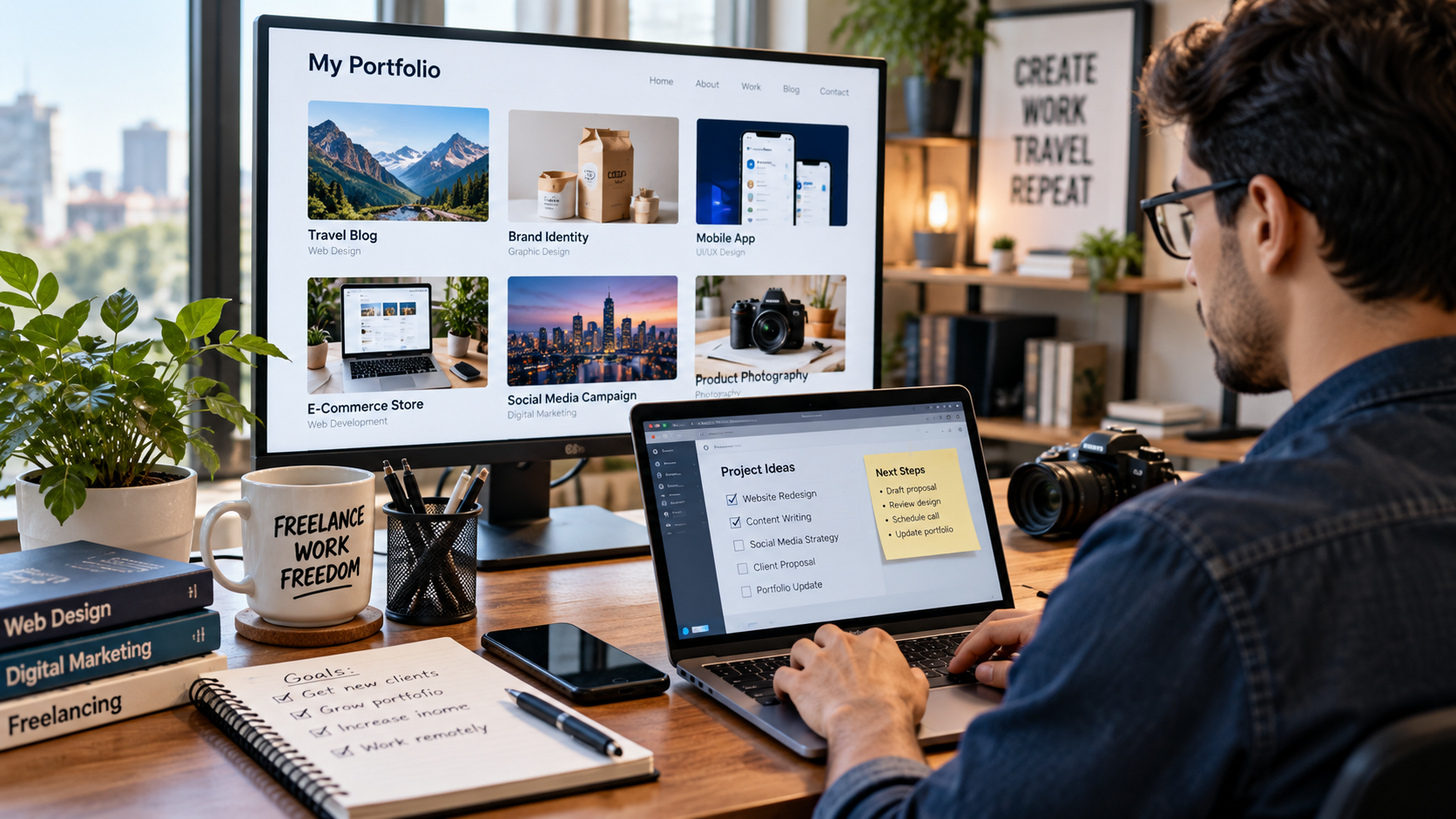
A sustainable freelance career starts with a demonstrable client problem, a transparent portfolio and a written project scope—not just a fashionable skill label. Research cutoff: October 12, 2026; confirm developing facts before publication.
What is happening and why readers are searching
Freelancing in 2026 rewards a credible problem-solving portfolio more than a generic promise to “work from anywhere.” Upwork’s February 2026 skills report found sustained demand in full-stack development, virtual assistance, data analytics and graphic design, while some AI-specific services expanded quickly. Its evidence comes from platform activity, so it should not be presented as a census of the entire labor market. Sources: Upwork research and FTC job scam guidance.
The important context competitors can overlook
The most durable freelance offers combine a technical or creative capability with a measurable business outcome. A web developer may improve checkout speed; an analyst may reconcile marketing data; a designer may build conversion-tested assets. Clients often purchase reduced uncertainty, not hours. That is why proof of previous work, clear project scopes and responsive communication can matter more than buzzwords in a profile. For primary-source checks and current reporting, see Upwork research and IRS Gig Economy Tax Center. The key distinction is evidence-led market demand plus realistic client-acquisition plan.
A practical way to use this information
Pick one niche, produce two original portfolio examples, publish a transparent service package and contact prospective clients with a brief problem-specific proposal. Track inquiries, meetings, closes and repeat revenue. Calculate unpaid administration time before quoting a rate. Beginners should be skeptical of job ads demanding deposits or advance purchases of equipment.
What to verify before making a decision
The right next step is to identify the source, timestamp and applicable market or jurisdiction. Check whether a number is a historical observation, official announcement, target, forecast or scenario. If you intend to act financially, legally or commercially, use the relevant provider’s current terms and obtain professional advice where appropriate. The sources cited here establish context; they are not a substitute for live prices, individual eligibility checks or binding agreements.
Reader questions
Which freelance skills were in demand in 2026?
Upwork reported demand for established areas such as full-stack development, virtual assistance and analytics.
Do I need an expensive certification before applying?
Often a relevant work sample and strong project communication matter more, although some regulated tasks require qualifications.
Start with a client problem rather than a fashionable skill label
A freelance career begins with a problem someone is willing to pay to solve. “I use AI” is a weak service description; “I organize a company’s weekly support reports into an accurate dashboard” is specific. The latter identifies a buyer, an output and a result that can be reviewed. In-demand skills lists are helpful for identifying markets, but platform surveys do not guarantee that every new freelancer will secure clients in a listed category. Experience, language, portfolio quality, reliability and competition influence the outcome.
Choose an initial service where you can produce a tangible sample: a redesigned product page, a reconciled spreadsheet, a short video with captions, a translation with terminology notes, or a software test report. For regulated topics such as legal advice, medicine or investment recommendations, credentials and professional obligations matter. A beginner should not market unqualified specialist advice simply because an online marketplace contains buyers asking for it.
Build a three-piece portfolio that proves capability
The first sample should demonstrate the basic service. The second should show a difficult or realistic constraint, such as correcting an inconsistent dataset or adapting a design for mobile readability. The third should tell a short case-study story: the initial problem, the actions taken, the tools used and the result. If a sample was created without a paying client, label it as a demonstration. Never invent customer testimonials, sales improvements or company permission. Credibility rises when a prospective client can inspect actual work and understand its limitations.
For writers and marketers, a strong sample can include an outline, source verification, original data interpretation and a final article. For developers, a small documented application with a working demo may be more convincing than a long list of programming languages. For virtual assistants, an anonymized process checklist or sample project board can communicate professionalism without revealing anyone’s private information. Focus on quality and clear explanation, not sheer quantity.
Pricing: hourly, fixed-project and retainer tradeoffs
Hourly pricing is convenient when the scope is uncertain, but clients need confidence that time will be recorded fairly. Fixed pricing can reward an efficient freelancer but becomes risky when revision requirements are vague. A monthly retainer creates predictable income when responsibilities and limits are clearly written. For example, a $400 fixed-price assignment that takes eight hours provides $50 per working hour before taxes, business expenses and time spent finding the job. If unexpected revisions double the work, the effective rate falls to $25. Freelancers should calculate their true workload, not just the proposed invoice amount.
Ask for a written scope including deliverables, deadlines, feedback rounds, necessary client inputs, payment terms and what counts as extra work. When a project requires third-party software or licensed images, specify who pays. An agreement should also address confidentiality, ownership and permitted use of the finished work. Complex contracts may warrant legal advice, but even a short written agreement prevents many basic misunderstandings.
Where the first clients can come from
Marketplaces can help beginners find buyers, but applications compete with experienced sellers. Other paths include referrals, professional communities, relevant local businesses and direct outreach based on a clearly identified need. A useful introductory message refers to the client’s situation and includes one relevant sample; mass messages claiming guaranteed results are unlikely to build trust. Track each outreach attempt, reply, call and proposal so that you can learn which offers attract serious interest.
Do not spend weeks perfecting a website if no one has yet validated demand for the service. A simple portfolio, defined offer and a few respectful conversations can provide more information than an elaborate brand package. Equally, do not underprice indefinitely to win reviews; low fees can make it impossible to allocate time for quality and client communication.
Turn delivery into repeat work
A professional freelancer confirms milestones, communicates delays early and documents handover. Include a concise explanation of how the client can use the deliverable and what support, if any, is included afterward. Ask permission before displaying confidential work in a public portfolio. A satisfied client may return for updates, adjacent projects or introductions, making retention an important part of earning a sustainable income.
Track utilization, unpaid administrative hours, late payments and client concentration. If one customer accounts for nearly all revenue, a missed renewal can put the business at risk. Building reserves and maintaining a pipeline are as important as mastering the latest software tool. A freelance career is an operating business, not simply a collection of online gigs.
Frequently asked questions for first-time freelancers
Should a beginner specialize immediately?
Begin with a reasonably narrow service to make your offer clear, while remaining open to adjacent needs. “I improve product-listing descriptions for small online stores” is easier for a buyer to assess than “I do everything digital.” As work accumulates, the freelancer can expand into analytics, design or customer support if the skill and demand justify it.
How do I get experience without inventing clients?
Build demonstration projects using fictional or publicly available data where permitted, contribute to genuine community efforts, or volunteer for a limited, transparently defined assignment. Label samples honestly. Employers and clients often value a clean explanation of a real approach more than a fabricated claim about a famous brand.
Should I accept work without a contract?
At minimum, secure a written agreement on deliverables, deadlines, payment, revisions and usage rights. The detail needed depends on project scale and jurisdiction. An unclear arrangement increases the possibility of scope creep, disputes or late payments. Keep client communications professional and preserve approvals.
Discover more from Remote Work Tips
Subscribe to get the latest posts sent to your email.
AI
Optimizing for AI Overviews: The Freelancer’s Guide to Schema Markup & Generative Engine Optimization (GEO)
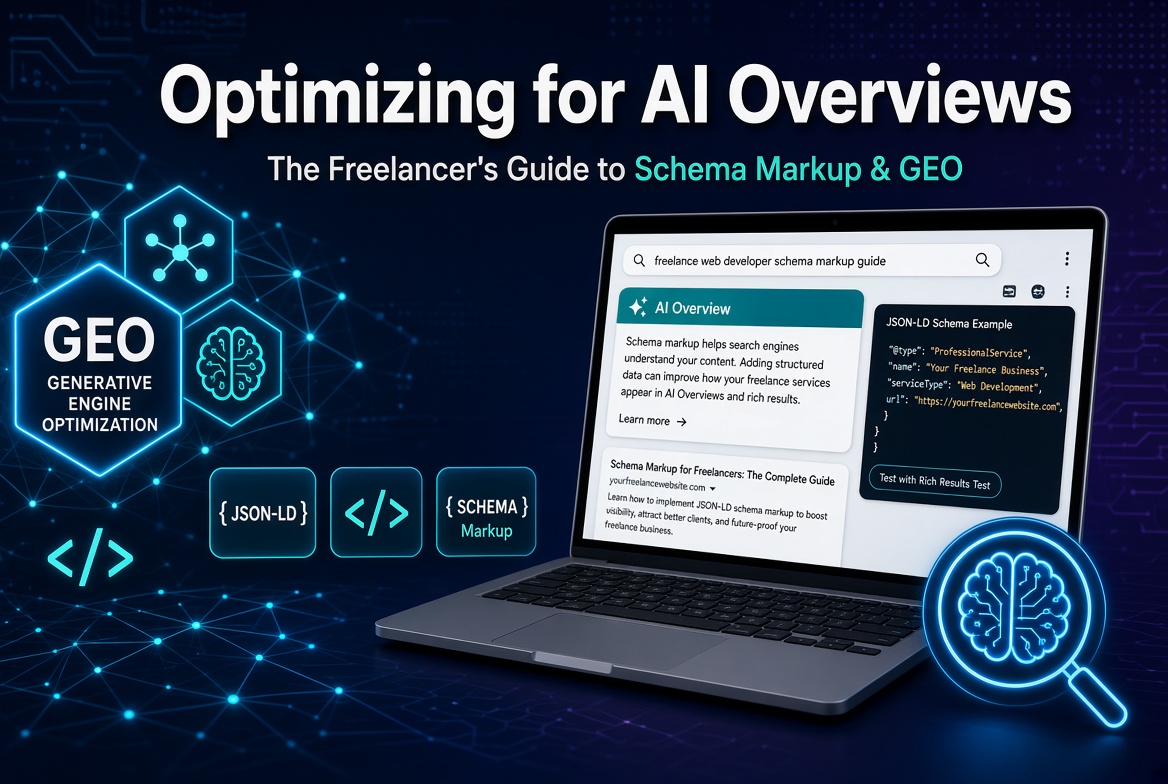
Traditional search engine optimization is undergoing a seismic shift. As Google AI Overviews, Perplexity, and SearchGPT handle millions of daily queries, the traditional “blue links” are giving way to synthetic AI summaries. For SEO freelancers, relying solely on keyword density and backlink building is no longer enough to secure visibility. To deliver high-tier value for your clients in 2026, you must master Generative Engine Optimization (GEO) and advanced Schema.org markup.
Generative Engine Optimization (GEO) is the strategy of structuring content so that artificial intelligence search models can easily parse, understand, and cite your site in zero-click summaries. Freelancers can execute GEO by pairing nested JSON-LD schema markup with an “answer-first” content architecture, entity-dense vocabulary, and authoritative data citations.
Traditional SEO vs. Generative Engine Optimization (GEO)
While traditional SEO optimizes for web crawlers that index pages based on keywords and page rank, GEO optimizes for Large Language Models (LLMs) and Retrieval-Augmented Generation (RAG) systems that analyze entities, facts, and relationships.
Feature Traditional SEO Generative Engine Optimization (GEO) Primary Goal Rank #1–#3 on Search Engine Result Pages (SERPs) Earn citation links inside AI-generated summaries Core Target Web Crawlers & Indexing Bots LLM Encoders, Vector Databases & RAG Pipelines Optimization Focus Keyword density, title tags, page speed Entity clarity, structured data, direct-answer hierarchy Success Metric Organic Click-Through Rate (CTR) Brand Impression Share & AI Citation Frequency
Why Schema Markup (JSON-LD) is the Foundation of GEO
Artificial intelligence models excel at understanding context, but they rely on structured data to eliminate ambiguity. According to Google Search Central, structured data provides explicit clues about the meaning of a page, transforming unstructured text into machine-readable facts.
By implementing Schema.org standards using JSON-LD (JavaScript Object Notation for Linked Data), you directly feed the search engine’s knowledge graph.
Critical Schema Types for GEO Freelancers:
- Article / TechArticle: Defines the author, publishing entity, and canonical subject matter.
- FAQPage: Provides clean, prompt-and-response text nodes ideal for LLM extraction.
- HowTo: Breaks complex processes down into strict sequential steps.
- Organization / Person: Establishes E-E-A-T (Experience, Expertise, Authoritativeness, and Trustworthiness) by linking social profiles, credentials, and institutional affiliations.
To help you audit client sites quickly, use this interactive GEO & Schema Readiness Calculator:
3 Steps to Optimize Content for AI Citations
Groundbreaking research from Princeton, Georgia Tech, and Allen Institute for AI demonstrated that incorporating specific GEO methods can boost a website’s visibility in generative search engine responses by up to 40%.
1. Implement the “Pyramid” Content Structure
AI engines prefer content that delivers immediate value before diving into nuances.
- H1: Clear, descriptive topic title.
- H2 (Immediate Answer): Place a 50–70 word direct definition or summary immediately below the main topic heading.
- H2/H3 (Deep Dive): Follow up with bulleted data, step-by-step methodologies, and comparison tables.
2. Nest JSON-LD Schema Correctly
Never separate your schemas into disconnected code blocks. Instead, nest entities within one another to show relationships. For example, nest the Person author schema inside the TechArticle schema.
{
  "@context": "https://schema.org",
  "@type": "TechArticle",
  "headline": "Optimizing for AI Overviews with GEO",
  "author": {
    "@type": "Person",
    "name": "Jane Doe",
    "jobTitle": "Technical SEO Consultant",
    "sameAs": "https://www.linkedin.com/in/janedoe"
  },
  "publisher": {
    "@type": "Organization",
    "name": "Remote Work Tips",
    "url": "https://remoteworktips.blog"
  }
}
3. Cite High-Authority Data Sources
LLMs are trained to prioritize factually grounded information. Incorporating statistics, primary research, and direct quotes from authoritative institutions—such as the World Wide Web Consortium (W3C) or Mozilla Developer Network (MDN)—signals high citation value to RAG algorithms.
Actionable Next Steps for Freelancers
- Conduct a GEO Audit: Use Google’s Rich Results Test and Schema Markup Validator to identify missing structured data on your clients’ top-performing pages.
- Package a “GEO Upsell”: Offer existing clients a $1,500 “AI Overview Readiness Package” that updates their top 10 articles with nested JSON-LD schemas and direct-answer snippets.
- Monitor AI Impressions: Track brand queries in Perplexity and SearchGPT manually or via specialized tracking platforms to measure citation growth month-over-month.
Frequently Asked Questions (FAQ)
Does implementing JSON-LD guarantee inclusion in Google AI Overviews?
No protocol guarantees inclusion, but valid JSON-LD drastically increases the probability by reducing the computational effort required for search engines to parse and verify your site’s facts.
What is the single most effective GEO tactic?
According to academic studies on GEO, adding authoritative citations and statistics, combined with clean structured data, yields the highest increase in AI search visibility.
Can I automate JSON-LD generation for large sites?
Yes. You can write custom PHP hooks in WordPress, use dedicated SEO plugins, or write Python scripts to dynamically map CMS metadata into valid JSON-LD schemas.
Discover more from Remote Work Tips
Subscribe to get the latest posts sent to your email.


Modern Freelance Tools in 2026: How to Build an AI-Assisted Workflow That Clients Trust
An effective freelance tool stack should reduce mistakes and administration, not merely add more subscriptions. Modern workflows might combine an...


Freelance Careers in 2026: In-Demand Skills, Portfolio Proof and Getting First Clients
A sustainable freelance career starts with a demonstrable client problem, a transparent portfolio and a written project scope—not just a...


Freelancing in 2026: The Tools, Projects and Positioning That Win High-Ticket Clients
Freelancing has split into two markets. Commodity work is getting cheaper, while expert work is getting more valuable. The tools...


How to Calculate Your Freelance Day Rate (& Raise It Without Losing Clients)
Setting your freelance day rate is one of the most critical commercial decisions you will make. Set it too low,...


Optimizing for AI Overviews: The Freelancer’s Guide to Schema Markup & Generative Engine Optimization (GEO)
Traditional search engine optimization is undergoing a seismic shift. As Google AI Overviews, Perplexity, and SearchGPT handle millions of daily...


Top 6 Payment Solutions for Freelancers Faster Than Banks
Midway through a project in Milan, a freelance UX designer named Elena watched her rent payment bounce. The client’s bank...


10 Freelancing Tips for Landing Projects in the AI Era
The Market Split No One Warned You About In February 2026, a mid-career graphic designer in Austin posted to a...


The Sovereign Developer: The 5 Most Lucrative Coding Jobs in 2026 (And Why They Pay So Well)
For the past three years, the prevailing tech narrative has been dominated by a singular, slightly hysterical prediction: AI is...
-

 blogging5 years ago
How to Use Social Media to Promote Your Blog
-

 freelance5 years ago
6 Future-Focused Skills Freelance Creatives Can’t Afford to Ignore
-

 social media5 years ago
How to Learn Social Media Without Getting Scammed
-

 freelance10 months ago
The Economics of Remote Work: How Hybrid Models Are Reshaping Global Productivity
-

 blogging5 years ago
20 Best Freelance Marketplaces for Freelancers in 2022 to Make Money
-

 freelance5 years ago
7 Highest Paying Freelance Jobs For Earning A Steady Income
-

 Digital Banking5 years ago
Pakistan Consumer Confidence Index increased by 8.8% in Q4 2021
-

 blogging5 years ago
30 “Proven” Ways to Make Money Online Blogging with WordPress