
App
TikTok planning to launch age-appropriate content restrictions


The restriction will help in stopping adult content from reaching underage users.
To avoid inappropriate content from reaching young users, TikTok is working on ways to rate and restrict content by age, according to the company.
TikTok, which has risen in popularity among teenagers in recent years, announced that it was conducting a limited test to see how adult-rated content could be blocked to reach accounts of younger users, either by the user or their parents/guardians.
The company, which is controlled by Chinese tech giant ByteDance, said it was based on existing content-rating standards for movies and video games.
It stated it would test a feature that would allow content creators to designate whether their content should only be seen by older users.
Since its popularity boom, TikTok has seen a massive surge of content from all genres, which also includes some inappropriate content, and since they have no restrictions, any user can access them.
Social media networks have been criticized for how they handle the safety of their younger audience. US senators have chastised Meta, the parent company of Facebook, Instagram, and WhatsApp, over its plans to launch a children’s version of Instagram.
After leaked internal documents highlighted issues about business research into Instagram’s effects on the mental health of young users, a consortium of state attorneys general launched an investigation into Meta for advertising Instagram to children despite potential dangers.
Discover more from Remote Work Tips
Subscribe to get the latest posts sent to your email.



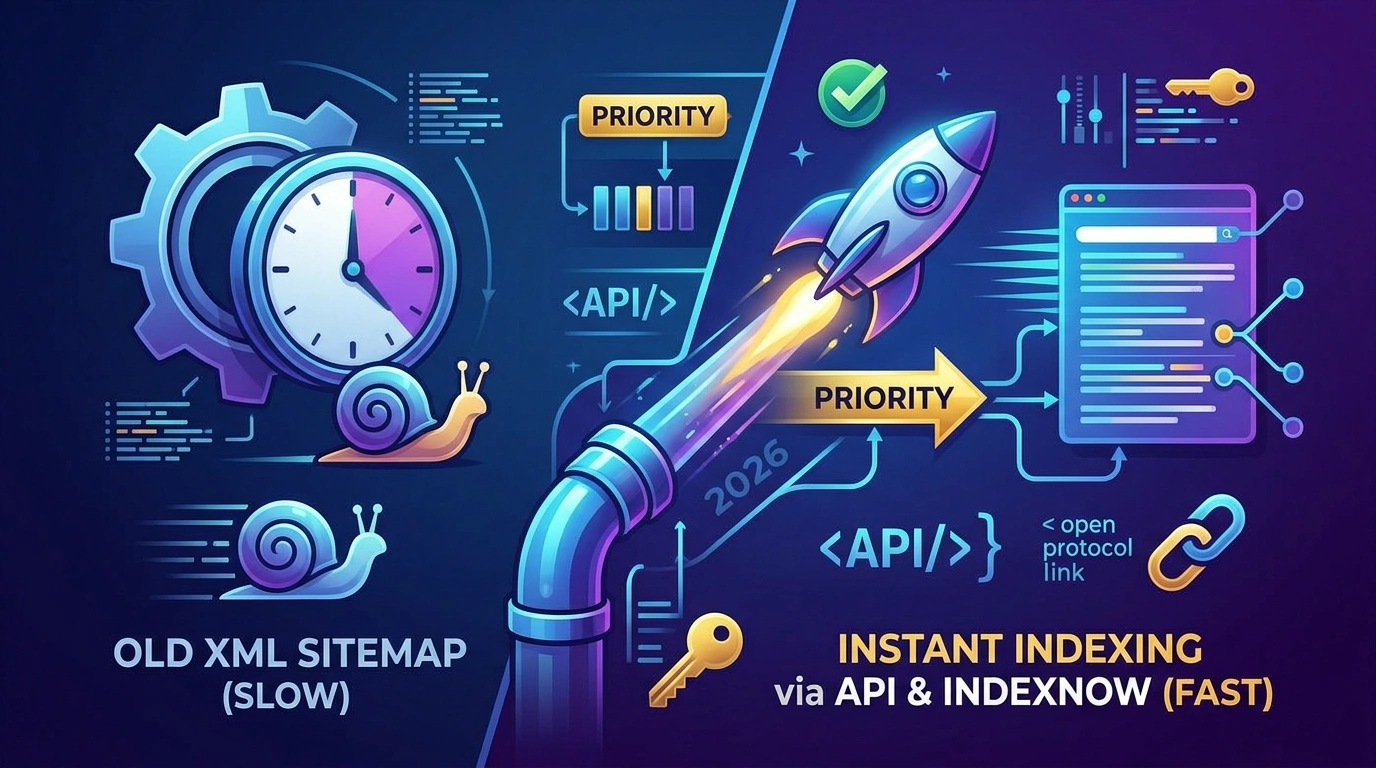
The traditional SEO model of publishing a post and passively waiting weeks for Googlebot to crawl your XML sitemap is dead. In the fast-paced 2026 digital landscape, search engines are allocating their crawl budgets more strictly than ever. For freelance developers and SEO consultants, this shift presents a highly lucrative opportunity: businesses are actively seeking technical specialists who can guarantee their new products, news, and generative AI content are indexed and ranking within hours, not weeks.
By mastering programmatic indexing protocols like the Google Indexing API and IndexNow, you can transition from selling standard “SEO optimization” to offering high-ticket “Instant Indexing Infrastructures.” This guide breaks down exactly how to implement these protocols for your clients, the technical nuances to navigate, and how to monetize this highly demanded skill.
How Do You Achieve Instant SEO Indexing in 2026?
To instantly index website content in 2026, webmasters must bypass passive XML sitemap crawling by programmatically pushing URL updates directly to search engines. For Google, this involves utilizing the Google Cloud Indexing API via a verified Service Account to trigger immediate crawls. For Microsoft Bing, Yahoo, and Yandex, implement the IndexNow protocol by hosting a verification .txt key at the server root and sending HTTP POST requests to automatically notify participating engines of new or updated content.
The Google Indexing API: Pushing Content to the Top
The Google Indexing API allows site owners to directly notify Google’s servers the exact moment a page is added, updated, or removed. Rather than waiting for a scheduled crawl, this API places your URLs in a high-priority queue.
Official vs. Unofficial Capabilities
According to official Google Search Central documentation, the Indexing API is strictly intended for pages containing JobPosting or BroadcastEvent structured data. For sites with highly volatile inventory (like daily job boards or livestream schedules), it keeps search results fresh by pushing updates individually.
However, technical SEO communities have long documented that implementing the API across standard eCommerce products and news articles frequently triggers successful, rapid indexing. While doing this operates in a gray area of Google’s official guidelines, the underlying mechanics remain the same.
Step-by-Step Implementation Framework
- Google Cloud Provisioning: Create a new project within the Google Cloud Console and enable the “Web Search Indexing API.”
- Service Account Creation: Generate a new Service Account and download the JSON key file. This file contains the cryptographic keys your script (or WordPress plugin) needs to authenticate.
- Search Console Authentication: This is the step most beginners miss. You must add the Service Account’s email address as an Owner in the Google Search Console property of the target domain.
- Sending the Payload: Using Node.js, Python, or a CMS plugin, send a POST request to
[https://indexing.googleapis.com/v3/urlNotifications:publish](https://indexing.googleapis.com/v3/urlNotifications:publish)with the target URL and theURL_UPDATEDorURL_DELETEDtype.
Quota Limitations: Google provisions a strict default limit of 200 API calls per day per project. For enterprise clients, you must request quota increases directly through the Cloud Console.
IndexNow: The Open-Source Future of Crawling
While Google maintains its proprietary API, the rest of the search landscape has unified under IndexNow. Supported by Microsoft Bing, Yandex, Seznam.cz, Naver, and Yep, IndexNow is an open-source ping protocol.
The defining advantage of IndexNow is its co-sharing mechanism. Search engines adopting the protocol agree to automatically share submitted URLs with all other participating search engines. You ping one; you update them all.
Implementing the IndexNow Protocol
Setting up IndexNow is significantly lighter than Google’s API, making it an easy “quick win” to offer clients:
- Key Generation: Generate an API key (a minimum of 8 and a maximum of 128 hexadecimal characters).
- Server Root Verification: Host a UTF-8 encoded text file named
{your-key}.txtat the root directory of the client’s website (e.g.,[https://www.example.com/3f2fa233444b4e87a5c40277499c4be4.txt](https://www.example.com/3f2fa233444b4e87a5c40277499c4be4.txt)). The file must contain the exact key string inside. - Triggering the Ping: To submit a single URL, you can fire a simple HTTP GET request.
- Example:
[https://www.bing.com/indexnow?url=https://www.example.com/product-page&key=your-key](https://www.bing.com/indexnow?url=https://www.example.com/product-page&key=your-key)
- Example:
- Batch Submissions: For bulk updates, you can submit up to 10,000 URLs per POST request using a JSON payload containing the
host,key, and anurlListarray.
Actionable Next Steps: Monetizing Your Indexing Skills
Do not sell “Google Indexing API setup” as an hourly task. Package this as a high-value technical infrastructure upgrade.
- The “Instant Index” Audit ($250 – $500): Audit a client’s current indexation ratio (pages published vs. pages indexed in Google Search Console).
- The Technical Implementation ($500 – $1,200): Set up the Google Cloud project, configure the Service Account, generate the IndexNow key, place it on their server, and configure their CMS (via custom PHP or headless architecture) to trigger pings on publish.
- The Retainer ($150/mo): Monitor API error logs, manage the 200-URL daily quota limitations, and maintain the JSON key security.
Frequently Asked Questions (FAQ)
Can I use the Google Indexing API for any type of website?
Officially, Google states the API is only for JobPosting and BroadcastEvent data. Any attempt to abuse the API to spam the index could result in your access being revoked. However, many technical SEOs successfully use it for standard pages, provided the content is high quality and not manipulative.
Do I still need XML sitemaps if I use IndexNow and the Indexing API?
Yes. Both Google and the IndexNow consortium explicitly state that APIs are meant to supplement, not replace, traditional sitemaps. The APIs handle rapid updates for volatile content, while XML sitemaps provide a comprehensive map for the complete structural coverage of your site.
How do I know if my IndexNow ping was successful?
A successful HTTP GET or POST request to the IndexNow endpoint will return an HTTP 200 response code. This confirms the search engine has received the URL, though it does not guarantee immediate inclusion in search engine results pages (SERPs).
Discover more from Remote Work Tips
Subscribe to get the latest posts sent to your email.
Here is a number worth sitting with: AI-enabled freelancers now save an average of eight hours per week and earn 40% more per hour than their non-AI-using counterparts. Jobbers In a profession where time is the only non-renewable resource, that gap is not merely a competitive advantage — it is the difference between a freelance practice that scales and one that quietly stagnates.
The global freelance economy has never been larger or more consequential. Over 64 million Americans were freelancing as of 2023, contributing more than $1.27 trillion to the U.S. economy — and freelancers are 2.2 times more likely to regularly use generative AI than their salaried peers. High 5 Test By March 2026, that lead has only widened. Freelancers with specialized AI and prompt engineering skills are commanding a 56% wage premium over traditional roles, as “Agentic AI” becomes a standard workplace tool. DemandSage
Yet the uncomfortable truth is that most independent professionals are still leaving enormous value on the table — not because they lack skill, but because they are burying billable hours beneath a slow avalanche of admin. The right AI stack, deployed intelligently, is the fastest structural change a freelancer can make to their income in 2026. What follows is a rigorous look at the five tools producing the biggest, most measurable gains right now.
The 40% Problem Nobody Talks About
Ask most freelancers where their day goes and you will hear a familiar litany: client emails, project briefs, invoice chasing, meeting notes, proposal drafts, scheduling threads. Freelancers today are no longer just service providers; they are project managers, marketers, accountants, customer support agents, and strategists all at once. FreelancingGig
Research consistently shows that knowledge workers spend between 40 and 60 percent of their working hours on tasks that are, in economic terms, non-productive — activities that consume time without directly generating revenue. For a freelancer billing $100 per hour who works a standard eight-hour day, that translates to $320 to $480 in theoretical daily earnings lost to overhead. Across a working year, the math becomes quietly devastating.
The promise of AI is not that it replaces your expertise — it is that it eliminates the administrative friction taxing that expertise at an invisible rate. Realistic expectations for drafting and ideation put time savings at 30 to 60 percent on first drafts, outlines, and idea generation. Asrify Stack that across five categories of daily work, and the compounding effect approaches — and in many documented cases exceeds — 50%.
[Link to related FT article: How AI is reshaping the economics of independent work]
The Top 5 AI Tools Unlocking 50% More Billable Hours in 2026
1. Claude (Anthropic) — The Strategic Thinking Partner
Value proposition: A long-context AI assistant that handles complex drafts, deep client research, and nuanced multi-document analysis with a consistency that rivals a senior research associate.
At the operational core of many six-figure freelance practices in 2026 sits Claude, Anthropic’s flagship model. Unlike general-purpose chatbots optimized for breadth, Claude has carved out a reputation for sustained reasoning across lengthy, complex material. Claude now offers a one-million-token context window, Agent Teams, and Claude Code Nxcode — meaning a freelance consultant can feed an entire client contract, three years of market reports, and a competitor analysis into a single session and receive synthesis that would have taken a junior analyst a full week to produce.
The productivity mechanics are concrete. Access to AI assistants of Claude’s caliber reduced the time employees needed for writing tasks by 40 percent, while the quality of output increased by 18 percent. ClickForest For a consultant producing six deliverables per month, that compression alone recovers roughly two full working days.
Real-world impact: A content creator using Claude to edit final drafts halved her content production time. 2727coworking A freelance consultant reported using Notion AI (powered partly by Claude Opus 4.1) to auto-generate client onboarding templates from bullet points, reducing prep time from two hours to 30 minutes per client. 2727coworking
Pricing context: Claude Pro is $20/month — the same price as a single billable hour for most mid-range freelancers. The return on that investment becomes positive within the first afternoon of serious use.
The economist’s take: Claude’s real structural advantage is asymmetric leverage. A solo freelancer using Claude effectively is not working harder than a boutique consultancy with three staff — they are working at the same cognitive bandwidth. That changes pricing power, not just output speed.
2. Notion AI — The Operating System for Your Entire Practice
Value proposition: An all-in-one workspace that turns project management, meeting notes, client databases, and strategic documents into a single AI-queryable knowledge base.
If Claude is the thinking partner, Notion AI is the institutional memory. The September 2025 launch of Notion 3.0 introduced autonomous AI Agents that can execute multi-step workflows, marking a fundamental shift from passive tools to active digital assistants that genuinely work alongside you. Max Productive AI
For freelancers juggling multiple clients across different time zones, the killer feature is Notion AI’s ability to surface information from your own workspace in response to natural-language questions. Ask “What were the key deliverables we agreed with Acme Corp last quarter?” and the system retrieves the relevant meeting notes, contract terms, and action items — not a generic internet answer, but your specific institutional knowledge. Users report saving 50 to 100 hours in just three months for repetitive writing tasks, and companies like Zapier reduced post-meeting admin time by 40 percent using Notion AI for converting raw meeting transcripts into organized notes. booststash
The autonomous Agent can work for up to 20 minutes performing multi-step tasks across hundreds of pages simultaneously — building comprehensive project launch plans, compiling client feedback from multiple sources, drafting detailed reports, and creating interconnected page structures. Max Productive AI
Pricing context: The Business plan at $20/user/month now includes full Notion AI — making it, as one analysis put it, the cost of a single ChatGPT subscription for an entire integrated workspace including AI access to GPT-5, Claude Opus 4.1, and o3.
The economist’s take: Notion AI solves a problem economists call “context switching cost” — the productivity tax paid every time a knowledge worker shifts between disconnected applications. By collapsing CRM, project management, note-taking, and AI writing into one queryable system, it eliminates the friction that compounds invisibly throughout the workday.
[Link to related FT article: The rise of AI-native knowledge management in the gig economy]
3. Zapier — The Invisible Infrastructure Layer
Value proposition: No-code automation that connects over 5,000 apps, letting AI handle repetitive cross-platform workflows while you focus exclusively on billable work.
Automation is the compounding interest of productivity. In 2026, freelancers who ignore automation often struggle to scale, while those who embrace it can handle more clients without increasing hours. FreelancingGig Zapier sits at the infrastructure layer of most high-performing freelance operations, quietly executing the administrative choreography that would otherwise consume hours per week.
The tool’s 2025-2026 AI upgrades are substantial. With Zapier’s latest AI upgrade, freelancers can now build automations using plain English — its multi-step “Zaps” reduce manual work, especially for those managing client onboarding or marketing funnels. Social Champ Practical applications range from automatically routing new client inquiry emails into a CRM, generating a first-draft proposal, and notifying via Slack — all without human intervention — to triggering invoice creation the moment a project milestone is marked complete in a project management tool.
Featured snapshot — what Zapier actually automates for top freelancers:
- New client form submission → auto-create Notion project page + send welcome email sequence
- Completed project milestone → generate invoice draft in FreshBooks + alert client via email
- Meeting scheduled → create agenda template + add follow-up reminder to Asana
- New testimonial received → format and publish to portfolio website
- Monthly financial data → compile into standardized reporting dashboard
A freelance consultant using Zapier’s AI automations reduced cross-platform administrative work by building “Zaps” that parse email content, summarize it, and route action items automatically 2727coworking — eliminating what had previously been a daily 45-minute triage ritual.
Pricing context: Free tier covers basic Zaps; the Professional plan at $19.99/month unlocks multi-step automations and AI features. For any freelancer billing above $40/hour, recovering even one hour per month justifies the cost within weeks.
The economist’s take: Zapier doesn’t save time — it creates time that never existed before, by executing work at machine speed during hours when you are asleep, in client meetings, or doing the creative work that actually commands premium rates.
4. Timely — AI-Powered Time Intelligence
Value proposition: An automatic time-tracking tool that logs your entire workday without manual input, ensuring every billable minute is captured, analyzed, and converted to revenue.
This is the most underestimated tool in the freelance stack, and arguably the one with the most immediate financial impact. AI-powered billable hours trackers like Timely use smart AI to remember your whole day without manual input — and users say these tools find 20% more billable time they had previously missed. apps365
For a freelancer billing $80 per hour who works approximately 100 hours per month, recovering 20% more billable time represents $1,600 in additional monthly revenue — from a tool that costs under $20/month. That is a return on investment that would make a private equity analyst blush.
Timely’s “memory” architecture runs passively in the background, tracking which applications, documents, and websites you engage with throughout the day, then reconstructing a timeline of your work that can be reviewed, edited, and converted to invoice-ready timesheets. In 2026, many freelancers rely on AI summaries from time-tracking tools to identify inefficiencies, suggest better pricing models, and even recommend when to raise rates based on workload trends. FreelancingGig
The behavioral insight dimension is equally valuable. Patterns in time data reveal which client relationships are actually profitable once admin overhead is accounted for, which project types produce scope creep, and where your most valuable peak-productivity hours are currently being allocated to low-value tasks.
Pricing context: Starter plans from approximately $9/month; professional tiers with full AI analysis from $16/month.
The economist’s take: In economics, what isn’t measured isn’t managed. Most freelancers operate with a systematic measurement gap between hours worked and hours billed — Timely closes that gap with a precision that manual tracking never achieves. The revenue uplift is real and immediate.
[Link to related Forbes article: The hidden billing gap costing freelancers thousands annually]
5. Perplexity AI — The Research Engine That Eliminates Dead Time
Value proposition: A real-time AI search and synthesis engine that compresses hours of research into minutes, complete with cited primary sources — the 2026 breakout tool for knowledge-intensive freelancers.
Every freelancer who does research-intensive work — consultants, writers, strategists, analysts — understands the invisible tax of information gathering. Building a solid base of evidence for a client deliverable can absorb two to four hours of a workday that should have been billable. Perplexity AI is the 2026 breakout tool attacking this specific bottleneck with striking effectiveness.
Unlike standard AI assistants that synthesize from training data, Perplexity conducts live web research and returns synthesized answers with source citations — functioning as a research assistant that works at fifty times human reading speed. Productivity research documents a 45% time reduction in research tasks for AI-enabled freelancers, Jobbers and Perplexity is the primary driver of that compression in knowledge work.
For a market research consultant charging $150/hour, compressing a four-hour research phase to two hours per project adds two billable hours per engagement. Across 12 projects per month, that is 24 additional billable hours — approximately $3,600 in monthly revenue uplift from a single tool costing $20/month in its Pro tier.
A 2025 McKinsey Global Institute report noted that AI-driven automation could boost global productivity by up to 40% by 2035, with early adopters in creative industries already seeing efficiency gains of 30%. Blockchain News Perplexity users in knowledge-intensive freelance fields are consistently at the leading edge of that adoption curve.
Pricing context: A generous free tier exists; Perplexity Pro at $20/month unlocks unlimited real-time search, advanced models, and API access for workflow integration.
The economist’s take: Research is a classic “threshold task” — you must complete it before any billable output can exist. Perplexity compresses the threshold, not the creative work itself. That asymmetry is exactly where AI delivers its highest marginal return.
[Link to related Economist article: How AI research tools are reshaping the knowledge economy]
Comparative Summary: Time Saved vs. Traditional Methods
| Tool | Primary Function | Documented Time Saving | Estimated Monthly Revenue Impact* | Price/Month |
|---|---|---|---|---|
| Claude | Research, drafting, analysis | 40–60% on writing tasks | $640–$960 | $20 |
| Notion AI | Knowledge management, project ops | 40–50% on admin & documentation | $320–$480 | $20 |
| Zapier | Cross-app workflow automation | 4–6 hrs/week eliminated | $480–$720 | $20 |
| Timely | Automatic time capture & billing | 20% more billable time recovered | $1,200–$1,600 | $16 |
| Perplexity AI | Research synthesis | 45% time reduction in research | $800–$1,200 | $20 |
*Estimates based on a freelancer billing $80/hour working 25 billable hours/week. Individual results vary.
The Compounding Effect and the Ethical Dimension
Deploy all five tools coherently — not as disconnected subscriptions but as an integrated system — and the aggregate impact approaches and frequently exceeds the 50% billable-hour uplift the headline promises. The math is not additive; it is compounding. Time saved by Timely reveals where to focus. Perplexity compresses research. Claude converts that research into polished deliverables. Notion AI manages the client relationship and institutional memory. Zapier runs the administrative infrastructure in the background while you sleep.
The global gig economy is projected to reach a valuation of $674.1 billion in 2026 DemandSage, and the professionals capturing an outsized share of that growth share one common characteristic: they treat AI not as a novelty, but as operational infrastructure.
The ethical considerations deserve equal seriousness. Transparency with clients about AI-assisted workflows is not merely good practice — it is the foundation of sustainable professional trust. Clients benefit from AI-enabled freelancers through faster delivery, more reliable quality, and clearer communication throughout projects, Useme but that value proposition holds only when the human expert remains genuinely in the loop, exercising judgment, catching errors, and bringing the contextual intelligence that no model can replicate.
There is also a structural concern worth naming. Basic writing job postings have decreased 21%, simple graphic design 17%, and data entry 35% since ChatGPT’s launch — but AI content editing grew 180%, prompt engineering 240%, and AI tool training 165%. Jobbers The market is not shrinking; it is bifurcating. Freelancers who position themselves at the expert layer — using AI to amplify rather than replace their specialized judgment — are on the right side of that divide.
The Next Step: Start With One, Not Five
The most common mistake in building an AI-powered freelance practice is attempting a wholesale transformation overnight. A more durable approach is sequential adoption: identify your single largest time drain, match it to the tool most precisely targeting that drain, measure the impact over 30 days, and then layer the next tool onto a stable foundation.
Start with one general tool and one specialist tool. Track ROI explicitly: estimate hours saved per week and new revenue generated from AI-assisted services. Upgrade only when you hit bottlenecks. Asrify
For most freelancers, the sequence that delivers the fastest measurable return is: Timely first (you cannot optimize what you cannot measure), Claude second (the highest-leverage creative amplifier), and Zapier third (the infrastructure that systematizes your gains). Notion AI and Perplexity follow naturally as your practice scales.
The 50% uplift in billable hours is not a marketing abstraction. It is a structural reality — documented, measurable, and increasingly separating the freelancers who thrive in the 2026 economy from those who remain caught in the administrative gravity of the old one.
The tools exist. The data is clear. The only remaining question is whether you will use the next hour to plan the adoption, or spend it on work that a well-configured AI could have handled before breakfast.
Discover more from Remote Work Tips
Subscribe to get the latest posts sent to your email.
AI
The People vs. AI: Why America’s Growing Backlash Against Data Centers Signals a Broader Tech Reckoning


From Virginia’s megacampus communities to Mississippi’s courtrooms, a cross-partisan coalition is demanding that America slow down and ask who, exactly, benefits from the AI revolution—and at what cost.
One icy morning in February, nearly 200 people gathered in a Richmond, Virginia church before dawn. They came from rural farms and suburban subdivisions, from the valleys of Botetourt County and the exurbs of Washington, D.C. Republicans stood alongside Democrats. Pastors sat next to environmental engineers. And though they had arrived carrying different anxieties—higher electricity bills, fouled groundwater, the low industrial hum that now keeps rural families awake at night—they shared a single, galvanizing conviction: that the AI industry’s appetite for infrastructure had outpaced its accountability to the people who must live beside it.
“Aren’t you tired of being ignored by both parties, and having your quality of life and your environment absolutely destroyed by corporate greed?” state senator Danica Roem asked the crowd. The standing ovation that followed was the sound of something new crystallizing in American political life. What is causing AI backlash? The short answer: communities feel they are absorbing all of the costs—environmental, economic, democratic—while the profits flow elsewhere.
The activists marched to the state capitol, where state delegate John McAuliff offered what may be the most honest six-word summary of the public’s relationship with the AI boom: “You’re getting a sh-t deal.”

AI Pessimism Is Not a Fringe Position
Pundits frequently portray skepticism of AI as technophobia. The data tell a different story. According to Pew Research Center’s 2025 AI Attitudes Survey, five times as many Americans are concerned as are excited about the increased use of AI in daily life—a ratio that has widened over the past two years, not narrowed, as the technology has become more pervasive. Majorities believe AI will worsen creative thinking, erode meaningful human relationships, and degrade decision-making. More than half say AI poses a serious risk of spreading political misinformation. These are not marginal anxieties; they are mainstream ones.
Internationally, the United States is among the most skeptical rich nations, a finding that surprises many observers who assume American technological exceptionalism translates into enthusiasm. It does not. The country that houses the majority of the world’s AI compute infrastructure is also one of the most apprehensive about its consequences. The table below, drawn from Pew’s cross-national data, illustrates the divide.
Table 1: AI Optimism vs. Pessimism by Country (Pew Research, 2025)
Country % More Excited % More Concerned Net Sentiment United States 18% 38% −20 (Pessimistic) United Kingdom 17% 42% −25 (Pessimistic) Germany 14% 52% −38 (Pessimistic) India 71% 11% +60 (Optimistic) Indonesia 65% 9% +56 (Optimistic) Nigeria 58% 12% +46 (Optimistic) Japan 20% 48% −28 (Pessimistic) Brazil 55% 14% +41 (Optimistic)
Source: Pew Research Center, “AI Attitudes Survey” 2025. Net sentiment = % excited minus % concerned.
The pattern is stark: wealthy democracies with established labor protections and high wages view AI as a threat to existing quality of life; rapidly developing economies, where AI offers tangible prospects of economic leapfrogging, are markedly more enthusiastic. This is not irrational on either side. It reflects a fundamental asymmetry in who stands to gain from the present deployment trajectory.
Ground Zero: Why Virginia Became the Symbol of Bipartisan Resistance to AI Development
Virginia’s Loudoun County—nicknamed “Data Center Alley”—hosts more data center capacity than any comparable geography on Earth, accounting for roughly 70% of the world’s internet traffic at any given moment. The concentration has brought tax revenue and construction jobs. It has also brought something else: a relentless surge in electricity demand that is reshaping the state’s energy grid and the household budgets of people nowhere near a server rack.
As NPR reported, residential customers in Dominion Energy’s service territory—which covers much of northern and central Virginia—have seen bills climb as the utility pursues new generation capacity to feed data centers whose power purchase agreements are structured to benefit large commercial customers first. Rural residents, already stretched by post-pandemic inflation, are being asked to help finance infrastructure they will never use.
The activists in homemade shirts—“Boondoggle: Data Center in Botetourt County”—were not opposing innovation in the abstract. They were opposing a specific regulatory and financial arrangement in which local residents bear external costs while shareholders and cloud tenants capture value. This is a data center backlash in Virginia 2026 that has become a template: similar coalitions are emerging in Indiana, Arizona, Nevada, and rural Texas.
Stalled Projects and the $98 Billion Question
The activism is having measurable economic effects. According to industry trackers, approximately $98 billion in planned U.S. data center projects were stalled or subject to significant regulatory delay in Q2 2025, with activism and permitting challenges cited as primary factors. The table below breaks down the stalls by state.
Table 2: Stalled U.S. Data Center Projects by State (Q2 2025, est.)
State Est. Capital at Risk Primary Objection Status Virginia $34B Energy costs, noise, water Multiple projects paused Indiana $18B Agricultural land use Zoning litigation Arizona $22B Water scarcity State review ordered Nevada $14B Grid capacity, water Environmental impact review Texas $10B Grid stability (ERCOT) Utility negotiations stalled
Source: Industry estimates, state regulatory filings, Q2 2025. Figures rounded.
The delays are not killing AI development—they are redirecting it, to jurisdictions with cheaper power, laxer environmental oversight, and weaker community organization. This is the classic spatial arbitrage of industrial capitalism: the factory moves when the community pushes back. Whether that dispersal is good or bad depends on whether you are in the community that succeeds in pushing or the one that inherits the factory.
The Legal Front: xAI in Mississippi and the Clean Air Act Test
The backlash has found its way into federal courts. Litigation against Elon Musk’s xAI facility in Memphis, Mississippi alleges violations of the Clean Air Act, with plaintiffs arguing that the company’s backup generators—operated as primary power sources during periods of grid stress—emit pollutants at levels requiring permits the company does not possess. The case is being watched nationally as a potential precedent for whether AI companies can claim de facto exemptions from environmental law by classifying their continuous operations as “emergency” use.
If plaintiffs succeed, the implications for the industry would be significant: hundreds of facilities across the country rely on similar generator arrangements. Environmental lawyers note that the xAI case may open the door to Clean Air Act enforcement against data centers at a scale the sector has never faced. “This is not a fringe environmental argument,” one former EPA enforcement official told The Guardian. “These are the same rules every other industrial emitter has to follow.”
Global Pressure: The AI Impact Summit 2026 and Trade Deal Disruptions
The U.S. backlash is not occurring in isolation. At the AI Impact Summit 2026 in New Delhi, delegates attempting to finalize a framework for AI-driven trade agreements—covering data localization, intellectual property, and labor displacement provisions—were disrupted by Youth Congress activists protesting what they called a “digital colonialism” framework that would concentrate AI-derived wealth in American and European technology companies while requiring developing nations to provide low-cost data and labor. The protests did not collapse the summit, but they delayed a planned joint communiqué and forced a revision of language around benefit-sharing mechanisms.
The New Delhi disruptions signal that AI skepticism is globalizing even as AI enthusiasm in some emerging economies remains strong. The distinction, activists argue, is between optimism about AI as a technology and skepticism about the terms on which it is being deployed. These are separable positions, and conflating them—as advocates for the industry often do—obscures the legitimate grievance at the heart of the backlash.
Bernie Sanders and the Case for a Moratorium
Senator Bernie Sanders has proposed what he calls a “moratorium on AI data center development” to “slow down the revolution and protect workers,” arguing that the pace of deployment has deliberately outrun the capacity of democratic institutions to govern it. The proposal, greeted with skepticism by economists who note that unilateral moratoriums invite capital flight, has nonetheless reframed the debate: instead of asking “how do we govern AI?,” it asks “should we be allowed to pause and decide?”
Sanders’ intervention illustrates the unusual political geography of AI resistance. As The Washington Post has documented in its polling analysis, concern about AI does not sort neatly along partisan lines. MAGA Republicans who distrust Silicon Valley’s cultural influence and democratic socialists who distrust its economic power converge, awkwardly but consequentially, on the same demand: slow down.
The AI Environmental Impact on Communities: What the Data Show
Beneath the politics lies a set of empirical disputes that deserve more rigorous public attention than they typically receive. The AI environmental impact on communities operates along three axes:
- Energy: A single large language model training run can consume as much electricity as several hundred U.S. homes use in a year. The inference costs—running the model millions of times daily—are ongoing and growing.
- Water: Cooling systems for major data centers can consume millions of gallons of water annually, a serious concern in drought-stressed regions like Arizona’s Phoenix metro, where several proposed facilities face water-availability challenges.
- Noise: Industrial cooling equipment operates continuously, producing low-frequency noise that affects nearby residents. Unlike construction noise, it does not stop; it is the permanent ambient condition of living near a data center campus.
None of these harms are, in principle, unmanageable. They are, however, being managed poorly—or not at all—under current regulatory frameworks that were not designed for facilities of this scale or this permanence.
AI Job Displacement: The Other Fear Nobody Talks About Plainly
Community opposition to data centers is partially a proxy for a deeper anxiety: public concerns about AI job loss. When residents object to a data center, they are often also expressing a fear that they are watching the physical infrastructure of their economic replacement being built in their backyard. Data centers employ relatively few people for their footprint—a facility consuming hundreds of megawatts may have a permanent workforce of dozens—while the AI systems they power are actively displacing white-collar and creative jobs in ways the public perceives, even if economists debate the magnitude.
A 2025 McKinsey analysis estimated that generative AI could displace 12 million workers in the United States by 2030 in occupations ranging from customer service to legal research to graphic design. Meanwhile, the TIME investigation into public AI pessimism found that workers in affected industries are not merely worried about losing their jobs; they are worried about losing the sense of purpose and mastery that skilled work confers. This is not easily compensated by a retraining voucher.
What Good Policy Would Look Like
The backlash is real, its grievances are legitimate, and it will not be resolved by dismissing protesters as technophobes or promising trickle-down prosperity from the AI economy. Several policy directions merit serious attention:
- Community benefit agreements: Require data center developers to negotiate directly with affected municipalities before permitting, covering utility cost guarantees, noise mitigation, water use limits, and local hiring commitments.
- Energy cost isolation: Regulatory reform to prevent data center power purchase agreements from socializing costs to residential ratepayers. Industrial customers that drive demand spikes should pay their proportional share of grid expansion costs.
- Environmental permitting reform: Close generator loopholes that allow data centers to operate industrial combustion equipment under emergency-use classifications. Require full Clean Air Act permits for any facility operating generators more than a defined annual threshold.
- AI worker transition funding: Establish a dedicated federal fund—potentially capitalized by a small levy on AI compute revenues—for worker retraining, wage insurance, and economic transition support in communities demonstrating displacement.
- International benefit-sharing frameworks: Pursue multilateral agreements that require AI platform companies to contribute to development funds in countries where their systems are deployed and their training data was sourced.
The Reckoning Is Already Here
The people who gathered in that Richmond church in February were not anti-technology. Most of them use smartphones, stream video, and google their symptoms before seeing a doctor. What they object to is a specific power arrangement: one in which transformative decisions about infrastructure, energy, water, and labor are made by a small number of corporations and ratified by governments responsive to lobbying, with communities consulted—if at all—after the cement has been poured.
AI will not be stopped. The economic incentives are too powerful, the competitive pressures too acute, and the genuine benefits in healthcare, scientific research, and educational access too real to dismiss. But “AI will not be stopped” is different from “the current deployment model is optimal or just.” The backlash against data centers is the most visible symptom of a reckoning the industry has been avoiding: that legitimacy, in a democracy, must be earned—not assumed.
As The New Republic argued in its analysis of local AI rebellions, data centers have become “the enemy we’ve all been waiting for” not because they are the worst thing that corporations do to communities, but because they are immediate, visible, and undeniable. You can see the construction. You can hear the cooling fans. You can open your utility bill.
The AI industry’s best advocates understand this. They know that social license, once forfeited, is very expensive to recover. The question is whether the companies building this infrastructure will engage with the communities affected before they are forced to—or whether they will wait for the lawsuits, the moratoriums, and the legislative backlash to compel them to a table they could have come to voluntarily.
Discover more from Remote Work Tips
Subscribe to get the latest posts sent to your email.


Top 6 Payment Solutions for Freelancers Faster Than Banks
Midway through a project in Milan, a freelance UX designer named Elena watched her rent payment bounce. The client’s bank...


10 Freelancing Tips for Landing Projects in the AI Era
The Market Split No One Warned You About In February 2026, a mid-career graphic designer in Austin posted to a...


The Sovereign Developer: The 5 Most Lucrative Coding Jobs in 2026 (And Why They Pay So Well)
For the past three years, the prevailing tech narrative has been dominated by a singular, slightly hysterical prediction: AI is...


Top 10 Most Demanded Freelance Skills in 2026
The Trillion-Dollar Talent Shift Nobody Is Talking About Honestly There is a number that should stop every career-minded professional in...


Fiverr Denies ‘Major Security Lapse’ Despite Private User Data Appearing in Google Search
Imagine logging into Google on a Tuesday morning to check your own name — a routine vanity search, the kind...


4 Must-Have Skills Every Nomadic Founder Needs to Build a Successful Online Business
Want to work from anywhere? I know this because I’ve been on both sides of that line. From Trucking Routes...


Unlock 50% More Billable Hours: Top 5 AI Tools Every Freelancer Needs in 2026
Here is a number worth sitting with: AI-enabled freelancers now save an average of eight hours per week and earn...


Challenges to Freelancers in the Age of 5G and AI in 2026
The Morning the Rates Dropped At 6:47 on a Tuesday morning in Bengaluru, Arjun Mehta refreshed his Upwork dashboard and...
-

 blogging5 years ago
How to Use Social Media to Promote Your Blog
-

 freelance5 years ago
6 Future-Focused Skills Freelance Creatives Can’t Afford to Ignore
-

 social media5 years ago
How to Learn Social Media Without Getting Scammed
-

 freelance9 months ago
The Economics of Remote Work: How Hybrid Models Are Reshaping Global Productivity
-

 blogging5 years ago
20 Best Freelance Marketplaces for Freelancers in 2022 to Make Money
-

 freelance5 years ago
7 Highest Paying Freelance Jobs For Earning A Steady Income
-

 Digital Banking5 years ago
Pakistan Consumer Confidence Index increased by 8.8% in Q4 2021
-

 blogging5 years ago
30 “Proven” Ways to Make Money Online Blogging with WordPress