
AI
Challenges to Freelancers in the Age of 5G and AI in 2026


The Morning the Rates Dropped
At 6:47 on a Tuesday morning in Bengaluru, Arjun Mehta refreshed his Upwork dashboard and felt the familiar tightening in his chest. The UX design brief he’d spent three hours crafting the night before had drawn eleven bids overnight — six of them from other humans, five from AI-augmented “studios” offering the same deliverable at 40 percent less. He lowered his rate. Then lowered it again. By the time he accepted the contract, his effective hourly had fallen to roughly what he’d charged in 2021.
Across the planet, variations of this scene play out in Nairobi, Warsaw, Manila, and São Paulo — millions of times a day. The freelance economy, which now encompasses an estimated 76.4 million workers in the United States alone and approaches 1.5 billion people globally, is being reshaped by two forces that arrived almost simultaneously: generative artificial intelligence capable of producing draft-quality creative and analytical work in seconds, and fifth-generation wireless networks that have effectively dissolved the friction once associated with remote collaboration. The result is not merely a technological upgrade. It is a structural reorganization of independent work — one that is simultaneously liberating and punishing, and that poses the most significant challenges to freelancers in the age of 5G and AI in 2026 that the gig economy has ever confronted.
The irony runs deep. The same infrastructure that allows a copywriter in Lagos to pitch a client in London without a dropped frame also allows that London client to bypass both of them and deploy an AI agent for a fraction of the cost. The same latency improvements that make real-time collaboration seamless have accelerated the deployment of autonomous AI systems that can complete those collaborations without human input at all.
Section 1: The AI Substitution Wave — Who Gets Compressed, and Who Gets Left Behind
The data is now unambiguous, if still politically inconvenient. A landmark study published in Organization Science — using Upwork’s platform as a real-time labor market proxy — found that freelancers in occupations more exposed to generative AI experienced a 2% decline in contracts and a 5% drop in earnings following the release of major AI software. Brookings More strikingly, the study found that high-skill freelancers were disproportionately affected — not insulated, as conventional wisdom would have predicted. Brookings A specialist is no longer protected by expertise alone; AI has become a generalist that reads like a specialist.
The writing category is, by now, the canonical example. Job postings for automation-prone roles in writing and coding fell by 21% within eight months of major AI tool releases, Brookings a compression that has not meaningfully reversed. The freelance challenges from AI in 2026 are not abstract — they are legible in platform earnings data and in the growing anxiety of workers who built careers on craft.

Yet supply-side pressure is only half the story. The demand side has undergone an equally dramatic restructuring. Upwork’s 2026 In-Demand Skills Report found that demand for AI-related skills grew 109% year-over-year, with AI video generation and editing surging 329% and AI integration work rising 178%. Quiver Quantitative This is not a story of unambiguous displacement — it is a story of bifurcation. Freelancers who have absorbed AI into their workflow are commanding a 56% wage premium over peers offering traditional services. Those who have not are facing what economists call rate compression: a downward squeeze on prices as AI-produced outputs flood the supply curve.
The World Economic Forum’s Future of Jobs Report 2025, drawing on surveys of over 1,000 employers representing 14 million workers across 55 economies, projects that 92 million roles will be displaced by 2030, while 170 million new ones will be created — a net gain of 78 million, but a transition that will be anything but smooth. World Economic Forum For freelancers, who lack the institutional buffers — reskilling programs, internal mobility tracks, severance — that cushion employed workers during such transitions, the gap between displacement and re-employment can be catastrophic.
The WEF report notes that 39% of job skills are expected to change by 2030, and that 63% of employers already cite the skills gap as their primary barrier to transformation. World Economic Forum For independent workers operating without HR departments or corporate learning-and-development budgets, navigating that gap is a self-funded, self-directed, often solitary endeavor. The gig economy was sold as flexibility; in 2026, it increasingly resembles exposure.
Section 2: 5G’s Double-Edged Sword — Connectivity Utopia and the New Dependencies
If AI is the demand shock, 5G is the infrastructure that amplifies every consequence — positive and negative — of the platform economy. The technology’s practical gifts to the freelance community are genuine. Fifth-generation networks deliver expanded bandwidth that allows multiple devices to operate simultaneously without congestion, with particular benefit for remote professionals handling large file transfers, cloud-based computing, and real-time AI applications. Capitaworks The buffering, the pixelated Zoom calls, the dropped handshakes between client and contractor across continents — these frictions are, in well-served markets, largely gone.
The 5G impact on freelancers is most tangibly felt in emerging markets, where mobile-first connectivity has historically been the only option. A graphic designer in Kigali who once struggled to upload high-resolution assets now does so in seconds. A video editor in Medellín who could not reliably join real-time review sessions can now collaborate with a Los Angeles studio in real-time. 5G has, in the narrow sense, democratized access to the infrastructure of remote work.
But the technology also creates new dependencies — and, critically, a new geography of advantage. By the end of 2025, private LTE and 5G networks had reached approximately 6,500 deployments worldwide, representing a market value of $2.4 billion, Computer Weekly concentrated overwhelmingly in North American, Western European, and East Asian enterprise environments. Global private cellular network revenue is projected to reach $12.2 billion by 2028, growing 114% — but this growth remains largely confined to enterprise and government applications, Computer Weekly not the co-working spaces, home offices, and rural villages where most of the world’s freelancers actually work.
The digital divide is, therefore, not disappearing — it is being redrawn. The old divide was between those with broadband and those without. The new divide is between those with access to high-performance, low-latency private 5G infrastructure and those dependent on variable public network quality. An independent contractor attempting to run real-time AI inference on a client’s proprietary model stack — increasingly the standard workflow in 2026 — needs not just 5G, but reliable 5G. The distinction matters enormously when your income depends on responsiveness.
There is a further structural concern that has received insufficient attention: the gig economy’s growing dependence on platform intermediaries whose own infrastructure increasingly runs on 5G-enabled edge computing. As platforms like Upwork, Fiverr, and Toptal integrate AI matching algorithms and real-time performance analytics that leverage network speed, they also accumulate greater power over the terms on which freelancers participate. Connectivity has become a threshold condition — not merely for doing the work, but for being visible within the algorithmic architecture that assigns it.
Section 3: The 5G + AI Convergence — New Threats at the Intersection
The most consequential development of 2026 is not AI alone, nor 5G alone, but their convergence — the emergence of ultra-fast AI agents capable of executing complex multi-step workflows in real time, enabled by the low-latency backbone that 5G provides. The gig economy AI 5G intersection is producing capabilities that would have seemed implausible three years ago.
Consider what this means in practice. An AI agent in 2024 could draft a document. An AI agent in 2026, running on edge infrastructure enabled by private 5G, can draft the document, review it against the client’s brand guidelines stored in a cloud API, revise it based on real-time audience analytics, submit it for approval via a workflow platform, and incorporate feedback — all within a single working session, at a cost that renders human alternatives economically irrational for commodity work. McKinsey’s November 2025 report on agents, robots, and skill partnerships estimates that AI agents and automated systems can now technically automate roughly 57% of U.S. work hours Fortune — a figure that understates the speed of change in knowledge work categories.
VR collaboration, made fluid by 5G’s bandwidth, is adding a further layer of disruption. Platforms are beginning to offer immersive client-freelancer review environments in which AI avatars participate alongside human participants — generating options, running analyses, flagging inconsistencies — at a pace that changes the nature of what it means to “collaborate.” Freelancers who have not developed the capacity to work within these environments will find themselves outside an increasingly standard professional workflow.
There is also the surveillance dimension, which warrants candor. 5G-enabled platforms are gathering behavioral data — keystroke cadences, response times, active hours, cursor movement — at a granularity that was technically impossible on earlier infrastructure. This data feeds algorithmic reputation systems that determine which freelancers appear on the first page of client searches. The result is a form of surveillance capitalism in which the terms of competition are set not by craft alone, but by compliance with platform-defined performance signals that workers neither negotiated nor, in most cases, consented to.
Section 4: Three Lives at the Intersection
Chisom, Lagos, Nigeria. A brand strategist who built her practice over five years servicing European e-commerce clients, Chisom began losing work in early 2025 when several clients shifted to AI-generated brand decks. She pivoted toward AI-augmented strategy consulting — offering not execution but interpretation. Her rates fell 20% before stabilizing. Today she earns less per brief but completes more briefs, and she has developed a secondary income stream training other African freelancers in AI tool literacy. The 5G rollout across Lagos has been patchy; she works from a co-working space with a private network connection. She represents a model of adaptation — successful, but costly in time and capital.
Karolina, Warsaw, Poland. A senior software developer who once commanded premium rates on Upwork, Karolina found that the introduction of agentic coding assistants in 2025 compressed rates for mid-complexity tasks by roughly 30%. She has repositioned as an AI systems integrator — the human who tells the agent what to build and validates that it built it correctly. Her income has recovered. But she is acutely aware that her current positioning depends on a window of comparative advantage that may close as AI systems become better at self-validation. She describes her career strategy not as a solution but as a “running negotiation with obsolescence.”
Raúl, Medellín, Colombia. A video producer who services Latin American advertising agencies, Raúl has benefited most visibly from 5G. His ability to collaborate in real time with clients in Bogotá and Mexico City — uploading and receiving large video files without delay — has allowed him to double his client base in eighteen months. But he has also noticed that AI-generated video is eating into the lower end of his market: explainer videos, social content, templated advertising. He has moved deliberately upmarket, focusing on narrative work that requires human judgment and cultural specificity. His conclusion: “The machine doesn’t understand what makes a Colombian grandmother laugh. Yet.”
Section 5: A Survival Blueprint for 2026 and Beyond
The contours of a viable freelance strategy in 2026 are becoming clearer — not through wishful thinking, but through analysis of where AI substitution has and has not penetrated.
Develop AI fluency, not just AI familiarity. The Upwork 2026 data is unambiguous: demand for AI-enabled skills grew 109% in a single year, while human expertise remained strong across all categories Quiver Quantitative — but only among practitioners who integrated AI into their workflow rather than resisting it. The threshold distinction is no longer “do you use AI?” but “can you produce outcomes that AI alone cannot?” Prompt engineering, AI output curation, and multi-tool orchestration are not optional competencies. They are table stakes.
Specialize toward the edges of human judgment. AI systems are, by design, trained on past data and existing distributions. They are predictably weak at cultural nuance, strategic ambiguity, ethical reasoning, and novel synthesis. Freelancers who position at these edges — the brand strategist who understands a specific regional market, the developer who can define the problem before solving it, the writer whose voice is irreducibly individual — are building moats that compound rather than erode.
Invest in connectivity infrastructure. The 5G divide is real, and the cost of being on the wrong side of it is not merely inconvenience — it is competitive disadvantage. Where private network access is not available, investing in the best available alternative is not a luxury; it is a business necessity. Co-working spaces with enterprise-grade connectivity are, in 2026, as professionally significant as the quality of one’s portfolio.
Demand portable benefits and platform transparency. Only 40% of gig economy workers in the U.S. currently have access to health insurance, OysterLink a figure that has barely moved despite years of advocacy. Policy reform is overdue. The European Union’s Platform Work Directive, which requires all member states to implement full employment rights for platform workers by December 2026, represents a meaningful precedent. Independent workers in other jurisdictions should organize, individually and collectively, around the same demands: algorithmic transparency, portable health and retirement benefits, and protection against arbitrary platform de-platforming.
Build direct client relationships. The platform layer is convenient and will remain so. But the degree of dependency on any single platform’s algorithmic priorities is a structural vulnerability. Freelancers who develop direct client relationships — who own their own distribution, in the language of the attention economy — are far less exposed to the kind of rate compression that platform competition enables.
Conclusion: The Terms of the Negotiation
The challenges to freelancers in the age of 5G and AI in 2026 are neither a temporary disruption nor an existential endpoint. They are the terms of a renegotiation between human labor and technological capability — a negotiation that has been ongoing for two centuries, with episodes of intense dislocation and, historically, eventual rebalancing.
What is different this time is the speed of the transition, the simultaneity of the infrastructure change, and the asymmetry of power between individual workers and the platforms and AI systems that mediate their economic lives. The freelancer is not powerless — the Upwork data, the wage premiums for AI-literate practitioners, the evidence of successful adaptation from Lagos to Warsaw to Medellín all testify to that. But agency requires information, capital, and time — resources distributed as unequally as the 5G signal itself.
The freelance economy in 2026 is not dying. It is sorting. The question is not whether independent work survives the age of AI and 5G. It is who gets to survive it on their own terms.
Sources: World Economic Forum Future of Jobs Report 2025 · Upwork In-Demand Skills Report 2026 · Brookings Institution / Organization Science: Is Generative AI a Job Killer? · McKinsey Global Institute: Agents, Robots, and Us (2025) · Computer Weekly: Private LTE/5G Networks 6,500 Deployments · MBO Partners State of Independence 2025 · HRStacks Gig Economy Statistics 2026 · DemandSage Gig Economy Statistics 2026
Discover more from Remote Work Tips
Subscribe to get the latest posts sent to your email.



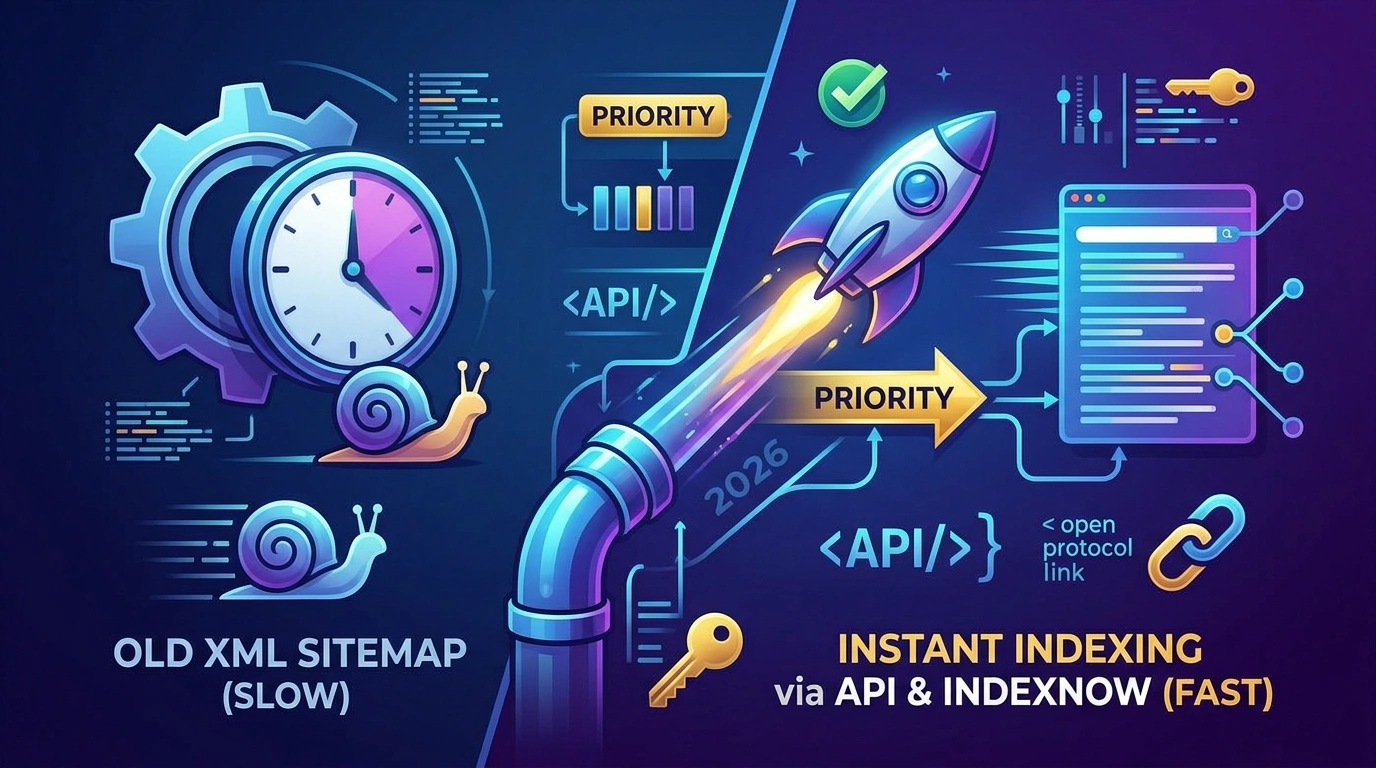
The traditional SEO model of publishing a post and passively waiting weeks for Googlebot to crawl your XML sitemap is dead. In the fast-paced 2026 digital landscape, search engines are allocating their crawl budgets more strictly than ever. For freelance developers and SEO consultants, this shift presents a highly lucrative opportunity: businesses are actively seeking technical specialists who can guarantee their new products, news, and generative AI content are indexed and ranking within hours, not weeks.
By mastering programmatic indexing protocols like the Google Indexing API and IndexNow, you can transition from selling standard “SEO optimization” to offering high-ticket “Instant Indexing Infrastructures.” This guide breaks down exactly how to implement these protocols for your clients, the technical nuances to navigate, and how to monetize this highly demanded skill.
How Do You Achieve Instant SEO Indexing in 2026?
To instantly index website content in 2026, webmasters must bypass passive XML sitemap crawling by programmatically pushing URL updates directly to search engines. For Google, this involves utilizing the Google Cloud Indexing API via a verified Service Account to trigger immediate crawls. For Microsoft Bing, Yahoo, and Yandex, implement the IndexNow protocol by hosting a verification .txt key at the server root and sending HTTP POST requests to automatically notify participating engines of new or updated content.
The Google Indexing API: Pushing Content to the Top
The Google Indexing API allows site owners to directly notify Google’s servers the exact moment a page is added, updated, or removed. Rather than waiting for a scheduled crawl, this API places your URLs in a high-priority queue.
Official vs. Unofficial Capabilities
According to official Google Search Central documentation, the Indexing API is strictly intended for pages containing JobPosting or BroadcastEvent structured data. For sites with highly volatile inventory (like daily job boards or livestream schedules), it keeps search results fresh by pushing updates individually.
However, technical SEO communities have long documented that implementing the API across standard eCommerce products and news articles frequently triggers successful, rapid indexing. While doing this operates in a gray area of Google’s official guidelines, the underlying mechanics remain the same.
Step-by-Step Implementation Framework
- Google Cloud Provisioning: Create a new project within the Google Cloud Console and enable the “Web Search Indexing API.”
- Service Account Creation: Generate a new Service Account and download the JSON key file. This file contains the cryptographic keys your script (or WordPress plugin) needs to authenticate.
- Search Console Authentication: This is the step most beginners miss. You must add the Service Account’s email address as an Owner in the Google Search Console property of the target domain.
- Sending the Payload: Using Node.js, Python, or a CMS plugin, send a POST request to
[https://indexing.googleapis.com/v3/urlNotifications:publish](https://indexing.googleapis.com/v3/urlNotifications:publish)with the target URL and theURL_UPDATEDorURL_DELETEDtype.
Quota Limitations: Google provisions a strict default limit of 200 API calls per day per project. For enterprise clients, you must request quota increases directly through the Cloud Console.
IndexNow: The Open-Source Future of Crawling
While Google maintains its proprietary API, the rest of the search landscape has unified under IndexNow. Supported by Microsoft Bing, Yandex, Seznam.cz, Naver, and Yep, IndexNow is an open-source ping protocol.
The defining advantage of IndexNow is its co-sharing mechanism. Search engines adopting the protocol agree to automatically share submitted URLs with all other participating search engines. You ping one; you update them all.
Implementing the IndexNow Protocol
Setting up IndexNow is significantly lighter than Google’s API, making it an easy “quick win” to offer clients:
- Key Generation: Generate an API key (a minimum of 8 and a maximum of 128 hexadecimal characters).
- Server Root Verification: Host a UTF-8 encoded text file named
{your-key}.txtat the root directory of the client’s website (e.g.,[https://www.example.com/3f2fa233444b4e87a5c40277499c4be4.txt](https://www.example.com/3f2fa233444b4e87a5c40277499c4be4.txt)). The file must contain the exact key string inside. - Triggering the Ping: To submit a single URL, you can fire a simple HTTP GET request.
- Example:
[https://www.bing.com/indexnow?url=https://www.example.com/product-page&key=your-key](https://www.bing.com/indexnow?url=https://www.example.com/product-page&key=your-key)
- Example:
- Batch Submissions: For bulk updates, you can submit up to 10,000 URLs per POST request using a JSON payload containing the
host,key, and anurlListarray.
Actionable Next Steps: Monetizing Your Indexing Skills
Do not sell “Google Indexing API setup” as an hourly task. Package this as a high-value technical infrastructure upgrade.
- The “Instant Index” Audit ($250 – $500): Audit a client’s current indexation ratio (pages published vs. pages indexed in Google Search Console).
- The Technical Implementation ($500 – $1,200): Set up the Google Cloud project, configure the Service Account, generate the IndexNow key, place it on their server, and configure their CMS (via custom PHP or headless architecture) to trigger pings on publish.
- The Retainer ($150/mo): Monitor API error logs, manage the 200-URL daily quota limitations, and maintain the JSON key security.
Frequently Asked Questions (FAQ)
Can I use the Google Indexing API for any type of website?
Officially, Google states the API is only for JobPosting and BroadcastEvent data. Any attempt to abuse the API to spam the index could result in your access being revoked. However, many technical SEOs successfully use it for standard pages, provided the content is high quality and not manipulative.
Do I still need XML sitemaps if I use IndexNow and the Indexing API?
Yes. Both Google and the IndexNow consortium explicitly state that APIs are meant to supplement, not replace, traditional sitemaps. The APIs handle rapid updates for volatile content, while XML sitemaps provide a comprehensive map for the complete structural coverage of your site.
How do I know if my IndexNow ping was successful?
A successful HTTP GET or POST request to the IndexNow endpoint will return an HTTP 200 response code. This confirms the search engine has received the URL, though it does not guarantee immediate inclusion in search engine results pages (SERPs).
Discover more from Remote Work Tips
Subscribe to get the latest posts sent to your email.

The launch of advanced large language models triggered a predictable collapse in the market for mediocre text. Content mills vanished, and freelance platforms saw rates for baseline SEO copy crater practically overnight. Yet, the death of the human writer was vastly overstated. What actually died was the commercial viability of regurgitation. For editors managing the desks at top-tier publications and corporate strategy units, the resulting flood of algorithmic prose has only clarified the value of what machines cannot execute. The market has rapidly bifurcated, placing an unprecedented premium on the specific freelance writing skills AI cannot replace.
The structural shift we are witnessing is not the end of commercial writing, but the automation of the consensus median. An algorithm trains on what has already been published, calculating the most probable next word to generate a perfectly average amalgamation of historical thought. According to global investment research from Goldman Sachs, generative AI could expose the equivalent of 300 million full-time jobs to automation, with administrative and mechanical text generation taking the heaviest initial hit.
Writing as the mere act of stringing grammatically correct sentences together is effectively a solved computational problem. Still, writing as an act of original synthesis and structural persuasion remains strictly human terrain. The economic value for independent writers no longer lies in producing the median. It lies in generating the alpha—the analytical edge that deviates from algorithmic predictability. Editors and brand directors are rapidly adjusting their budgets. They refuse to pay for competent summaries, instead directing capital toward investigative rigor, lived context, and the deliberate friction of human thought.
The Core Development: Moving Beyond Probability
To understand where freelance writers hold an insurmountable advantage, one must understand how generative models fail. AI operates on statistical probability, not truth, memory, or physical reality. It cannot pick up a phone, secure an off-the-record briefing, or read the nervous body language of a chief executive during an earnings call.
The first irreplaceable skill is primary source extraction. Algorithms summarize the internet; elite freelancers interview the people building it. The ability to identify the right human source, build sudden rapport, and extract a candid quote that has never been digitized is a moat AI cannot cross. The Reuters Institute for the Study of Journalism notes that original reporting and exclusive human sourcing remain the primary drivers of subscriber trust and retention.
Closely tied to this is strategic omission. Generative models are inherently additive. They default to comprehensiveness, listing every possible factor in a bulleted sequence because they lack the editorial confidence to leave things out. Human writers know that what you cut is as important as what you keep. Deciding to ignore three valid data points because they dilute the core narrative tension requires a discerning judgment that probability matrices do not possess.
That leads directly to subtextual analysis. AI reads text literally. It cannot read the room. Consider an editorial chief managing a digital finance publication in Sindh. When assigning a column on the latest IMF policy interventions or regional inflation metrics, they know an algorithm will merely summarize the official press release. It takes a human economist to read the deliberate silences within a central bank’s sterile prose, translating bureaucratic hesitation into a localized forecast on energy subsidies.
The Analytical Layer: Generating the Alpha
If the baseline of content is now perfectly competent and entirely unoriginal, the premium shifts to structural interpretation. This is where high-income freelancers transition from writers to analysts.
Why does AI fail at analytical writing? Generative models are designed to find the safest mathematical consensus within their training data. They average out competing viewpoints to avoid hallucinations or controversy. Analytical writing requires taking a definitive, original stance, relying on inductive reasoning and critical leaps that algorithms are explicitly programmed to avoid.
This introduces the fourth skill: counter-narrative generation. When the entire digital ecosystem is parroting the same trend, the valuable freelance writer constructs a well-defended contrarian thesis. If the market consensus is that a new technology will streamline logistics, the human analyst looks at the historical labor relations of the sector and predicts a union strike.
Fifth is institutional critique. Algorithms are heavily guardrailed by their parent companies to avoid offending governments, corporations, or protected groups. They struggle to formulate biting, structural criticisms of powerful entities. A human writer can identify systemic hypocrisy—for instance, tracking how a specific regulatory framework quietly benefits the very monopolies it claims to police.
Sixth is the mastery of asymmetric synthesis. AI is excellent at comparing two highly related concepts. It is remarkably poor at connecting two seemingly unrelated disciplines to form a new thesis. A human writer can draw a structural parallel between 19th-century maritime insurance law and modern cryptocurrency exchanges, creating a conceptual bridge that no algorithmic training data has previously linked.
Implications and Second-Order Effects: The Emotional Economy
The downstream consequences of the AI content flood are already visible in corporate marketing and digital publishing. As the volume of synthetic text approaches infinity, the cost of generating words falls to zero. Consequently, reader trust is plummeting. Businesses are discovering that while AI copy can fill a webpage instantly, it often fails to convert at the bottom of the funnel because it lacks edge, conviction, and emotional resonance.
This brings us to the seventh skill: emotional pacing. Algorithms write at a single, unrelenting cadence. They do not understand how to build intellectual suspense, when to deploy a fragmented sentence for blunt impact, or how to let a devastating statistic sit alone on a line to force the reader to pause. Human writers manipulate rhythm to control the reader’s breathing and emotional state.
Eighth is the application of irony and calculated irreverence. Sarcasm, wit, and irony require a shared understanding of cultural context and human absurdity. When AI attempts humor, it defaults to algorithmic puns or safe, sterile jokes. A human writer can deploy a dry, cynical observation about a failing tech startup that resonates perfectly with a frustrated audience.
Ninth is the capacity for ethical framing. Data does not exist in a vacuum. According to the Bank for International Settlements, while artificial intelligence can process macroeconomic data at unprecedented speeds, the interpretation of that data carries profound ethical implications. When writing about poverty metrics, job displacement, or public health, a human writer frames the statistics with an innate understanding of human suffering and dignity—something an algorithm can only pantomime.
The Counterargument: The Illusion of Algorithmic Context
Tech determinists argue this view is shortsighted. They suggest the limitations of current LLMs are temporary engineering problems, not permanent philosophical boundaries. Proponents of autonomous agents argue that the next generation of models will possess infinite contextual memory and the ability to execute multi-step research workflows independently.
According to researchers at MIT Technology Review, autonomous AI agents will soon be capable of scraping localized databases, monitoring real-time financial feeds, and generating localized analysis without human prompting. From this perspective, the idea that only humans can synthesize complex data or execute macroeconomic contextualisation is a romantic delusion. The machine, they argue, will eventually simulate empathy, irony, and analytical reasoning so flawlessly that the end consumer will neither notice nor care about the distinction.
Yet, this argument fundamentally misunderstands the economics of attention. Even if a machine perfectly simulates a controversial opinion, it remains a simulation. A machine cannot put its reputation on the line. The tenth and most critical skill is skin in the game. Readers value a bold piece of analysis because a human being risked their professional credibility to publish it. An algorithm cannot be brave, because an algorithm has nothing to lose. When a freelancer attaches their byline to a fierce institutional critique, the value stems entirely from the fact that a human mind took a verifiable risk.
The Enduring Premium on Human Friction
The paradox of the generative era is that the more flawless machine text we produce, the higher the market premium on verified human thought. The skills that will sustain high-income freelancers over the next decade have very little to do with typing speed, grammatical perfection, or baseline SEO optimization.
Those capabilities have been permanently commoditized. The future belongs to the editors, the economists, the investigative reporters, and the analysts who treat writing merely as the final delivery mechanism for their thinking. The algorithm can perfectly summarize what happened yesterday. The human writer’s job is to explain why it matters, who is lying about it, and what will inevitably break tomorrow.
Discover more from Remote Work Tips
Subscribe to get the latest posts sent to your email.
Here is a number worth sitting with: AI-enabled freelancers now save an average of eight hours per week and earn 40% more per hour than their non-AI-using counterparts. Jobbers In a profession where time is the only non-renewable resource, that gap is not merely a competitive advantage — it is the difference between a freelance practice that scales and one that quietly stagnates.
The global freelance economy has never been larger or more consequential. Over 64 million Americans were freelancing as of 2023, contributing more than $1.27 trillion to the U.S. economy — and freelancers are 2.2 times more likely to regularly use generative AI than their salaried peers. High 5 Test By March 2026, that lead has only widened. Freelancers with specialized AI and prompt engineering skills are commanding a 56% wage premium over traditional roles, as “Agentic AI” becomes a standard workplace tool. DemandSage
Yet the uncomfortable truth is that most independent professionals are still leaving enormous value on the table — not because they lack skill, but because they are burying billable hours beneath a slow avalanche of admin. The right AI stack, deployed intelligently, is the fastest structural change a freelancer can make to their income in 2026. What follows is a rigorous look at the five tools producing the biggest, most measurable gains right now.
The 40% Problem Nobody Talks About
Ask most freelancers where their day goes and you will hear a familiar litany: client emails, project briefs, invoice chasing, meeting notes, proposal drafts, scheduling threads. Freelancers today are no longer just service providers; they are project managers, marketers, accountants, customer support agents, and strategists all at once. FreelancingGig
Research consistently shows that knowledge workers spend between 40 and 60 percent of their working hours on tasks that are, in economic terms, non-productive — activities that consume time without directly generating revenue. For a freelancer billing $100 per hour who works a standard eight-hour day, that translates to $320 to $480 in theoretical daily earnings lost to overhead. Across a working year, the math becomes quietly devastating.
The promise of AI is not that it replaces your expertise — it is that it eliminates the administrative friction taxing that expertise at an invisible rate. Realistic expectations for drafting and ideation put time savings at 30 to 60 percent on first drafts, outlines, and idea generation. Asrify Stack that across five categories of daily work, and the compounding effect approaches — and in many documented cases exceeds — 50%.
[Link to related FT article: How AI is reshaping the economics of independent work]
The Top 5 AI Tools Unlocking 50% More Billable Hours in 2026
1. Claude (Anthropic) — The Strategic Thinking Partner
Value proposition: A long-context AI assistant that handles complex drafts, deep client research, and nuanced multi-document analysis with a consistency that rivals a senior research associate.
At the operational core of many six-figure freelance practices in 2026 sits Claude, Anthropic’s flagship model. Unlike general-purpose chatbots optimized for breadth, Claude has carved out a reputation for sustained reasoning across lengthy, complex material. Claude now offers a one-million-token context window, Agent Teams, and Claude Code Nxcode — meaning a freelance consultant can feed an entire client contract, three years of market reports, and a competitor analysis into a single session and receive synthesis that would have taken a junior analyst a full week to produce.
The productivity mechanics are concrete. Access to AI assistants of Claude’s caliber reduced the time employees needed for writing tasks by 40 percent, while the quality of output increased by 18 percent. ClickForest For a consultant producing six deliverables per month, that compression alone recovers roughly two full working days.
Real-world impact: A content creator using Claude to edit final drafts halved her content production time. 2727coworking A freelance consultant reported using Notion AI (powered partly by Claude Opus 4.1) to auto-generate client onboarding templates from bullet points, reducing prep time from two hours to 30 minutes per client. 2727coworking
Pricing context: Claude Pro is $20/month — the same price as a single billable hour for most mid-range freelancers. The return on that investment becomes positive within the first afternoon of serious use.
The economist’s take: Claude’s real structural advantage is asymmetric leverage. A solo freelancer using Claude effectively is not working harder than a boutique consultancy with three staff — they are working at the same cognitive bandwidth. That changes pricing power, not just output speed.
2. Notion AI — The Operating System for Your Entire Practice
Value proposition: An all-in-one workspace that turns project management, meeting notes, client databases, and strategic documents into a single AI-queryable knowledge base.
If Claude is the thinking partner, Notion AI is the institutional memory. The September 2025 launch of Notion 3.0 introduced autonomous AI Agents that can execute multi-step workflows, marking a fundamental shift from passive tools to active digital assistants that genuinely work alongside you. Max Productive AI
For freelancers juggling multiple clients across different time zones, the killer feature is Notion AI’s ability to surface information from your own workspace in response to natural-language questions. Ask “What were the key deliverables we agreed with Acme Corp last quarter?” and the system retrieves the relevant meeting notes, contract terms, and action items — not a generic internet answer, but your specific institutional knowledge. Users report saving 50 to 100 hours in just three months for repetitive writing tasks, and companies like Zapier reduced post-meeting admin time by 40 percent using Notion AI for converting raw meeting transcripts into organized notes. booststash
The autonomous Agent can work for up to 20 minutes performing multi-step tasks across hundreds of pages simultaneously — building comprehensive project launch plans, compiling client feedback from multiple sources, drafting detailed reports, and creating interconnected page structures. Max Productive AI
Pricing context: The Business plan at $20/user/month now includes full Notion AI — making it, as one analysis put it, the cost of a single ChatGPT subscription for an entire integrated workspace including AI access to GPT-5, Claude Opus 4.1, and o3.
The economist’s take: Notion AI solves a problem economists call “context switching cost” — the productivity tax paid every time a knowledge worker shifts between disconnected applications. By collapsing CRM, project management, note-taking, and AI writing into one queryable system, it eliminates the friction that compounds invisibly throughout the workday.
[Link to related FT article: The rise of AI-native knowledge management in the gig economy]
3. Zapier — The Invisible Infrastructure Layer
Value proposition: No-code automation that connects over 5,000 apps, letting AI handle repetitive cross-platform workflows while you focus exclusively on billable work.
Automation is the compounding interest of productivity. In 2026, freelancers who ignore automation often struggle to scale, while those who embrace it can handle more clients without increasing hours. FreelancingGig Zapier sits at the infrastructure layer of most high-performing freelance operations, quietly executing the administrative choreography that would otherwise consume hours per week.
The tool’s 2025-2026 AI upgrades are substantial. With Zapier’s latest AI upgrade, freelancers can now build automations using plain English — its multi-step “Zaps” reduce manual work, especially for those managing client onboarding or marketing funnels. Social Champ Practical applications range from automatically routing new client inquiry emails into a CRM, generating a first-draft proposal, and notifying via Slack — all without human intervention — to triggering invoice creation the moment a project milestone is marked complete in a project management tool.
Featured snapshot — what Zapier actually automates for top freelancers:
- New client form submission → auto-create Notion project page + send welcome email sequence
- Completed project milestone → generate invoice draft in FreshBooks + alert client via email
- Meeting scheduled → create agenda template + add follow-up reminder to Asana
- New testimonial received → format and publish to portfolio website
- Monthly financial data → compile into standardized reporting dashboard
A freelance consultant using Zapier’s AI automations reduced cross-platform administrative work by building “Zaps” that parse email content, summarize it, and route action items automatically 2727coworking — eliminating what had previously been a daily 45-minute triage ritual.
Pricing context: Free tier covers basic Zaps; the Professional plan at $19.99/month unlocks multi-step automations and AI features. For any freelancer billing above $40/hour, recovering even one hour per month justifies the cost within weeks.
The economist’s take: Zapier doesn’t save time — it creates time that never existed before, by executing work at machine speed during hours when you are asleep, in client meetings, or doing the creative work that actually commands premium rates.
4. Timely — AI-Powered Time Intelligence
Value proposition: An automatic time-tracking tool that logs your entire workday without manual input, ensuring every billable minute is captured, analyzed, and converted to revenue.
This is the most underestimated tool in the freelance stack, and arguably the one with the most immediate financial impact. AI-powered billable hours trackers like Timely use smart AI to remember your whole day without manual input — and users say these tools find 20% more billable time they had previously missed. apps365
For a freelancer billing $80 per hour who works approximately 100 hours per month, recovering 20% more billable time represents $1,600 in additional monthly revenue — from a tool that costs under $20/month. That is a return on investment that would make a private equity analyst blush.
Timely’s “memory” architecture runs passively in the background, tracking which applications, documents, and websites you engage with throughout the day, then reconstructing a timeline of your work that can be reviewed, edited, and converted to invoice-ready timesheets. In 2026, many freelancers rely on AI summaries from time-tracking tools to identify inefficiencies, suggest better pricing models, and even recommend when to raise rates based on workload trends. FreelancingGig
The behavioral insight dimension is equally valuable. Patterns in time data reveal which client relationships are actually profitable once admin overhead is accounted for, which project types produce scope creep, and where your most valuable peak-productivity hours are currently being allocated to low-value tasks.
Pricing context: Starter plans from approximately $9/month; professional tiers with full AI analysis from $16/month.
The economist’s take: In economics, what isn’t measured isn’t managed. Most freelancers operate with a systematic measurement gap between hours worked and hours billed — Timely closes that gap with a precision that manual tracking never achieves. The revenue uplift is real and immediate.
[Link to related Forbes article: The hidden billing gap costing freelancers thousands annually]
5. Perplexity AI — The Research Engine That Eliminates Dead Time
Value proposition: A real-time AI search and synthesis engine that compresses hours of research into minutes, complete with cited primary sources — the 2026 breakout tool for knowledge-intensive freelancers.
Every freelancer who does research-intensive work — consultants, writers, strategists, analysts — understands the invisible tax of information gathering. Building a solid base of evidence for a client deliverable can absorb two to four hours of a workday that should have been billable. Perplexity AI is the 2026 breakout tool attacking this specific bottleneck with striking effectiveness.
Unlike standard AI assistants that synthesize from training data, Perplexity conducts live web research and returns synthesized answers with source citations — functioning as a research assistant that works at fifty times human reading speed. Productivity research documents a 45% time reduction in research tasks for AI-enabled freelancers, Jobbers and Perplexity is the primary driver of that compression in knowledge work.
For a market research consultant charging $150/hour, compressing a four-hour research phase to two hours per project adds two billable hours per engagement. Across 12 projects per month, that is 24 additional billable hours — approximately $3,600 in monthly revenue uplift from a single tool costing $20/month in its Pro tier.
A 2025 McKinsey Global Institute report noted that AI-driven automation could boost global productivity by up to 40% by 2035, with early adopters in creative industries already seeing efficiency gains of 30%. Blockchain News Perplexity users in knowledge-intensive freelance fields are consistently at the leading edge of that adoption curve.
Pricing context: A generous free tier exists; Perplexity Pro at $20/month unlocks unlimited real-time search, advanced models, and API access for workflow integration.
The economist’s take: Research is a classic “threshold task” — you must complete it before any billable output can exist. Perplexity compresses the threshold, not the creative work itself. That asymmetry is exactly where AI delivers its highest marginal return.
[Link to related Economist article: How AI research tools are reshaping the knowledge economy]
Comparative Summary: Time Saved vs. Traditional Methods
| Tool | Primary Function | Documented Time Saving | Estimated Monthly Revenue Impact* | Price/Month |
|---|---|---|---|---|
| Claude | Research, drafting, analysis | 40–60% on writing tasks | $640–$960 | $20 |
| Notion AI | Knowledge management, project ops | 40–50% on admin & documentation | $320–$480 | $20 |
| Zapier | Cross-app workflow automation | 4–6 hrs/week eliminated | $480–$720 | $20 |
| Timely | Automatic time capture & billing | 20% more billable time recovered | $1,200–$1,600 | $16 |
| Perplexity AI | Research synthesis | 45% time reduction in research | $800–$1,200 | $20 |
*Estimates based on a freelancer billing $80/hour working 25 billable hours/week. Individual results vary.
The Compounding Effect and the Ethical Dimension
Deploy all five tools coherently — not as disconnected subscriptions but as an integrated system — and the aggregate impact approaches and frequently exceeds the 50% billable-hour uplift the headline promises. The math is not additive; it is compounding. Time saved by Timely reveals where to focus. Perplexity compresses research. Claude converts that research into polished deliverables. Notion AI manages the client relationship and institutional memory. Zapier runs the administrative infrastructure in the background while you sleep.
The global gig economy is projected to reach a valuation of $674.1 billion in 2026 DemandSage, and the professionals capturing an outsized share of that growth share one common characteristic: they treat AI not as a novelty, but as operational infrastructure.
The ethical considerations deserve equal seriousness. Transparency with clients about AI-assisted workflows is not merely good practice — it is the foundation of sustainable professional trust. Clients benefit from AI-enabled freelancers through faster delivery, more reliable quality, and clearer communication throughout projects, Useme but that value proposition holds only when the human expert remains genuinely in the loop, exercising judgment, catching errors, and bringing the contextual intelligence that no model can replicate.
There is also a structural concern worth naming. Basic writing job postings have decreased 21%, simple graphic design 17%, and data entry 35% since ChatGPT’s launch — but AI content editing grew 180%, prompt engineering 240%, and AI tool training 165%. Jobbers The market is not shrinking; it is bifurcating. Freelancers who position themselves at the expert layer — using AI to amplify rather than replace their specialized judgment — are on the right side of that divide.
The Next Step: Start With One, Not Five
The most common mistake in building an AI-powered freelance practice is attempting a wholesale transformation overnight. A more durable approach is sequential adoption: identify your single largest time drain, match it to the tool most precisely targeting that drain, measure the impact over 30 days, and then layer the next tool onto a stable foundation.
Start with one general tool and one specialist tool. Track ROI explicitly: estimate hours saved per week and new revenue generated from AI-assisted services. Upgrade only when you hit bottlenecks. Asrify
For most freelancers, the sequence that delivers the fastest measurable return is: Timely first (you cannot optimize what you cannot measure), Claude second (the highest-leverage creative amplifier), and Zapier third (the infrastructure that systematizes your gains). Notion AI and Perplexity follow naturally as your practice scales.
The 50% uplift in billable hours is not a marketing abstraction. It is a structural reality — documented, measurable, and increasingly separating the freelancers who thrive in the 2026 economy from those who remain caught in the administrative gravity of the old one.
The tools exist. The data is clear. The only remaining question is whether you will use the next hour to plan the adoption, or spend it on work that a well-configured AI could have handled before breakfast.
Discover more from Remote Work Tips
Subscribe to get the latest posts sent to your email.


Top 6 Payment Solutions for Freelancers Faster Than Banks
Midway through a project in Milan, a freelance UX designer named Elena watched her rent payment bounce. The client’s bank...


10 Freelancing Tips for Landing Projects in the AI Era
The Market Split No One Warned You About In February 2026, a mid-career graphic designer in Austin posted to a...


The Sovereign Developer: The 5 Most Lucrative Coding Jobs in 2026 (And Why They Pay So Well)
For the past three years, the prevailing tech narrative has been dominated by a singular, slightly hysterical prediction: AI is...


Top 10 Most Demanded Freelance Skills in 2026
The Trillion-Dollar Talent Shift Nobody Is Talking About Honestly There is a number that should stop every career-minded professional in...


Fiverr Denies ‘Major Security Lapse’ Despite Private User Data Appearing in Google Search
Imagine logging into Google on a Tuesday morning to check your own name — a routine vanity search, the kind...


4 Must-Have Skills Every Nomadic Founder Needs to Build a Successful Online Business
Want to work from anywhere? I know this because I’ve been on both sides of that line. From Trucking Routes...


Unlock 50% More Billable Hours: Top 5 AI Tools Every Freelancer Needs in 2026
Here is a number worth sitting with: AI-enabled freelancers now save an average of eight hours per week and earn...


Challenges to Freelancers in the Age of 5G and AI in 2026
The Morning the Rates Dropped At 6:47 on a Tuesday morning in Bengaluru, Arjun Mehta refreshed his Upwork dashboard and...
-

 blogging5 years ago
How to Use Social Media to Promote Your Blog
-

 freelance5 years ago
6 Future-Focused Skills Freelance Creatives Can’t Afford to Ignore
-

 social media5 years ago
How to Learn Social Media Without Getting Scammed
-

 freelance9 months ago
The Economics of Remote Work: How Hybrid Models Are Reshaping Global Productivity
-

 blogging5 years ago
20 Best Freelance Marketplaces for Freelancers in 2022 to Make Money
-

 freelance5 years ago
7 Highest Paying Freelance Jobs For Earning A Steady Income
-

 Digital Banking5 years ago
Pakistan Consumer Confidence Index increased by 8.8% in Q4 2021
-

 blogging5 years ago
30 “Proven” Ways to Make Money Online Blogging with WordPress